 luckpanda
Quick answer
What should a taxi bill show, and is GST charged on it?
A taxi bill shows the operator's name, phone and GSTIN, the bill number and date, the passenger, the vehicle number, the trip date and times, pick-up and drop points, kilometres or hours, the fare and extras such as driver allowance, then tolls and parking at actual cost. A registered cab operator usually charges 5% GST without input tax credit, or 18% if it has opted to take credit. For app-booked rides the app pays the GST.
- Registered operator: 5% (no credit) or 18% (with credit; 12% before 22 September 2025).
- App rides: the aggregator pays GST under section 9(5).
- Metered taxis hailed on the street are exempt.
- Tolls and parking at actuals can stay outside GST if billed as pure agent.
Last reviewed:
On this page
- What a taxi bill is and who uses it
- How to fill in this taxi bill format
- Example: an outstation trip billed per kilometre
- What goes on a taxi bill, field by field
- GST on taxi fares after 22 September 2025
- Billing outstation trips
- Taxi bills for reimbursement: what employers accept
- Mistakes to avoid on a taxi bill
- Taxi bill vs car rental bill vs transport bill vs app receipt
- Key terms
- Questions people ask
What a taxi bill is and who uses it
A taxi bill (cab bill, taxi receipt) is the invoice a cab operator or driver gives for a hire: a point-to-point ride, a local package, an airport transfer or an outstation trip. The passenger uses it to pay and, usually, to claim the cost back from an employer. That second use is why it needs more than an amount: the employer wants to see the trip itself.
Under GST, a taxi ride is either passenger transport by motor cab (SAC 9964), where the operator carries you from A to B, or renting of a motor vehicle with operator (SAC 9966, "rent-a-cab"), where the car and driver are at your disposal for hours or days. Both, when the fare includes fuel, carry the same rate options, so the bill looks the same; the difference matters mainly for reverse charge, below.
How to fill in this taxi bill format
- Add the operatorEnter the operator's or driver's name, address, phone and GSTIN if registered.
- Add the passenger or companyEnter the passenger, and the company if it is being billed (with its GSTIN). For a company hiring a cab from a firm or individual at 5%, plan for reverse charge.
- Describe the tripPut the date, times, route and vehicle number in the first line or the notes, with kilometres or hours as the quantity and the rate per km or package.
- Add extras and pass-through costsAdd driver allowance, night and waiting charges at the fare's GST rate. Add tolls and parking at actuals at 0%, and note that receipts are attached.
- Issue itCheck the CGST and SGST, then sign in to issue: the bill gets the next number in your series and is recorded in your books, ready for GSTR-1. Downloading the PDF is free, with a small LuckPanda footer; issuing, sending and clean PDFs without our branding need the Sales module.
Example: an outstation trip billed per kilometre
Rohan Mehta of Seabreeze Media hires a sedan from Sai Ram Tours & Travels for a day trip from Mumbai to Pune and back, pays by UPI and claims the cost from his employer. The operator is registered and charges 5% on the kilometres and the driver allowance. Tolls are paid on the passenger's behalf and billed at actual cost outside the taxable value, with the receipts attached.
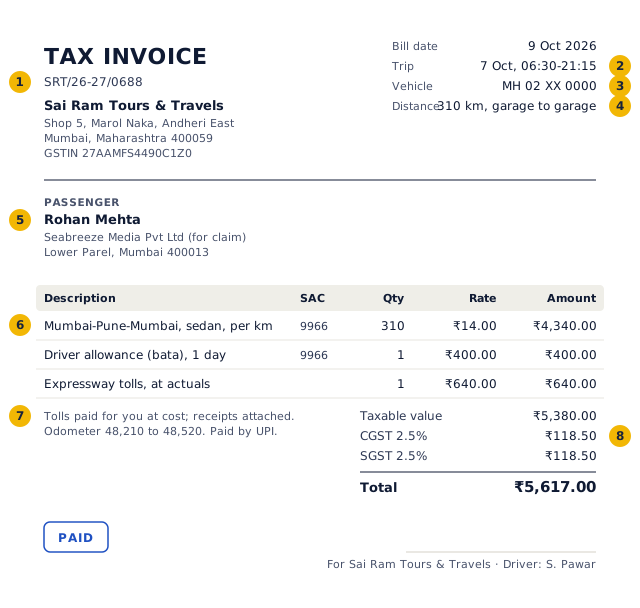
- Bill number from a continuous series, and the operator's GSTIN if registered.
- Trip date and times: start and end, which also decide night charges and extra hours.
- Vehicle registration number: employers check it against the trip.
- Kilometres, with opening and closing odometer readings in the notes.
- Passenger, and the company if the bill supports a claim or the company is billed.
- Fare lines: per km (or package), driver allowance, waiting and night charges, each separately.
- Tolls and parking at actuals, with receipts, and the payment mode.
- GST at 5% as CGST + SGST on the fare and allowance, not on tolls billed at cost.
The numbers: bill SRT/26-27/0688
| Item | HSN/SAC | Qty | Rate | Taxable value | Tax |
|---|---|---|---|---|---|
| Mumbai-Pune-Mumbai, sedan, per km | 9966 | 310 | ₹14.00 | ₹4,340.00 | ₹217.00 |
| Driver allowance (bata), 1 day | 9966 | 1 | ₹400.00 | ₹400.00 | ₹20.00 |
| Expressway tolls, at actuals | 1 | ₹640.00 | ₹640.00 | ₹0.00 | |
| Taxable value | ₹5,380.00 | ||||
| CGST 2.5% | ₹118.50 | ||||
| SGST 2.5% | ₹118.50 | ||||
| Total | ₹5,617.00 | ||||
GST is ₹237.00 on ₹4,740.00 of fare and allowance; the tolls add ₹640.00 without tax, and the bill totals ₹5,617.00.
A local package with extra kilometres and hours
City hire is usually sold as a package, such as 8 hours or 80 km, with extra kilometres and extra hours billed on top. Airport or mall parking paid for the passenger goes at cost.
Local package 8 h / 80 km, with extras
| Item | HSN/SAC | Qty | Rate | Taxable value | Tax |
|---|---|---|---|---|---|
| Local package, 8 hours / 80 km, sedan | 9966 | 1 | ₹2,200.00 | ₹2,200.00 | ₹110.00 |
| Extra km beyond 80 | 9966 | 14 | ₹16.00 | ₹224.00 | ₹11.20 |
| Extra hour beyond 8 | 9966 | 1 | ₹180.00 | ₹180.00 | ₹9.00 |
| Airport parking, at actuals | 1 | ₹100.00 | ₹100.00 | ₹0.00 | |
| Taxable value | ₹2,704.00 | ||||
| CGST 2.5% | ₹65.10 | ||||
| SGST 2.5% | ₹65.10 | ||||
| Total | ₹2,834.20 | ||||
Only the package and the extras carry GST; the ₹100.00 parking is passed through at cost.
What goes on a taxi bill, field by field
| Field | What to enter | Why |
|---|---|---|
| Operator details | Name, address, phone, GSTIN if registered | Identifies the supplier; employers call to verify |
| Bill number and date | Next number in the series | Continuous numbering; unique for the year |
| Passenger or company | Passenger name; company name and GSTIN if the company is billed | Who the service is for, and who pays the GST |
| Vehicle | Registration number and type (hatchback, sedan, SUV) | Rates differ by vehicle; proof of the trip |
| Trip date and times | Start and end time, date of each day | Waiting, extra-hour and night charges depend on them |
| Pick-up and drop | Addresses or landmarks, and the route for outstation | Proof of the trip for reimbursement |
| Distance or duration | Km (opening and closing odometer) or hours | The basis of the fare |
| Fare | Per km, package or fixed fare | The taxable value |
| Extras | Driver allowance, night charges, waiting charges, extra km or hours | Part of the fare; same GST rate |
| Pass-through costs | Tolls, parking, state permit or entry tax at actuals, with receipts | Outside the taxable value if billed as pure agent |
| GST | 5% or 18% as CGST + SGST (or IGST), or a reverse-charge statement | Shows the tax and who pays it |
| Payment | Cash, UPI, card, with reference | Proof of payment |
GST on taxi fares after 22 September 2025
Notification 15/2025-Central Tax (Rate) raised the with-credit option for cab and rent-a-cab services from 12% to 18% from 22 September 2025. The 5% option is unchanged.
| Situation | GST | Notes |
|---|---|---|
| Registered operator, fare includes fuel: taxi ride or rent-a-cab | 5% | No input tax credit, except on cab hire bought from another operator |
| Same, operator has chosen to take full credit | 18% (12% until 21 Sep 2025) | Full credit on vehicles, repairs and insurance |
| Ride booked through an app (Uber, Ola, Rapido and similar) | 5%, paid by the app | Section 9(5): the platform is liable, even if the driver is unregistered |
| Metered cab or auto-rickshaw hailed on the street | Exempt | Not exempt when booked through an app since 1 January 2022 |
| Operator below the registration threshold | No GST | ₹20 lakh of turnover in most states; app rides still taxed via the app |
| Cab rented with fuel by an operator that is not a company, to a company, at 5% | 5%, paid by the company | Reverse charge: the operator's bill shows no GST |
Reverse charge when a company hires the cab
When an operator that is not a body corporate (an individual or a partnership firm, like Sai Ram Tours & Travels) rents a cab with fuel to a company and does not charge the higher with-credit rate, the company pays the 5% under reverse charge (entry 15 of Notification 13/2017-Central Tax (Rate)). The operator's bill to the company then carries no GST and says "tax payable by the recipient under reverse charge". The reverse-charge entry still refers to the old 12% rate rather than 18%, which practitioners treat as a drafting gap; take advice if you bill companies at 18%. A plain point-to-point ride is passenger transport, not renting, and is not covered by this entry.
The same trip billed to the company under reverse charge
| Item | HSN/SAC | Qty | Rate | Taxable value | Tax |
|---|---|---|---|---|---|
| Mumbai-Pune-Mumbai, sedan, per km | 9966 | 310 | ₹14.00 | ₹4,340.00 | ₹0.00 |
| Driver allowance (bata), 1 day | 9966 | 1 | ₹400.00 | ₹400.00 | ₹0.00 |
| Expressway tolls, at actuals | 1 | ₹640.00 | ₹640.00 | ₹0.00 | |
| Subtotal | ₹5,380.00 | ₹0.00 | |||
| Total | ₹5,380.00 | ||||
Seabreeze Media pays the operator ₹5,380.00 and pays the ₹237.00 of GST itself under reverse charge.
Can a company claim the GST?
Usually not. Section 17(5) of the CGST Act blocks credit on leasing, renting or hiring of motor vehicles that seat up to 13 people, unless the buyer uses them to supply the same service or must provide transport to employees by law. A company that pays GST under reverse charge on a cab hire therefore usually bears it as a cost.
Other points
- The choice is the operator's, for its business: practitioners generally treat 5% and 18% as alternative conditions the operator meets for its supplies, not a rate to pick per customer.
- Place of supply: for a trip within one state billed to a local customer, CGST and SGST. For a registered business customer in another state, generally IGST.
- E-invoicing: suppliers of passenger transport services are exempt, so taxi bills never need an IRN.
- Tolls and parking: they stay outside the taxable value only if the operator pays them as the passenger's pure agent (rule 33): agreed in advance, shown separately at actual cost, with receipts. Otherwise they are part of the fare and taxed with it.
Billing outstation trips
- Kilometres garage to garage: the trip is usually measured from the operator's garage and back, read from the odometer, and the readings go on the bill.
- Minimum kilometres per day: outstation rates usually carry a daily minimum (often 250 or 300 km a day); a short day is billed at the minimum. State it on the bill so the passenger sees why.
- Driver allowance (bata): a fixed amount per day for the driver's food and stay, part of the fare and taxed with it.
- Night charges: an extra amount when the car runs or the driver is on duty late at night, commonly between about 10 pm and 6 am; state the hours.
- State permit and entry taxes for crossing state borders are paid at actuals and passed through with receipts.
- Multi-day trips: one line per day, or per-km plus one driver allowance line per day, so the employer can match the bill to the travel dates.
Taxi bills for reimbursement: what employers accept
Employers reimburse business travel against a bill that proves the trip. Most expense policies look for:
- the operator's name and phone number, and GSTIN if registered;
- a bill number and date;
- the passenger's name;
- the vehicle registration number;
- pick-up and drop points with times, and kilometres or hours;
- the fare breakdown, with tolls and parking supported by receipts;
- the payment mode, and a signature or stamp on a paper bill.
For app rides, the trip receipt the app emails is the bill: it already shows the route, time, fare and GST. Employers rarely accept handwritten slips without a bill number or vehicle number, and many cap claims at what an app ride would have cost.
Mistakes to avoid on a taxi bill
- Charging 12%. Since 22 September 2025 the with-credit option is 18%; the other option is 5% without credit.
- Charging 5% while claiming credit on the car. The 5% rate is conditional on not taking input tax credit beyond hired cabs.
- Charging GST on app bookings. For rides through an aggregator the app pays the GST.
- Adding GST to tolls billed at cost. If tolls are passed through as pure agent, they carry no GST; if they are part of the fare, include them in the taxable fare instead.
- Charging GST to a company where reverse charge applies. A firm or individual renting a cab with fuel to a company at 5% bills without GST.
- No vehicle number or kilometres. The bill will not support a reimbursement claim.
Taxi bill vs car rental bill vs transport bill vs app receipt
| Taxi bill | Car rental bill | Transport bill | App ride receipt | |
|---|---|---|---|---|
| Service | Passenger ride or cab with driver | Vehicle hired for a period | Carrying goods (GTA) | Ride booked through an aggregator |
| Issued by | Cab operator or driver | Rental company | Goods transport agency | The app, on behalf of the driver |
| GST | 5% or 18%; reverse charge in some company hires | With driver and fuel: 5% or 18% | 5% reverse charge, or 5% / 18% forward | 5%, paid by the app |
| Format | Taxi bill format | Car rental bill format | Transport bill format | From the app |
Key terms
- Rent-a-cab
- Renting of a motor vehicle with a driver, fuel included, for a period or distance (SAC 9966).
- Driver allowance (bata)
- A daily amount paid for the driver's food and stay on outstation trips; part of the taxable fare.
- Pure agent
- A supplier who pays costs such as tolls on the customer's behalf and recovers them at actual cost, outside its taxable value.
- Section 9(5)
- The rule that makes an e-commerce operator pay GST on notified services sold through it, including passenger transport.
- Garage to garage
- Measuring an outstation trip from the operator's base and back, by odometer.
Questions people ask
Is GST charged on taxi fares?
Registered cab and rent-a-cab operators charge 5% without input tax credit, or 18% if they have opted to take credit (12% before 22 September 2025). Operators below the ₹20 lakh registration threshold charge no GST. For rides booked through an aggregator app, the platform pays the GST.
Are tolls and parking taxed?
Tolls and parking paid on the passenger's behalf can be shown at actual cost outside the taxable value if they meet the pure agent conditions in rule 33. Otherwise they form part of the fare.
What do employers need on a taxi bill?
Usually the date, pick-up and drop points, distance or hours, vehicle number, amount and the operator's name and contact details. Some also ask for the operator's GSTIN and toll receipts.
Who pays GST on Ola and Uber rides?
The app. Under section 9(5) of the CGST Act the e-commerce operator pays the 5% GST on rides booked through it, whether or not the driver is registered. The app's receipt shows it.
Do companies pay GST under reverse charge on cab hire?
Yes, when a firm or individual rents a cab with fuel to a company and does not charge the with-credit rate. The company pays the 5% itself and the operator's bill shows no GST.
Can a company claim input tax credit on taxi bills?
Generally not. Section 17(5) blocks credit on hiring motor vehicles that seat up to 13 people, unless they are used to supply the same service or the employer must provide transport by law.
Are metered taxis and auto-rickshaws exempt from GST?
Yes, when hailed directly. Since 1 January 2022 the exemption does not apply to rides booked through an app, where the app pays 5%.
How is an outstation taxi trip billed?
Usually per kilometre garage to garage, with a daily minimum such as 250 or 300 km, plus a driver allowance per day, night charges if applicable, and tolls, parking and state permits at actuals.
Can I make a taxi bill in Word or PDF here?
This is an online editor that adds up the fare and GST as you type. You can download it as a PDF free, with a small LuckPanda footer. Signing in issues it as a numbered bill you can send; issuing, sending and clean PDFs without our branding need the Sales module.