 luckpanda
Quick answer
What is a transport bill, and how is GST charged on freight?
A transport bill is the invoice a goods transport agency (GTA) raises for freight, quoting the consignment note (LR, GR or bilty) for each load with the vehicle, route, goods and weight. By default a business customer pays 5% GST on it under reverse charge and the bill shows no tax. A GTA can instead opt to charge GST itself: 5% without input tax credit, or 18% with credit since 22 September 2025.
- Only a transporter that issues a consignment note is a GTA.
- Reverse charge: the registered or corporate customer pays 5%, and can claim it back.
- Forward charge: 5% without credit or 18% with credit, opted in Annexure V by 31 March.
- Loads above ₹50,000 need an e-way bill; payers deduct TDS unless the owner has 10 or fewer trucks.
Last reviewed:
On this page
- What a transport bill is
- How to fill in this transport bill format
- Example: a freight bill under reverse charge
- What goes on a transport bill and a consignment note
- GST on GTA services: reverse charge or forward charge
- Freight, detention, loading and other charges
- E-way bills and the transport bill
- TDS on payments to transporters
- Mistakes to avoid on a transport bill
- Transport bill vs consignment note vs e-way bill vs trucking invoice
- Key terms
- Questions people ask
What a transport bill is
A transport bill (also called a freight bill or GTA invoice) is what a transporter sends the customer who pays the freight. It is separate from the consignment note, which the transporter issues when it takes the goods: the consignment note travels with the truck and records the load; the bill asks for payment, usually for one or several consignment notes.
Under GST, a goods transport agency is anyone who provides a service in relation to transport of goods by road and issues a consignment note, by whatever name it is called. The consignment note is the test. A truck owner who carries goods without issuing one is not a GTA: transport of goods by road other than by a GTA or a courier is exempt, and hiring out a truck with driver and fuel is a separate service, "renting of goods carriage", taxed at 5% or 18%.
| Document | What it is | Who issues it |
|---|---|---|
| Consignment note (LR, GR, bilty) | Receipt for goods taken for transport, serially numbered, travels with the vehicle | The GTA, per load |
| Transport bill (freight invoice) | The charge for one or more loads, with GST or a reverse-charge statement | The GTA, to whoever pays the freight |
| E-way bill | Electronic movement document for goods worth more than ₹50,000 | Consignor, consignee or the transporter |
| Tax invoice for the goods | The sale of the goods themselves | The consignor (seller) |
How to fill in this transport bill format
- Enter the GTAAdd the transport company's name, address and GSTIN, and its PAN in the notes so the customer can apply TDS correctly.
- Add the customer paying the freightEnter the consignor or consignee who pays, with its GSTIN. Its state sets the place of supply and whether the tax is IGST or CGST + SGST.
- Bill each loadAdd a line per consignment note: LR number and date, route and vehicle in the description, tonnes or trips as the quantity and the rate. Add loading, unloading and detention on their own lines.
- Set the taxUnder reverse charge use 0% and write "GST payable by recipient under reverse charge at 5%" in the notes. If you have opted for forward charge, use 5% or 18% as declared.
- Issue itCheck the totals, then sign in to issue: the bill gets the next number in your series and is recorded in your books, ready for GSTR-1. Downloading the PDF is free, with a small LuckPanda footer; issuing, sending and clean PDFs without our branding need the Sales module.
Example: a freight bill under reverse charge
Punjab Golden Roadways, a Ludhiana GTA, carries 9 tonnes of cotton yarn to Noyyal Spinning Mills in Tiruppur on LR 4471 at ₹6,200 a tonne, with loading and one day of detention at the mill. The mill is a registered company that pays the freight, and the GTA has not opted for forward charge, so the GST is the mill's to pay under reverse charge. The bill shows no tax, only the statement.
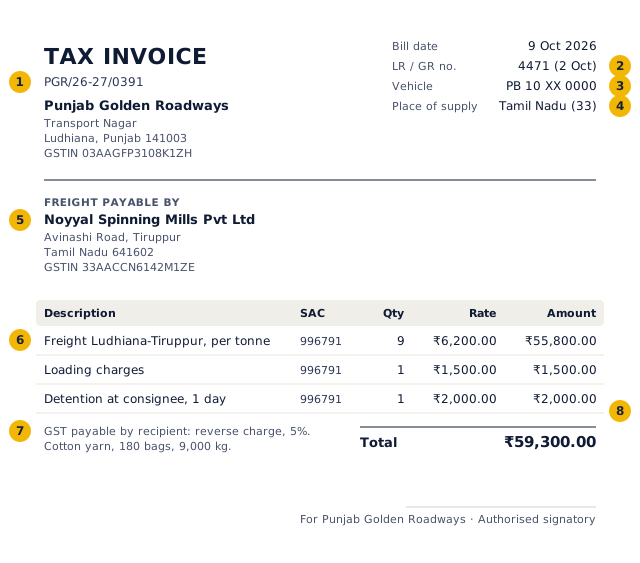
- Bill number: continuous series, at most 16 characters.
- Consignment note number and date for each load billed; it is what makes the transporter a GTA.
- Vehicle number, as on the consignment note and the e-way bill.
- Place of supply: the registered recipient's state, so the tax is IGST here (Punjab to Tamil Nadu).
- Whoever pays the freight is the recipient: consignor on a "paid" LR, consignee on a "to pay" LR.
- Freight, loading and detention: charges incidental to the transport follow the freight's tax treatment.
- Reverse-charge statement: rule 46 requires the invoice to say tax is payable on reverse charge.
- No GST charged: under reverse charge the recipient pays it directly to the government.
The bill: PGR/26-27/0391, reverse charge
| Item | HSN/SAC | Qty | Rate | Taxable value | Tax |
|---|---|---|---|---|---|
| Freight Ludhiana-Tiruppur, per tonne | 996791 | 9 | ₹6,200.00 | ₹55,800.00 | ₹0.00 |
| Loading charges | 996791 | 1 | ₹1,500.00 | ₹1,500.00 | ₹0.00 |
| Detention at consignee, 1 day | 996791 | 1 | ₹2,000.00 | ₹2,000.00 | ₹0.00 |
| Subtotal | ₹59,300.00 | ₹0.00 | |||
| Total | ₹59,300.00 | ||||
The mill pays the GTA ₹59,300.00 and nothing more.
The 5% IGST on the same freight
| Item | HSN/SAC | Qty | Rate | Taxable value | Tax |
|---|---|---|---|---|---|
| Freight Ludhiana-Tiruppur, per tonne | 996791 | 9 | ₹6,200.00 | ₹55,800.00 | ₹2,790.00 |
| Loading charges | 996791 | 1 | ₹1,500.00 | ₹1,500.00 | ₹75.00 |
| Detention at consignee, 1 day | 996791 | 1 | ₹2,000.00 | ₹2,000.00 | ₹100.00 |
| Taxable value | ₹59,300.00 | ||||
| IGST 5% | ₹2,965.00 | ||||
| Total | ₹62,265.00 | ||||
Under reverse charge the mill pays this ₹2,965.00 of IGST to the government in its own GSTR-3B, in cash, and then claims it back as input tax credit. If the GTA had opted for 5% forward charge, the same ₹2,965.00 would appear on the GTA's bill instead, the GTA would pay it, and the mill would pay the GTA ₹62,265.00.
If the GTA opts for 18% with input tax credit
| Item | HSN/SAC | Qty | Rate | Taxable value | Tax |
|---|---|---|---|---|---|
| Freight Ludhiana-Tiruppur, per tonne | 996791 | 9 | ₹6,200.00 | ₹55,800.00 | ₹10,044.00 |
| Loading charges | 996791 | 1 | ₹1,500.00 | ₹1,500.00 | ₹270.00 |
| Detention at consignee, 1 day | 996791 | 1 | ₹2,000.00 | ₹2,000.00 | ₹360.00 |
| Taxable value | ₹59,300.00 | ||||
| IGST 18% | ₹10,674.00 | ||||
| Total | ₹69,974.00 | ||||
At 18% the bill carries ₹10,674.00 of IGST. The mill can claim it all, so its cost is the same; the GTA gains because it can claim credit on its own trucks, tyres, repairs and hired vehicles. This option was 12% until 21 September 2025.
What goes on a transport bill and a consignment note
| Field | What to enter | Why |
|---|---|---|
| GTA details | Name, address, GSTIN, PAN, phone | Rule 46 particulars; PAN for the customer's TDS |
| Bill number and date | Next number in the series | Unique for the financial year |
| Customer | The party paying the freight, with GSTIN and address | The recipient decides reverse charge and place of supply |
| Consignment notes | LR or GR number and date for each load | Links the bill to the loads; evidence of GTA status |
| Vehicle | Registration number of each goods carriage | Matches the LR and the e-way bill |
| Route | From and to, with dates | Shows the service supplied |
| Consignor and consignee | Names, and GSTINs if registered | Shows who sent and who received the goods |
| Goods | Description, packages, weight | Freight is usually per tonne, per trip or per package |
| Charges | Freight, loading, unloading, detention, other charges, each on its own line | Incidental charges follow the freight's GST treatment |
| SAC | 996791 (GTA services for road transport) | Classification of the service |
| GST | Rate and IGST or CGST + SGST, or "tax payable on reverse charge" | Rule 46 requires the reverse-charge statement |
| Payment terms | Due date and bank details | Customer's payables and TDS |
The consignment note
For GST, a consignment note is a document a GTA issues against receipt of goods for transport in a goods carriage. It must be serially numbered and contain the names of the consignor and consignee, the registration number of the goods carriage, details of the goods, the places of origin and destination, and the GSTIN of the person liable to pay tax: consignor, consignee or the GTA. Local names for it are LR (lorry receipt), GR (goods receipt) and bilty. The usual freight terms printed on it decide who the recipient is: paid (consignor pays), to pay (consignee pays on delivery) or to be billed (one party is billed later, typically monthly).
GST on GTA services: reverse charge or forward charge
Notification 15/2025-Central Tax (Rate) changed the GTA forward-charge option with credit from 12% to 18% from 22 September 2025. The other options are unchanged.
| Option | Rate | Who pays | Credit |
|---|---|---|---|
| Reverse charge (default) | 5% | The recipient, if it is a specified recipient (below) | The recipient can claim it; the GTA charges nothing |
| Forward charge, 5% | 5% | The GTA, on its bill | GTA gets no credit except on GTA services hired from other GTAs |
| Forward charge, 18% | 18% (12% until 21 Sep 2025) | The GTA, on its bill | Full credit for the GTA; the recipient claims the 18% |
| Supply to an unregistered individual or other non-specified person | Exempt | No one | None |
Who pays under reverse charge
Reverse charge applies when the GTA has not opted for forward charge and the person paying the freight is: a factory registered under the Factories Act; a society; a co-operative society; any GST-registered person; a body corporate (company or LLP); a partnership firm or association of persons; or a casual taxable person. That recipient pays 5% in cash in its own return and takes credit for it. GTA services to anyone else, typically an unregistered individual moving household goods, are exempt.
Opting for forward charge: Annexure V
A GTA that wants to charge GST itself files a declaration in Annexure V on the GST portal between 1 January and 31 March of the preceding financial year (for FY 2027-28, by 31 March 2027). A new GTA files it within 45 days of applying for registration or one month of getting it, whichever is later. Since July 2023 the option carries forward year after year; to go back to reverse charge, the GTA files Annexure VI in the same January to March window. The option covers all the GTA's supplies: it cannot charge 18% to one customer and leave another on reverse charge.
IGST or CGST and SGST
For a registered recipient the place of supply is the recipient's location (section 12(8) of the IGST Act), not the route. A Punjab GTA billing a Tamil Nadu mill uses IGST even if the truck never leaves Punjab; billing a Punjab customer for a Ludhiana-to-Chennai trip it uses CGST and SGST. For an unregistered recipient, it is where the goods are handed over for transport.
Exemptions by goods
GTA transport of certain goods is exempt whoever pays: agricultural produce; milk, salt and food grains including flour, pulses and rice; organic manure; registered newspapers and magazines; relief materials for disaster victims; and defence or military equipment. The older exemptions for loads with freight up to ₹1,500 per carriage or ₹750 per consignee were withdrawn from 18 July 2022.
Freight, detention, loading and other charges
- Freight is billed per tonne, per trip (full truck load), per kilometre or per package, as agreed. Part loads are often billed on the higher of actual and minimum chargeable weight.
- Loading and unloading done by the GTA as part of the transport are part of one composite supply of transport, so they follow the freight: no GST under reverse charge, or the GTA's forward-charge rate.
- Detention or demurrage for waiting at the loading or delivery point beyond the free time is charged per day or per hour and treated the same way as the freight.
- Tolls, permits and weighbridge fees are usually built into the freight. Shown separately at actual cost, they can stay outside the taxable value only if the GTA meets the pure-agent conditions of rule 33.
- Insurance arranged by the GTA, and advances paid to the driver, are recorded on the bill or the LR so the customer can reconcile them.
E-way bills and the transport bill
Goods worth more than ₹50,000 per consignment (taxable value plus GST) need an e-way bill to move between states. For movement within a state, each state sets its own limit: several, such as Delhi and Maharashtra, use ₹1 lakh, and West Bengal moved from ₹1 lakh to ₹50,000 from 1 June 2026. Check the origin state's current limit.
- The consignor or consignee generates Part A (goods, value, parties); the transporter fills Part B (vehicle number). If neither party generates it, the GTA can generate it on the consignor's authority.
- Validity runs from Part B: one day for each 200 km for ordinary cargo (20 km for over-dimensional cargo).
- If the goods change trucks, update Part B with the new vehicle before the goods move.
- Quote the e-way bill number on the consignment note. The freight bill itself does not need one, but auditors expect the LR, the e-way bill and the bill to agree on vehicle and weight.
TDS on payments to transporters
A business paying freight to a transporter deducts income tax at source under the rules for payments to contractors, now in section 393 of the Income-tax Act 2025 (formerly section 194C), from 1 April 2026:
- 1% if the transporter is an individual or HUF, 2% for a firm or company, on the freight excluding GST shown separately.
- No deduction if a single payment is up to ₹30,000 and the payments in the year total up to ₹1,00,000.
- No deduction for small fleet owners: if the transporter is in the business of plying, hiring or leasing goods carriages, owns ten or fewer goods carriages at any time in the year and gives the payer a declaration with its PAN, the payer does not deduct, but still reports the payment in its TDS return.
- Without a PAN, tax is deducted at the higher rate of 20%.
Put the GTA's PAN on the bill (it is also the middle of the GSTIN) and, if it qualifies, keep the declaration on file with the customer.
Mistakes to avoid on a transport bill
- Charging 12%. The 12% forward-charge option became 18% on 22 September 2025.
- Charging GST under reverse charge. If the GTA has not filed Annexure V, its bill to a specified recipient shows no GST, only the statement.
- Mixing options between customers. The forward-charge option, once exercised, applies to all the GTA's supplies for the year.
- No consignment note. Without one, the service is not GTA service, and reverse charge and the GTA rates do not apply.
- IGST or CGST by route. For a registered recipient the place of supply is the recipient's location, not where the truck went.
- Taxing loading or detention separately at 18%. Incidental charges follow the freight.
- Missing PAN or the TDS declaration. The customer will deduct TDS it need not have deducted.
Transport bill vs consignment note vs e-way bill vs trucking invoice
| Transport bill | Consignment note (LR) | E-way bill | Delivery challan | |
|---|---|---|---|---|
| Purpose | Charge for freight | Receipt of goods for transport | Permit to move goods | Moves goods without a sale |
| Issued by | GTA | GTA | Consignor, consignee or transporter | Consignor |
| Carries GST | Yes, or a reverse-charge statement | No; names who pays it | No; records value and tax of the goods | No |
| Travels with the truck | No | Yes | Yes (number) | Yes |
| Format | Transport bill format | On the GTA's LR book | E-way bills | Delivery challans |
For US trucking companies billing in dollars, see the trucking invoice template.
Key terms
- Goods transport agency (GTA)
- A person who provides road transport of goods and issues a consignment note.
- Consignment note (LR, GR, bilty)
- The serially numbered receipt a GTA issues for goods taken for transport, naming the person liable to pay GST.
- Reverse charge
- The rule under which the recipient, not the supplier, pays the GST on a supply.
- Annexure V
- The declaration by which a GTA opts to pay GST itself under forward charge.
- Detention
- A charge for a vehicle kept waiting at the loading or delivery point beyond the agreed free time.
- SAC 996791
- Services accounting code for goods transport agency services for road transport.
Questions people ask
What is a GTA?
A goods transport agency transports goods by road and issues a consignment note. A truck owner who carries goods without issuing a consignment note is not a GTA, and that service is exempt from GST.
When does reverse charge apply to GTA services?
When the GTA has not opted to pay tax itself and the recipient is a factory, a registered person, a company, a partnership firm or another specified recipient. The recipient then pays 5% GST under reverse charge, and the GTA's bill shows no GST.
Can a GTA charge GST itself?
Yes, by opting for forward charge in Annexure V by 31 March of the preceding financial year: 5% without input tax credit, or 18% with credit (12% before 22 September 2025). The option continues each year until the GTA reverts with Annexure VI.
What if the customer is an individual?
GTA services to an unregistered individual who is not a specified recipient are exempt. Reverse charge applies only to the specified recipients.
What is the GST rate on freight charges?
5% for GTA services, paid by the recipient under reverse charge unless the GTA has opted for forward charge at 5% or 18%. Freight charged by a seller on its own sale of goods is part of the goods' value and takes the goods' rate.
Is GST charged on loading, unloading and detention?
When the GTA provides them as part of the transport, they are part of one composite GTA supply and follow the freight: reverse charge at 5%, or the GTA's forward-charge rate.
What is the difference between an LR, a bilty and a transport bill?
LR (lorry receipt), GR and bilty are names for the consignment note the GTA issues when it takes the goods. The transport bill is the invoice for the freight, often covering several LRs.
Do GTAs need to e-invoice?
No. GTAs supplying road transport of goods are exempt from e-invoicing whatever their turnover.
Is TDS deducted on transport payments?
Yes, at 1% (individual or HUF) or 2% (others) above ₹30,000 a payment or ₹1,00,000 a year, unless the transporter owns ten or fewer goods carriages and gives a declaration with its PAN.
Can I make a transport bill in Excel or Word here?
This is an online editor rather than a spreadsheet: it works out the totals and GST as you type. You can download it as a PDF free, with a small LuckPanda footer. Signing in issues it as a numbered bill you can send; issuing, sending and clean PDFs without our branding need the Sales module.