 luckpanda
Quick answer
Commercial invoice template: what it is
A commercial invoice is the final invoice the seller issues for an international shipment: customs in both countries use it to value the goods and charge duty, so it lists HS codes, country of origin, Incoterms and the shipping details alongside the price. Export paperwork for customs: HS codes, origin, Incoterms.
Last reviewed:
On this page
Example: a filled commercial invoice
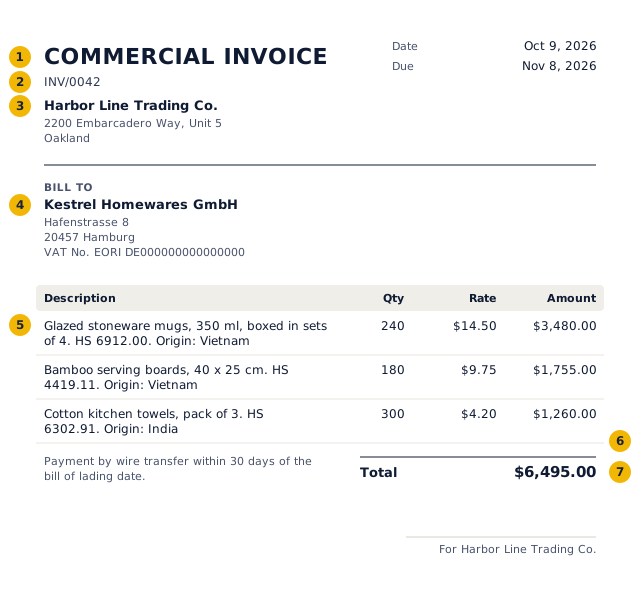
- The title says what the document is: a commercial invoice.
- A unique number from a continuous series, allocated when you issue it.
- Your business name and address, and tax number if registered.
- Who it is for.
- Each line: description, quantity, rate and amount.
- Tax by rate.
- The total in the document's currency and format.
Worked example: the numbers behind the commercial invoice above
| Item | Qty | Rate | Amount | Tax |
|---|---|---|---|---|
| Glazed stoneware mugs, 350 ml, boxed in sets of 4. HS 6912.00. Origin: Vietnam | 240 | $14.50 | $3,480.00 | $0.00 |
| Bamboo serving boards, 40 x 25 cm. HS 4419.11. Origin: Vietnam | 180 | $9.75 | $1,755.00 | $0.00 |
| Cotton kitchen towels, pack of 3. HS 6302.91. Origin: India | 300 | $4.20 | $1,260.00 | $0.00 |
| Subtotal | $6,495.00 | $0.00 | ||
| Total | $6,495.00 | |||
No tax is charged on these lines, so the total equals the value of the supply.
How to fill in the commercial invoice
- Enter exporter and importer with addresses and tax or EORI numbers.
- Describe each product precisely, with its HS code and country of origin.
- Add the Incoterms rule, weights and package count in the notes.
- Save it, then sign in to issue it and attach it to the shipment.
What customs expects on a commercial invoice
US Customs sets out its requirements in 19 CFR 141.86; most other customs authorities ask for the same core details.
- Exporter and importer (or consignee) names, addresses and tax, EORI or IEC numbers
- Invoice number and date
- A plain description of each product: what it is, what it is made of and what it is for, not just a SKU
- HS code for each line
- Country of origin for each line
- Quantity, unit price and line value, with the currency
- Incoterms 2020 rule and named place, for example FOB Shanghai or DAP Rotterdam
- Number of packages, gross and net weight, and shipping marks
- Reason for export: sale, sample, repair or return
- A signed declaration that the information is true
Common causes of customs holds
- Vague descriptions such as "parts" or "samples"
- A declared value that does not match the payment or the proforma
- Missing country of origin, which decides the duty rate and any trade-agreement preference
- Weights or package counts that differ from the airway bill or bill of lading
- No Incoterms, so nobody can tell whether freight and insurance are in the value
United States rules for a commercial invoice
- There is no federal invoice format. Include what your client's accounts payable needs to pay: your legal name, invoice number and date, what was supplied, amounts, due date and payment instructions.
- Sales tax is set by each state. Charge it only where you have nexus (a physical presence or, since 2018, economic nexus by sales volume) and the item is taxable; most services are exempt in many states.
- A business that pays a contractor $2,000 or more in a year (the threshold rose from $600 for payments made from 2026) reports it on Form 1099-NEC, so expect your client to ask for a W-9.
Mistakes to avoid
- Editing or deleting an issued invoice instead of issuing a credit note.
- Gaps or duplicates in the number series.
- Charging the wrong tax type (for India: IGST on an intra-state sale, or CGST and SGST across states).
- Leaving out the due date and payment details, which is the commonest reason invoices are paid late.
- Rounding each line's tax differently from the total; LuckPanda computes tax per line and keeps the components adding up.
Commercial invoice vs other sales documents
| Document | When | Asks for payment | Tax document | In the books |
|---|---|---|---|---|
| Quotation / estimate | Before the order | No | No | No |
| Proforma invoice | After the order, before supply | Advance only | No | No |
| Invoice / tax invoice | On supply | Yes | Yes | Yes: sale and receivable |
| Receipt | When paid | No, confirms payment | No (receipt voucher for advances in India) | Yes: payment |
| Credit note | After an invoice, to reduce it | No, reduces what is owed | Yes | Yes: reverses part of the sale |
Questions people ask
What is the difference between a commercial invoice and a proforma invoice?
A proforma is sent before shipment to confirm the price or support an advance payment or import licence. The commercial invoice travels with the goods and is what customs uses to assess duty. Values on both should match unless the order changed.
Who prepares the commercial invoice?
The exporter, or a freight forwarder working from the exporter's details. The importer's customs broker relies on it to file the entry.
Do I charge VAT or sales tax on an export?
Exports of goods are usually zero-rated for VAT and GST, and US sales tax does not apply to goods shipped abroad. Show tax as zero and keep proof of export.
How many digits should the HS code have?
The first six digits are the same worldwide. Importing countries add more: the US uses 10-digit HTS numbers and the EU 8-digit CN codes. Give at least six; your buyer or broker can confirm the full code.