 luckpanda
Quick answer
What is the credit note format under GST?
A GST credit note must show the particulars in rule 53(1A) of the CGST Rules: the words "Credit note", the supplier's name, address and GSTIN, a consecutive number of up to 16 characters unique for the financial year, the date, the recipient's name, address and GSTIN, the number and date of each original invoice, the taxable value, rate and tax credited, and a signature. Add the reason; auditors expect it.
- Same parties, HSN and GST rate as the original invoice; only the amount credited.
- Its own number series (CN/…), separate from invoices.
- One credit note may list several invoices of the same financial year.
- For when you may issue one, the time limit and the buyer's ITC reversal, see the credit note guide.
Last reviewed:
On this page
- GST credit note format under rule 53(1A)
- How to fill in this credit note format
- Worked example: credit note for a sales return
- Sample credit note formats for common cases
- Credit notes for invoices issued before 22 September 2025
- Credit note format in Excel or Word
- Debit note format
- After you issue it
- Credit note vs debit note vs tax invoice: what the format changes
- Format mistakes to avoid
- Key terms
- Questions people ask
GST credit note format under rule 53(1A)
Section 34 of the CGST Act allows the credit note; rule 53(1A) lists what it must contain. Like the tax invoice, there is no government template: any layout with every particular is valid. The usual one mirrors your invoice, so the buyer can match the two line by line.
Yamuna Electricals Distributors in Delhi invoiced Pink City Electric Mart in Jaipur for ceiling fans on 18 September 2026. Six arrived damaged and came back. Delhi to Rajasthan is inter-state, so the original invoice charged IGST at 18%, and so does the credit note.
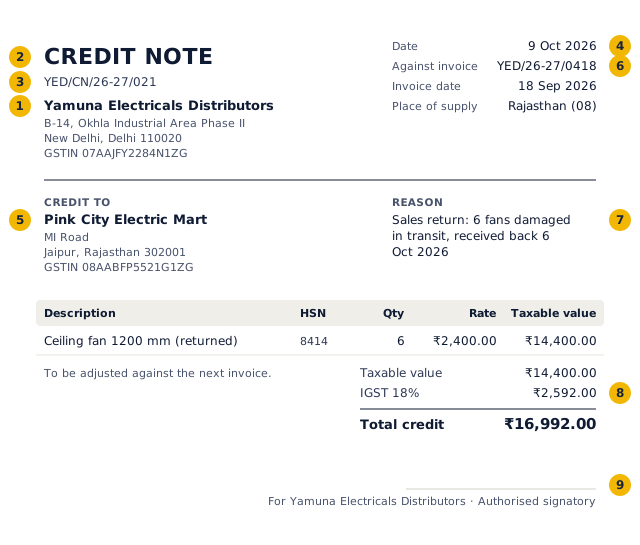
- 53(1A)(a) Supplier's name, address and GSTIN.
- 53(1A)(b) Nature of the document: "Credit note".
- 53(1A)(c) Consecutive number, up to 16 characters, unique for the financial year.
- 53(1A)(d) Date of issue.
- 53(1A)(e) Recipient's name, address and GSTIN; for an unregistered buyer, (f): delivery address with state name and code.
- 53(1A)(g) Number and date of each original invoice.
- Reason: not a listed particular, but it shows the credit falls under section 34.
- 53(1A)(h) Taxable value, rate and amount of tax credited.
- 53(1A)(i) Signature or digital signature.
| Rule 53(1A) | Particular | How it usually appears |
|---|---|---|
| (a) | Supplier's name, address, GSTIN | Letterhead block, as on the invoice |
| (b) | Nature of the document | Title "Credit note" (or "Debit note") |
| (c) | Serial number | CN/26-27/001 style: up to 16 characters, letters, digits, hyphen and slash |
| (d) | Date of issue | Decides the GSTR-1 period it is reported in |
| (e) | Registered recipient | Name, address, GSTIN or UIN |
| (f) | Unregistered recipient | Name, address, delivery address, state name and code |
| (g) | Original invoice(s) | Number and date of each invoice or bill of supply reduced |
| (h) | Value and tax credited | Taxable value, GST rate, CGST and SGST or IGST credited |
| (i) | Signature | Signature or digital signature of the supplier or an authorised person |
Worth adding even though rule 53(1A) does not ask for them: the reason, the place of supply (repeat the original invoice's), HSN or SAC per line, and how the credit will be settled (refund or adjustment).
How to fill in this credit note format
- Copy the parties from the original invoiceYour name, address and GSTIN, and the buyer's, exactly as on the invoice. The two state codes give the same CGST and SGST or IGST as the invoice.
- Reference the invoice and the reasonIn the notes: "Against tax invoice YED/26-27/0418 dated 18 September 2026", every invoice if there are several, the reason and the place of supply.
- Add only what is creditedOne line per returned item, rate difference or discount, with the invoice's HSN or SAC and quantity.
- Use the original GST rateSet the rate on the original invoice, even if the rate has changed since.
- Sign in to issue itCreating here is free. Signing in issues it with the next number in your credit note series, reverses the sale and GST in your books and makes it ready for GSTR-1; issuing needs the Sales module.
Worked example: credit note for a sales return
Credit note YED/CN/26-27/021: 6 returned ceiling fans
| Item | HSN/SAC | Qty | Rate | Taxable value | Tax |
|---|---|---|---|---|---|
| Ceiling fan 1200 mm (returned) | 8414 | 6 | ₹2,400.00 | ₹14,400.00 | ₹2,592.00 |
| Taxable value | ₹14,400.00 | ||||
| IGST 18% | ₹2,592.00 | ||||
| Total credit | ₹16,992.00 | ||||
Pink City's balance on YED/26-27/0418 falls by ₹16,992. Yamuna reports the note in GSTR-1 for October 2026, and its IGST falls by ₹2,592 once Pink City accepts the note and reverses the same input tax credit.
Sample credit note formats for common cases
The layout stays the same; what changes is the reason, the lines and the invoice references. Each sample below shows only what differs.
Rate difference: invoiced at a higher price than agreed
Shivneri Steel invoiced 12,000 kg of MS angle to a Pune fabricator at ₹62 a kg; the purchase order said ₹58. Both are in Maharashtra. The credit note has one line for the difference, with quantity 12,000 and rate ₹4, and the reason "Rate difference as per PO".
Rate difference: ₹4 a kg on 12,000 kg, CGST and SGST
| Item | HSN/SAC | Qty | Rate | Taxable value | Tax |
|---|---|---|---|---|---|
| Rate difference, MS angle 50x50x5 | 7216 | 12,000 | ₹4.00 | ₹48,000.00 | ₹8,640.00 |
| Taxable value | ₹48,000.00 | ||||
| CGST 9% | ₹4,320.00 | ||||
| SGST 9% | ₹4,320.00 | ||||
| Total credit | ₹56,640.00 | ||||
Discount after the sale, across several invoices
A Coimbatore supplier's contract gives a Bengaluru distributor 2% off once quarterly purchases cross ₹5 lakh. Purchases for July to September came to ₹6,00,000 over three invoices. One credit note covers all three: list each invoice number, date and taxable value in the notes, and credit 2% of the total. GST may be reduced only because the discount was agreed in advance and is linked to those invoices.
Volume discount: 2% of ₹6,00,000 over three invoices, IGST
| Item | HSN/SAC | Qty | Rate | Taxable value | Tax |
|---|---|---|---|---|---|
| 2% volume discount, Jul to Sep 2026 | 8509 | 1 | ₹12,000.00 | ₹12,000.00 | ₹2,160.00 |
| Taxable value | ₹12,000.00 | ||||
| IGST 18% | ₹2,160.00 | ||||
| Total credit | ₹14,160.00 | ||||
Deficient service
A Bengaluru studio's support retainer promised 20 hours in September; 6 were not delivered. The credit note uses the SAC from the invoice, a line for the 6 hours at the invoiced rate, and the reason "Service deficient: 6 of 20 retainer hours not delivered".
Service credit: 6 hours at ₹1,500, CGST and SGST
| Item | HSN/SAC | Qty | Rate | Taxable value | Tax |
|---|---|---|---|---|---|
| Support retainer, September: hours not delivered | 998313 | 6 | ₹1,500.00 | ₹9,000.00 | ₹1,620.00 |
| Taxable value | ₹9,000.00 | ||||
| CGST 9% | ₹810.00 | ||||
| SGST 9% | ₹810.00 | ||||
| Total credit | ₹10,620.00 | ||||
Financial (commercial) credit note, without GST
A discount not agreed before the sale, such as a festival scheme announced later, cannot reduce GST. Issue a financial credit note: title it "Credit note (financial)" or "Commercial credit note", give it its own series, show the amount without any GST columns, and say that GST and input tax credit remain as invoiced (CBIC Circular 92/11/2019-GST). It is not reported in GSTR-1.
Credit notes for invoices issued before 22 September 2025
GST rates were rationalised from 22 September 2025, and many goods moved from 12% or 28% to 5% or 18%. A credit note reverses the tax actually charged on the original invoice, so it carries the rate on that invoice, not today's rate. That is the prevailing practice, and it keeps your reduction equal to the credit the buyer claimed; confirm with your adviser if the amounts are large.
Return in October 2026 of goods invoiced in August 2025 at 12% IGST
| Item | Qty | Rate | Taxable value | Tax |
|---|---|---|---|---|
| Returned goods, invoice dated 14 Aug 2025 | 4 | ₹6,500.00 | ₹26,000.00 | ₹3,120.00 |
| Taxable value | ₹26,000.00 | |||
| IGST 12% | ₹3,120.00 | |||
| Total credit | ₹29,120.00 | |||
Mind the deadline: for supplies made in FY 2025-26, a credit note must be declared by 30 November 2026, or by the date the 2025-26 annual return is filed if that is earlier. After that it can only be a financial credit note.
Credit note format in Excel or Word
GST does not care what software produced the credit note, only what is on it. If you keep the format in a spreadsheet, these are the columns, and the rules that spreadsheets usually break:
| Column | Content | Rule |
|---|---|---|
| A | Original invoice no. and date | One row per invoice line credited; required by rule 53(1A)(g) |
| B | Description | Same wording as the invoice line |
| C | HSN/SAC | Same code as the invoice line |
| D | Qty credited | Returned quantity, or 1 for a lump-sum credit |
| E | Rate | Invoiced rate for a return; the difference for a rate correction |
| F | Taxable value | =ROUND(D*E, 2) |
| G | GST % | The rate on the original invoice |
| H | IGST, or CGST and SGST | Same tax type as the original invoice: =ROUND(F*G/100, 2), or half each |
| I | Total credit | =F+H |
- Keep a separate CN series and a register of every number used; a file copied to make the next note is where duplicates come from.
- Never change the tax type. If the invoice charged IGST, so does the credit note, even if the buyer has since moved state.
- Word formats are fine for a one-off, but recalculate every figure; the most common error is a total that does not match the lines.
- PDF for sending, register for records. You still need the data for GSTR-1 and, if you e-invoice, for the IRN.
Debit note format
A supplier's debit note under section 34(3) uses exactly the same rule 53(1A) particulars, with the title "Debit note" and the tax debited instead of credited. Issue it when the invoice was too low: an undercharged rate, extra quantity supplied, or a price increase agreed after the invoice. It is reported in GSTR-1 table 9B with credit notes, and the buyer can claim credit on it.
Buyers also send "debit notes" to suppliers when they return goods. That document is a commercial claim, not a section 34 note: it does not change anyone's GST. The supplier's credit note is what reduces the tax. LuckPanda Sales issues supplier debit notes; see debit notes.
After you issue it
- Report it in GSTR-1 for the month or quarter of issue: table 9B (CDNR) for registered buyers, CDNUR for unregistered buyers on large inter-state invoices and exports.
- E-invoice it if you e-invoice: B2B credit notes need an IRN, within 30 days of their date if your turnover is ₹10 crore or more.
- Ask the buyer to accept it in the Invoice Management System: your tax falls only once they reverse the matching credit.
- Mind the time limit: 30 November after the end of the financial year of the supply, or the annual return date if earlier.
Each of these is explained in full, with the October 2025 change to section 34(2), in the credit note guide.
Credit note vs debit note vs tax invoice: what the format changes
| Tax invoice | Credit note | Debit note | |
|---|---|---|---|
| Title | "Tax invoice" | "Credit note" | "Debit note" |
| Rule | 46 | 53(1A) | 53(1A) |
| Number series | Invoice series | Own CN series | Own DN series |
| Original invoice reference | No | Yes, every invoice reduced | Yes, every invoice increased |
| Lines | Everything supplied | Only what is credited | Only the extra charged |
| Tax | Charged | Credited at the original rate and type | Debited at the original rate and type |
| Place of supply, reverse charge | Required | Not listed; repeat the invoice's | Not listed; repeat the invoice's |
| GSTR-1 | Tables 4 to 7 | Table 9B | Table 9B |
Format mistakes to avoid
- No original invoice number and date. Rule 53(1A)(g) requires them.
- A different rate or tax type from the invoice, including today's rate on a pre-September 2025 invoice.
- Using the invoice number series. It breaks both series.
- Repeating the whole invoice instead of only what is credited.
- GST on a discount that was not agreed in advance. Use a financial credit note.
- Several invoices on one note without listing each.
- No signature on a printed credit note.
Key terms
- Credit note
- A supplier's document under section 34 that reduces the value or tax of an invoice already issued.
- Debit note
- A supplier's document under section 34(3) that increases an invoice; also a buyer's commercial claim on a return.
- Financial credit note
- A credit note that reduces the amount payable but not the GST.
- Rule 53(1A)
- The CGST rule listing the particulars of credit and debit notes.
- CDNR / CDNUR
- GSTR-1 table 9B sections for credit and debit notes to registered and unregistered recipients.
Questions people ask
When can a credit note be issued under GST?
When the taxable value or tax charged on an invoice was more than it should have been, when goods are returned, or when goods or services supplied are found deficient.
Is there a time limit?
Yes. A credit note must be declared in a return by 30 November following the end of the financial year of the original supply, or by the date of filing the annual return if that is earlier.
Can I reduce GST for a discount given after the sale?
Only if the discount was agreed at or before the time of supply, is linked to specific invoices, and the buyer reverses the matching input tax credit. Otherwise issue a financial credit note that does not reduce GST.
What is the difference between a credit note and a debit note?
A credit note reduces what the buyer owes. A debit note, also issued by the supplier, increases it, for example when the price was undercharged.
What must a GST credit note contain?
Under rule 53(1A): supplier's name, address and GSTIN; the words "Credit note"; a consecutive number up to 16 characters; date; recipient's details and GSTIN; number and date of the original invoices; taxable value, rate and tax credited; and a signature.
Can one credit note cover several invoices?
Yes. List the number and date of each invoice. Keep to invoices of one financial year so the time limit is clear.
Is a credit note made in Excel or Word valid?
Yes, if it has every rule 53(1A) particular and a number from a consecutive series. The software does not matter; the contents and the GSTR-1 reporting do.
Which GST rate goes on a credit note for an invoice issued before the September 2025 rate change?
The rate charged on the original invoice. The credit note reverses that tax, and the buyer reverses the same credit.
Is a credit note number series separate from invoices?
It should be. Rule 53(1A) allows one or more series, each consecutive and unique for the financial year; a CN prefix keeps credit notes and invoices both continuous.