 luckpanda
Quick answer
Bill format: what it is
A tax invoice is the document a GST-registered seller issues to charge for goods or services; it fixes the taxable value and the CGST, SGST or IGST, and it is what the buyer claims input tax credit on. Shop bill with items, GST and total in rupees.
Last reviewed:
On this page
Example: a filled invoice
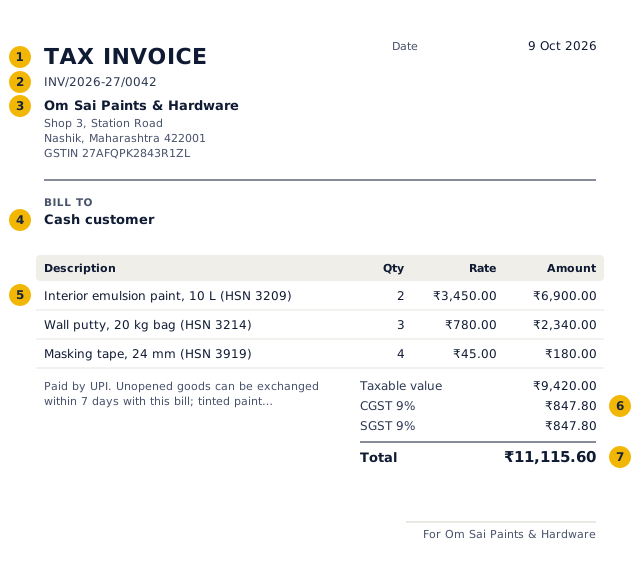
- The title says what the document is: an invoice.
- A unique number from a continuous series, allocated when you issue it.
- Your name, address and GSTIN.
- Who it is for.
- Each line: description, HSN/SAC, quantity, rate and taxable value.
- GST split by component: CGST and SGST in the same state, IGST across states.
- The total in the document's currency and format.
Worked example: the numbers behind the invoice above
| Item | Qty | Rate | Taxable value | Tax |
|---|---|---|---|---|
| Interior emulsion paint, 10 L (HSN 3209) | 2 | ₹3,450.00 | ₹6,900.00 | ₹1,242.00 |
| Wall putty, 20 kg bag (HSN 3214) | 3 | ₹780.00 | ₹2,340.00 | ₹421.20 |
| Masking tape, 24 mm (HSN 3919) | 4 | ₹45.00 | ₹180.00 | ₹32.40 |
| Taxable value | ₹9,420.00 | |||
| CGST 9% | ₹847.80 | |||
| SGST 9% | ₹847.80 | |||
| Total | ₹11,115.60 | |||
GST is worked out per line and split into CGST and SGST (same state) or IGST (other state) from the two GSTINs.
How to fill in the bill format
- Add your shop name, address and GSTIN if registered.
- Enter the customer, or "Cash customer" for counter sales.
- List items with quantity, rate and GST.
- Save the bill; sign in to number bills and keep a daily record.
Bill format for a GST-registered shop
| Part | Contents |
|---|---|
| Header | Shop name, address, phone and GSTIN; title "Tax invoice" |
| Bill details | Bill number, date, customer name; buyer GSTIN for business buyers |
| Items | Item name, HSN, quantity, rate, discount, taxable value |
| Tax | GST rate, with CGST and SGST amounts |
| Total | Amount payable in figures and words |
| Footer | Payment mode, exchange or return policy, signature |
Bills for consumers
For sales to consumers within your state, the buyer's name and address are optional unless the value is ₹50,000 or more, when the name, delivery address and state must be shown. A one-line exchange policy on the bill saves arguments at the counter.
What to put on an invoice, field by field
| Field | What to enter |
|---|---|
| Document title | Say exactly what it is: "Tax invoice". The title tells the buyer and the tax authority how to treat it. |
| Number and date | A unique number in a continuous series (at most 16 characters, unique for the financial year) and the issue date. LuckPanda allocates the number when you issue. |
| Your business | Name, address and GSTIN (state code is the first two digits) |
| Customer | Name, address and GSTIN if registered; for unregistered buyers, name, address and state |
| Lines | Description, quantity, unit and rate, with the HSN code for goods or SAC for services. Each line carries its own tax rate. |
| Tax | GST rate per line. Same state: CGST and SGST, half each. Another state or export: IGST. |
| Totals | Taxable value, tax by component and the total, in the document currency. Amounts in words are customary in India. |
| Terms | Due date, bank or payment details and late-payment terms. |
India GST rules for an invoice
- Contents are set by rule 46 of the CGST Rules: supplier name, address and GSTIN; a consecutive serial number of up to 16 characters, unique for the financial year; date; recipient details and GSTIN if registered; HSN or SAC; description, quantity, taxable value; rate and amount of CGST, SGST/UTGST or IGST; place of supply for inter-state supplies; a reverse-charge statement where it applies; and a signature.
- HSN digits: businesses with aggregate turnover up to ₹5 crore show 4 digits on B2B invoices; above ₹5 crore, 6 digits on every invoice.
- Timing: for goods, on or before removal or delivery; for services, within 30 days of supply.
- E-invoicing (an IRN from the Invoice Registration Portal) applies to B2B invoices of businesses whose aggregate turnover crossed ₹5 crore in any year since 2017-18.
- Unregistered or composition sellers do not issue tax invoices: they issue a bill of supply and charge no GST.
Mistakes to avoid
- Editing or deleting an issued invoice instead of issuing a credit note.
- Gaps or duplicates in the number series.
- Charging the wrong tax type (for India: IGST on an intra-state sale, or CGST and SGST across states).
- Leaving out the due date and payment details, which is the commonest reason invoices are paid late.
- Rounding each line's tax differently from the total; LuckPanda computes tax per line and keeps the components adding up.
Invoice vs other sales documents
| Document | When | Asks for payment | Tax document | In the books |
|---|---|---|---|---|
| Quotation / estimate | Before the order | No | No | No |
| Proforma invoice | After the order, before supply | Advance only | No | No |
| Invoice / tax invoice | On supply | Yes | Yes | Yes: sale and receivable |
| Receipt | When paid | No, confirms payment | No (receipt voucher for advances in India) | Yes: payment |
| Credit note | After an invoice, to reduce it | No, reduces what is owed | Yes | Yes: reverses part of the sale |
Questions people ask
Do I have to give a bill for small sales?
A registered business may issue one consolidated tax invoice at the end of the day for sales under ₹200 each to unregistered buyers who do not ask for an invoice.
What should a bill without GST look like?
The same, without the GST columns or the words "Tax invoice". Under the composition scheme, title it "Bill of supply" and state that you are a composition taxable person.
Should the total be written in words?
It is customary in India and prevents disputes over altered figures, though Rule 46 itself only requires the total value.