 luckpanda
Quick answer
What is a credit note?
A credit note is a document a seller issues to reduce what a customer owes on an invoice already issued: for returned goods, an overcharge, a discount agreed after the sale or a cancelled order. It names the original invoice, reverses the tax on the amount credited, and is settled by a refund or set off against the next invoice. In the US it is usually called a credit memo.
- The seller issues it; the original invoice is never edited or deleted.
- Tax is credited at the same rate as the original invoice.
- India: issue it by 30 November after the end of the financial year of the supply, and report it in GSTR-1.
- UK: it must show the original invoice number and date and the VAT credited in sterling.
Last reviewed: · Also in: हिन्दी · தமிழ் · मराठी · Deutsch · Français
On this page
- What a credit note does
- How to fill in this credit note generator
- When to issue a credit note
- Example: a GST credit note for returned goods
- What goes on a credit note, field by field
- India: credit notes under GST (section 34)
- Journal entry for a credit note
- United Kingdom: VAT credit notes
- EU and United States
- Credit note vs debit note vs refund vs credit memo
- Mistakes to avoid
- Key terms
- Questions people ask
What a credit note does
An issued invoice is a record: it has a number in your series, it is in your sales ledger and, in most countries, it has already been reported to the tax authority. When the amount turns out to be too high, you do not edit it. You issue a credit note that points at it and says by how much it is reduced, and why.
A credit note does three things at once. It reduces the sale in your books, it reduces the tax you owe on that sale (and the input tax your business customer may claim), and it reduces the balance the customer owes. What happens to the money is a separate step: you either refund it or let the customer use the credit against a future invoice.
How to fill in this credit note generator
- Add your business and the customerUse exactly the names, addresses and tax numbers (GSTIN or VAT number) on the original invoice.
- Reference the original invoiceEnter the original invoice number and date in their own fields, e.g. INV/2026-27/0118 dated 18 Sep 2026; both print on the note. If one credit note covers several invoices, list the others in the notes.
- List only what is creditedAdd a line for each returned item or overcharge with its quantity and rate. For a percentage discount, add one line for the discount amount.
- Use the original tax rateSet the same GST or VAT rate as the invoice line. In India, the regime (CGST + SGST or IGST) follows the two GSTINs, as it did on the invoice.
- State the reason and the settlementSay why (sales return, rate difference, discount, deficiency, cancellation) and whether you will refund or adjust against the next invoice.
- Issue itCheck the totals, then sign in to issue: the credit note gets the next number in your series, the sale and tax are reversed in your books, and it is ready for GSTR-1 or your VAT return. Issuing needs the Sales module.
When to issue a credit note
| Situation | Example | Credit note? |
|---|---|---|
| Goods returned | 3 of 20 mixer grinders arrive damaged and go back | Yes, for the returned quantity |
| Overcharge or wrong rate | Invoiced 40 hours, 36 were worked | Yes, for the difference |
| Discount after the sale | A 10% volume discount agreed in the contract, earned at quarter end | Yes (India: only if the discount was agreed in advance and is linked to the invoices) |
| Services deficient | A support month missed its agreed hours | Yes, for the agreed reduction |
| Order cancelled after invoicing | Event cancelled; the invoice was already issued | Yes, for the full amount |
| Duplicate invoice | The same job was invoiced twice | Yes, cancel the duplicate with a full credit note |
| Customer does not pay | A debt you cannot collect | No. Write it off as a bad debt; tax relief for bad debts has its own rules |
| Tax was charged too low | Invoiced 5% instead of 18% | No. Issue a debit note (India) or a supplementary invoice for the extra |
If the invoice is still a draft, nothing has been issued: correct the draft. A credit note is only for invoices that have been issued.
Example: a GST credit note for returned goods
Kaveri Home Appliances in Bengaluru invoiced Sahyadri Retail in Pune for 20 mixer grinders on invoice INV/2026-27/0118. Three arrived damaged and were returned. Karnataka to Maharashtra is an inter-state supply, so the original invoice charged IGST at 18%, and the credit note reverses IGST on the three units.
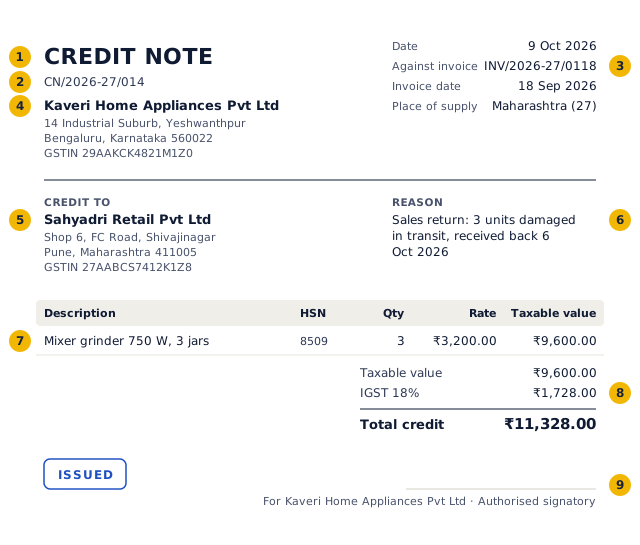
- Nature of the document: the words "Credit note".
- Serial number: consecutive, at most 16 characters, unique for the financial year. A separate series from invoices is usual.
- Original invoice number and date: required; one credit note may list several invoices.
- Supplier name, address and GSTIN.
- Recipient name, address and GSTIN if registered.
- Reason: not a listed field in rule 53(1A), but auditors and the buyer expect it.
- Goods credited with HSN, quantity and taxable value.
- Tax credited at the original rate: IGST here, because the original sale was inter-state.
- Signature or digital signature of the supplier or an authorised person.
The numbers: credit note CN/2026-27/014
| Item | HSN/SAC | Qty | Rate | Taxable value | Tax |
|---|---|---|---|---|---|
| Mixer grinder 750 W, 3 jars (returned) | 8509 | 3 | ₹3,200.00 | ₹9,600.00 | ₹1,728.00 |
| Taxable value | ₹9,600.00 | ||||
| IGST 18% | ₹1,728.00 | ||||
| Total credit | ₹11,328.00 | ||||
Sahyadri Retail's balance on INV/2026-27/0118 falls by ₹11,328. Kaveri reports the credit note in its GSTR-1 for October 2026 (table 9B), which lowers its IGST for the month by ₹1,728 once Sahyadri reverses the same amount of input tax credit.
A partial credit: a discount agreed after the sale
Northwind Design Studio and its Bengaluru client agreed in the contract that the client gets 10% off once the project passes acceptance. The ₹1,20,000 project was invoiced in full; on acceptance, Northwind credits 10%. Both are in Karnataka, so the credit splits into CGST and SGST.
Partial credit note: 10% of ₹1,20,000
| Item | HSN/SAC | Qty | Rate | Taxable value | Tax |
|---|---|---|---|---|---|
| Agreed 10% discount on website project, invoice INV/2026-27/0087 | 998314 | 1 | ₹12,000.00 | ₹12,000.00 | ₹2,160.00 |
| Taxable value | ₹12,000.00 | ||||
| CGST 9% | ₹1,080.00 | ||||
| SGST 9% | ₹1,080.00 | ||||
| Total credit | ₹14,160.00 | ||||
The client's balance falls by ₹14,160: ₹12,000 plus CGST and SGST of ₹1,080 each. Because the discount was agreed before the supply and is linked to a specific invoice, it may reduce GST under section 15(3)(b), provided the client reverses the matching input tax credit.
What goes on a credit note, field by field
| Field | What to enter | Why |
|---|---|---|
| Title | "Credit note" (US: "Credit memo") | Tells the customer and the tax authority how to treat it |
| Credit note number | Next number in your credit note series, e.g. CN/2026-27/014 | Must be unique and continuous; India caps it at 16 characters |
| Date | The day you issue it | Decides which tax period the reduction falls in |
| Original invoice | Number and date of each invoice being reduced | Required in India and the UK; links the credit to the sale |
| Your business | Legal name, address, GSTIN or VAT number | Same as on the invoice |
| Customer | Name, address, GSTIN or VAT number if registered | Their input tax credit is reduced by the same amount |
| Reason | Sales return, rate difference, discount, deficiency, cancellation | Shows the credit is genuine; required by the customer's auditors |
| Lines | What is credited: description, HSN/SAC, quantity, rate | Only what is being reduced, not the whole invoice again |
| Tax | Same rate and tax type as the original line (IGST, CGST + SGST, VAT) | A different rate means the credit does not match the invoice |
| Total credit | Taxable value + tax credited | The amount the balance falls by |
| Settlement | "Refunded to account …" or "Adjusted against the next invoice" | Makes clear whether money moves |
| Signature | Signature or digital signature | Required on GST credit notes |
India: credit notes under GST (section 34)
Under section 34(1) of the CGST Act a registered supplier may issue a credit note when the taxable value or tax charged on a tax invoice is more than it should be, when goods are returned, or when goods or services supplied are found deficient. Since February 2019 one credit note may cover one or more invoices of the same financial year.
Time limit
A credit note that reduces tax must be declared by 30 November following the end of the financial year in which the supply was made, or the date the annual return for that year is filed, whichever is earlier. For a supply invoiced on 18 September 2026 (FY 2026-27) that is 30 November 2027, unless the annual return is filed before then. After that date you can still issue a commercial credit note, but it no longer reduces GST.
The buyer must reverse the input tax credit
From 1 October 2025 the proviso to section 34(2), substituted by the Finance Act 2025, allows the supplier to reduce its output tax only if the registered recipient has reversed the input tax credit attributable to the credit note (for unregistered recipients, only if the tax was not passed on to anyone else). In practice the buyer accepts the credit note in the Invoice Management System (IMS), which reverses its credit; a credit note the buyer rejects does not reduce the supplier's liability.
Reporting in GSTR-1
- Report the credit note in GSTR-1 for the month (or quarter, under QRMP) in which it is issued, not the month of the original invoice.
- Registered buyers: table 9B, CDNR (credit/debit notes, registered).
- Unregistered buyers where the original invoice was a large inter-state B2C invoice (above ₹1 lakh) or an export: table 9B, CDNUR.
- Other unregistered buyers: net the credit against the month's B2C supplies in table 7 (B2CS).
- Corrections to a credit note already reported go in table 9C.
E-invoicing
If your business must e-invoice (aggregate turnover above ₹5 crore in any year since 2017-18), B2B credit notes need an IRN from the Invoice Registration Portal just like invoices. Businesses with aggregate turnover of ₹10 crore or more cannot report a credit note to the portal more than 30 days after its date, so issue and report them promptly.
Discounts after the sale
A discount given after supply reduces the taxable value only if it was agreed before or at the time of supply and is linked to the relevant invoices (section 15(3)(b)), and the recipient reverses the matching input tax credit. Discounts that do not meet these conditions can still be passed on through a financial or commercial credit note without GST: the supplier's tax and the buyer's credit stay as invoiced (CBIC Circular 92/11/2019-GST). The Finance Act 2026 rewrites section 15(3)(b) to tie the discount to a section 34 credit note and ITC reversal; check whether it has been notified before relying on the new wording.
Journal entry for a credit note
For the returned mixer grinders above, the seller's entry reverses the sale and the output tax and reduces the customer's balance:
| Account | Debit | Credit |
|---|---|---|
| Sales returns (or Sales) | ₹9,600.00 | |
| Output IGST | ₹1,728.00 | |
| Sahyadri Retail Pvt Ltd (customer) | ₹11,328.00 |
If you then refund the money: debit the customer ₹11,328 and credit the bank. If the customer keeps the credit, the balance stays on their account and is set off against the next invoice. The buyer records the mirror image: debit the supplier, credit purchase returns and the input IGST.
In TallyPrime the same entry is a Credit Note voucher against the party, with the original invoice selected in the bill-wise details. In LuckPanda, issuing the credit note posts this entry for you; a posted entry is never edited, only reversed.
United Kingdom: VAT credit notes
HMRC treats a credit note as valid for VAT only if it reflects a genuine overcharge or an agreed reduction in the price, and it is issued within 14 days of any refund being paid to the customer (VAT Notice 700, section 18.2.3). It must show:
- its own identifying number and date;
- your and your customer's names, addresses and VAT registration numbers;
- for each item: a description, the quantity and the amount credited, and the total credited excluding VAT;
- the rate and amount of VAT credited, in sterling;
- the number and date of the original VAT invoice.
Adjust the VAT in the return for the period in which the reduction happens (section 18.2.6). You and your customer may instead agree not to adjust the VAT, in which case no VAT credit note is needed, but both sides must keep the original VAT. A credit note is not the route for unpaid invoices: use bad debt relief, available once the debt is more than six months overdue and written off in your accounts (VAT Notice 700/18).
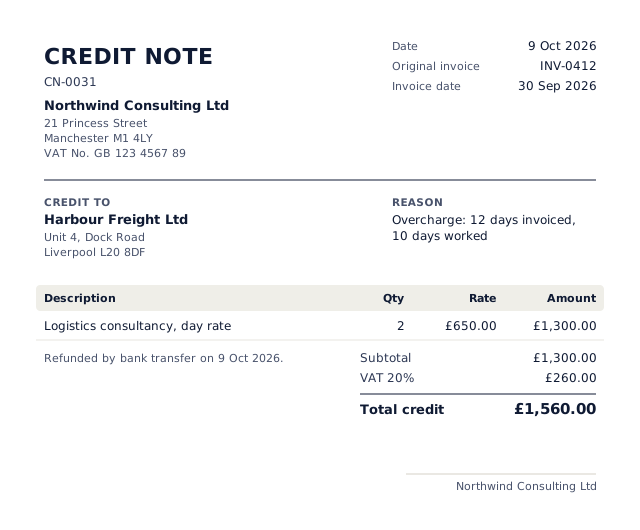
The numbers: UK credit note CN-0031
| Item | Qty | Rate | Amount | Tax |
|---|---|---|---|---|
| Logistics consultancy, day rate (overcharged) | 2 | £650.00 | £1,300.00 | £260.00 |
| Subtotal | £1,300.00 | |||
| VAT 20% | £260.00 | |||
| Total credit | £1,560.00 | |||
EU and United States
EU. Under article 219 of the VAT Directive, any document that amends an invoice and refers to it specifically is treated as an invoice, so a credit note needs the same core details as the invoice it corrects. Article 90 lets the taxable amount be reduced for cancellations, refusals and price reductions after supply.
- Germany: call it a Rechnungskorrektur or Stornorechnung. In German VAT law a "Gutschrift" is a self-billed invoice issued by the buyer (§ 14 (2) UStG). A correction by the seller labelled "Gutschrift" is not treated as one (UStAE 14.3), but the clearer term avoids confusion; the real risk is a genuine self-billed Gutschrift showing VAT the supplier does not owe, which creates a liability under § 14c UStG. B2B e-invoices are being phased in: every business must be able to receive them since 1 January 2025, and corrections to an e-invoice are issued as e-invoices too.
- France: the document is a facture d'avoir (or simply avoir). It carries the mandatory invoice details, its own number in the sequence and a reference to the original invoice. Since 1 September 2026 every VAT-registered business must be able to receive e-invoices, and large and mid-sized companies must issue them; small businesses issue from 1 September 2027.
United States. There is no federal format. Businesses usually call it a credit memo (credit memorandum). If the original invoice charged sales tax, refund the tax on returned taxable goods and deduct the returned sale on your next sales tax return; each state sets its own rules and some require the refund to reach the customer first.
US credit memo: 4 returned items with Texas sales tax at 8.25%
| Item | Qty | Rate | Amount | Tax |
|---|---|---|---|---|
| Returned item, unopened | 4 | $85.00 | $340.00 | $28.05 |
| Subtotal | $340.00 | |||
| Tax 8.25% | $28.05 | |||
| Total credit | $368.05 | |||
Credit note vs debit note vs refund vs credit memo
| Credit note | Debit note | Refund | Credit memo | Revised invoice | |
|---|---|---|---|---|---|
| What it is | Seller reduces an issued invoice | Seller increases an issued invoice (India); or a buyer's claim on a supplier | Money paid back | US name for a credit note | A new invoice replacing the old one |
| Changes tax | Yes, reduces it | Yes, increases it | No, the credit note does | Yes, reduces sales tax | Only before the original is reported |
| Money moves | No, the balance changes | No, the balance changes | Yes | No | No |
| India GST | Section 34(1), GSTR-1 table 9B | Section 34(3), GSTR-1 table 9B | Recorded as a payment | Not a GST term | Revised tax invoices are for new registrations only |
| When | Return, overcharge, discount, deficiency | Undercharge, extra quantity, rate increase | After a credit note, if the customer wants cash | Same as a credit note | Rarely; use a credit note and a new invoice |
Most "credit note vs refund" confusion goes away once you separate the paperwork from the money: the credit note changes what is owed; the refund is a payment that settles the credit. You can refund all of a credit, part of it, or none, and carry the rest forward.
Mistakes to avoid
- Editing or deleting the issued invoice. It breaks the number series and the tax record. Issue a credit note, then a new invoice if needed.
- No reference to the original invoice. Without it the credit cannot be matched, and in India and the UK it is not a valid tax credit note.
- A different tax rate or tax type from the original. Credit IGST if the sale was IGST, even if the customer has since moved state.
- Missing the GST time limit. After 30 November of the following year, a credit note no longer reduces your GST.
- Assuming the credit note is the refund. Record the refund as a payment; until then the customer holds a credit.
- Issuing a credit note for a bad debt. Use bad debt relief (UK) or a write-off; it is not a ground for a GST credit note.
- Calling a German correction "Gutschrift". Use "Rechnungskorrektur".
- Using the invoice series for credit notes. Keep a separate series (CN/…) so both stay continuous.
Key terms
- Credit note
- A seller's document that reduces the amount, and the tax, of an invoice already issued.
- Credit memo
- The US name for a credit note.
- Debit note
- A supplier's document that increases an invoice; also a buyer's claim on a supplier for returned goods.
- Sales return
- Goods sent back by the customer; the usual reason for a credit note.
- Input tax credit (ITC)
- The GST a business buyer may set off against its own GST; a credit note reduces it.
- CDNR / CDNUR
- GSTR-1 table 9B sections for credit and debit notes issued to registered and unregistered recipients.
- Invoice Management System (IMS)
- The GST portal screen where a buyer accepts or rejects suppliers' invoices and credit notes.
Questions people ask
Why not just edit the invoice?
An issued invoice is a record in your number series, your books and, often, your tax returns and the customer's. Changing it leaves no trail. A credit note reduces it with its own number and date, so both records stay intact.
Does a credit note repay the customer?
No. It reduces what the customer owes. If they have already paid, you either refund the credited amount (a separate payment) or let them use the credit against a future invoice.
Should the tax be credited too?
Yes, at the same rate and of the same type as on the original invoice, so the tax you reported and the credit the customer claimed fall by the same amount. The exception is a commercial credit note issued without GST, for example a discount not agreed before the supply.
What is the time limit for a credit note under GST?
It must be declared by 30 November after the end of the financial year in which the supply was made, or the date of filing the annual return for that year if earlier. For FY 2026-27 supplies that is 30 November 2027 at the latest.
Can one credit note cover several invoices?
Yes. Since February 2019, section 34 allows one credit note for one or more tax invoices. List each invoice number and date, and keep the credit within one financial year's supplies.
Does my customer need to do anything when I issue a GST credit note?
Yes. From 1 October 2025 your output tax falls only if a registered customer reverses the input tax credit on the credit note, which normally happens when they accept it in the Invoice Management System. Ask them to accept it.
Do credit notes need an e-invoice (IRN)?
Yes, if you are required to e-invoice: B2B credit notes are reported to the Invoice Registration Portal like invoices. If your aggregate turnover is ₹10 crore or more, report each one within 30 days of its date.
Can I issue a credit note without GST?
Yes, as a financial or commercial credit note. It reduces the amount payable but not the GST: your tax and the buyer's input tax credit stay as invoiced. Use it for discounts that do not meet section 15(3)(b) or after the section 34 time limit.
What is the difference between a credit note and a debit note?
A credit note reduces an invoice; a debit note increases it, for an undercharge or extra quantity. In India both are issued by the supplier under section 34. Buyers also use "debit note" for the claim they send a supplier when returning goods.
Is a sales return a credit note or a debit note?
For the seller, a sales return is recorded with a credit note: it reduces the sale and the customer's balance. The buyer records the same return as a purchase return, often with a debit note sent to the supplier; under GST it is the supplier's credit note that adjusts the tax.
What is the difference between a credit note and a credit memo?
None in substance. "Credit memo" is the usual US term; "credit note" is used in India, the UK, the EU and most other countries.
Do credit notes expire?
A credit note issued against an invoice does not expire by itself. The customer's right to the money is subject to the general limitation period for contract claims (three years in India, six in England and Wales). Store credit or gift vouchers are different and may carry their own terms.
Can I issue a credit note for a customer who will not pay?
Not to reduce tax. Non-payment is not a reason for a credit note in India, and in the UK the route is VAT bad debt relief once the debt is six months overdue and written off.
How is a credit note numbered?
From its own continuous series, separate from invoices, for example CN/2026-27/001. In India the number may be up to 16 characters and must be unique for the financial year. LuckPanda allocates the next number when you issue.

