 luckpanda
Quick answer
What should a travel agent's bill show, and how is GST charged?
A travel bill lists each booking (tickets with sector, date and PNR, hotel stays with dates) and the agent's own service fee. When the agent pays airlines and hotels as the customer's pure agent, those costs pass through at actual cost without GST from the agent, and the agent charges 18% GST only on its fee. A tour operator selling a package for one price charges 5% on the whole package instead.
- Pure agent: fares and hotel at cost, 18% GST on the service fee only.
- Air agents may instead pay GST on 5% (domestic) or 10% (international) of the basic fare.
- Tour packages: 5% of the gross price without credit, or 18% with credit.
- Overseas packages: TCS at a flat 2% from 1 April 2026.
Last reviewed:
On this page
- What a travel bill is
- How to fill in this travel bill format
- Example: tickets and hotel at cost, GST on the fee
- What goes on a travel bill, field by field
- GST rules for travel agents and tour operators
- TCS on overseas tour packages
- Travel bills for reimbursement and leave travel allowance
- Mistakes to avoid on a travel bill
- Travel bill vs hotel bill vs taxi bill vs car rental bill
- Key terms
- Questions people ask
What a travel bill is
A travel bill is the invoice a travel agent or tour operator gives the customer for bookings it made: air or rail tickets, hotels, cabs, visas, insurance and its own fee. Customers use it to pay, and companies and employees use it to support expense claims and leave travel allowance.
The bill has to make one thing clear: which amounts are the agent's own income and which are money passed on to airlines, railways and hotels. That decides the GST. There are two models:
| Agent (pure agent) | Tour operator (package) | |
|---|---|---|
| What is sold | Bookings made on the customer's behalf, plus a service fee | A planned tour for one inclusive price |
| How it is billed | Each fare and hotel at actual cost, fee on a separate line | One gross package price |
| GST from the seller | 18% on the service fee only | 5% on the whole package (or 18% with credit) |
| GST on fares and hotels | Charged by the airline or hotel on its own invoice | Absorbed in the package; no credit at 5% |
| SAC | 9985 (reservation services) | 998552 (tour operator services) |
How to fill in this travel bill format
- Add the agencyEnter the agency's name, address and GSTIN, and any IATA or other accreditation number in the notes.
- Add the customerEnter the company or person paying, with GSTIN for a business. Name the travellers in the notes.
- List bookings at costAdd each ticket (sector, date, PNR) and hotel stay (city, dates, rooms) at actual cost with 0% GST, as pure-agent pass-throughs.
- Add your feesAdd your service fee per booking with SAC 9985 at 18%. A tour operator adds one package line at 5% instead, stating that it includes stay and transport.
- Issue itCheck the totals, then sign in to issue: the bill gets the next number in your series, is recorded in your books and is ready for GSTR-1. Downloading the PDF is free, with a small LuckPanda footer; issuing, sending and clean PDFs without our branding need the Sales module.
Example: tickets and hotel at cost, GST on the fee
Navrang Tours & Travels in Ahmedabad books return flights to Delhi and two hotel rooms for two nights for two engineers of Kankaria Engineering. It pays the airline and the hotel on the company's behalf, and the hotel issues its own invoice in the company's name. Navrang bills the fares and the hotel at actual cost, without GST of its own, and charges 18% on its fees. Both are in Gujarat, so the GST is CGST and SGST.
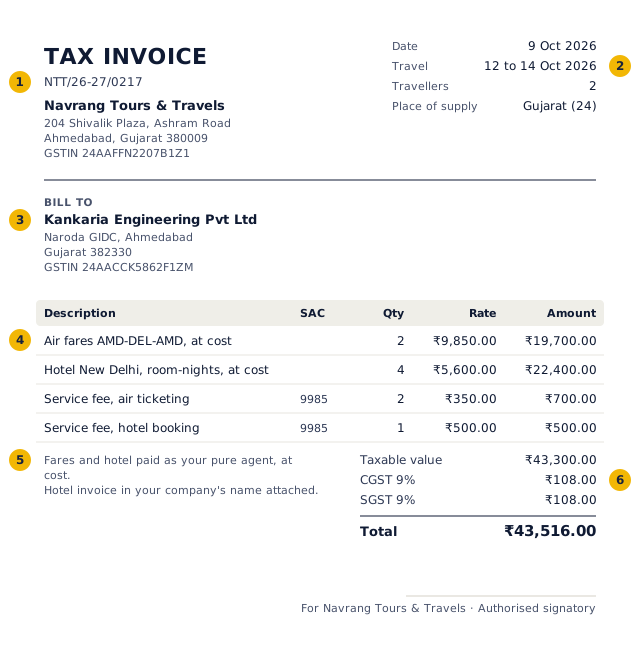
- Bill number from the agent's continuous series.
- Travel dates, and in the description the sector, carrier, class and PNR of each ticket.
- Customer name and GSTIN: the company, with the travellers named in the notes.
- Costs paid on the customer's behalf at actual cost with no GST from the agent, then the service fees with SAC 9985, one per booking.
- Pure-agent statement: costs paid on the customer's authority, recovered at cost, with the supplier's invoices attached.
- GST at 18% on the fees only, as CGST + SGST here because both parties are in Gujarat.
The numbers: bill NTT/26-27/0217
| Item | HSN/SAC | Qty | Rate | Taxable value | Tax |
|---|---|---|---|---|---|
| Air fares AMD-DEL-AMD, at cost | 2 | ₹9,850.00 | ₹19,700.00 | ₹0.00 | |
| Hotel New Delhi, room-nights, at cost | 4 | ₹5,600.00 | ₹22,400.00 | ₹0.00 | |
| Service fee, air ticketing | 9985 | 2 | ₹350.00 | ₹700.00 | ₹126.00 |
| Service fee, hotel booking | 9985 | 1 | ₹500.00 | ₹500.00 | ₹90.00 |
| Taxable value | ₹43,300.00 | ||||
| CGST 9% | ₹108.00 | ||||
| SGST 9% | ₹108.00 | ||||
| Total | ₹43,516.00 | ||||
The agent's GST is ₹216.00 on ₹1,200.00 of fees, and the bill total is ₹43,516.00. The airline's and hotel's GST is inside the fares and on the hotel's own invoice, which is in the company's name, so the company can claim the hotel's GST from that invoice if the hotel is in a state where it is registered.
A domestic tour package at 5%
The same agency sells a four-night Kerala package (flights, hotels, transfers and sightseeing) to a couple for one inclusive price. As a tour operator it charges 5% on the gross amount and cannot claim credit on the hotels, cabs and flights it buys in.
Tour package, 2 adults, 5% on the gross price
| Item | HSN/SAC | Qty | Rate | Taxable value | Tax |
|---|---|---|---|---|---|
| Kerala 4 nights / 5 days package, all inclusive, per adult | 998552 | 2 | ₹38,500.00 | ₹77,000.00 | ₹3,850.00 |
| Taxable value | ₹77,000.00 | ||||
| CGST 2.5% | ₹1,925.00 | ||||
| SGST 2.5% | ₹1,925.00 | ||||
| Total | ₹80,850.00 | ||||
The bill must say the price includes accommodation and transport and is the gross amount for the tour; that statement is a condition of the 5% rate.
An air ticketing agent using rule 32(3)
An air travel agent that cannot easily separate its commission can opt to value its service at 5% of the basic fare for domestic tickets and 10% for international tickets, and pay 18% on that value. On a domestic ticket with a basic fare of ₹8,000, the deemed value is ₹400:
Rule 32(3): deemed value on a ₹8,000 domestic basic fare
| Item | HSN/SAC | Qty | Rate | Taxable value | Tax |
|---|---|---|---|---|---|
| Air ticketing service: 5% of basic fare ₹8,000 | 9985 | 1 | ₹400.00 | ₹400.00 | ₹72.00 |
| Taxable value | ₹400.00 | ||||
| CGST 9% | ₹36.00 | ||||
| SGST 9% | ₹36.00 | ||||
| Total | ₹472.00 | ||||
The agent's GST on the ticket is ₹72.00. "Basic fare" is the part of the fare on which airlines normally pay agents commission, not the total with taxes and fees.
What goes on a travel bill, field by field
| Field | What to enter | Why |
|---|---|---|
| Agency details | Name, address, GSTIN, phone, IATA or other accreditation if any | Rule 46 particulars; customers check the GSTIN |
| Bill number and date | Next number in the series | Unique for the financial year |
| Customer | Company or person paying, with address and GSTIN | Credit on the fee, and the place of supply |
| Travellers | Name of each traveller | Needed for reimbursement and LTA |
| Tickets | Sector, date, carrier, flight or train, class, PNR, fare | Proof of travel; class decides the airline's GST |
| Hotels | Hotel, city, check-in and check-out, rooms, nights, amount | The hotel's own invoice should be in the customer's name |
| Other costs | Visa fees, insurance, cabs, at cost | Pass-through items, if pure-agent conditions are met |
| Service fees | Fee per booking, SAC 9985, 18% GST | The agent's own taxable income |
| Package (tour operators) | One line, gross price, statement that it includes stay and transport | Condition of the 5% rate |
| TCS (overseas packages) | TCS collected and the buyer's PAN | Income-tax requirement |
| Totals and payment | Total, advance, balance, mode, due date | Reconciles with the customer's payment |
| Cancellation terms | Airline and hotel rules, plus the agent's fee | Sets expectations for refunds |
GST rules for travel agents and tour operators
Pure agent: rule 33
Under rule 33 of the CGST Rules, amounts a supplier pays to third parties on the customer's behalf are excluded from its taxable value only if it acts as a pure agent: it has a contractual agreement with the customer to pay those costs, it neither holds nor intends to hold title to what is bought, it does not use it for its own interest, and it recovers only the actual amount. The costs must be shown separately on the bill and be in addition to the agent's own services. Practically, the airline's ticket and the hotel's invoice should be in the traveller's or company's name.
Rates that apply
| Supply | GST | Notes |
|---|---|---|
| Agent's service fee, commission or convenience fee | 18% | With input tax credit |
| Air agent opting for rule 32(3) | 18% on 5% (domestic) or 10% (international) of the basic fare | Optional valuation instead of the actual commission |
| Tour operator package, inclusive of stay and transport | 5% on the gross amount | No credit except on tour operator services bought from another tour operator |
| Tour operator package, with credit | 18% | If the 5% conditions are not met or not chosen |
| Air ticket, economy class (charged by airline) | 5% | Unchanged in 2025 |
| Air ticket, premium economy, business, first (charged by airline) | 18% | 12% until 21 Sep 2025 |
| Hotel room (charged by hotel) | 5% up to ₹7,500 a night, 18% above | See the hotel bill format |
| Rail tickets, AC and first class (charged by railways) | 5% | Other classes exempt |
The rate rationalisation of 22 September 2025 did not change the tour operator entry or the 18% rate on agents' fees. What changed for agents is the cost of what they book: hotel rooms up to ₹7,500 became 5% without credit, and non-economy air fares went from 12% to 18%.
Cancellations
Cancellation charges levied by an airline, railway or hotel are, per CBIC Circular 178/10/2022-GST, consideration for the same supply and taxed at the rate of the underlying service. The agent passes them on at cost; its own cancellation or rebooking fee is a fresh 18% service fee.
Business customers and credit
A company can claim the 18% on an agent's fee for business travel. Credit on travel given to employees on vacation, such as leave or home travel concession, is blocked by section 17(5)(b) of the CGST Act. A company buying a 5% package for a business offsite can claim the 5% if the conditions of section 16 are met; the operator's "no credit" condition restricts the operator, not the buyer.
TCS on overseas tour packages
A seller of an overseas tour programme package (travel abroad with accommodation, boarding, lodging or similar) must collect tax at source from the buyer under the Income-tax Act. From 1 April 2026 the rate is a flat 2% of the amount received, with no threshold, under section 394 of the Income-tax Act 2025 as amended by the Finance Act 2026. Until 31 March 2026 it was 5% up to ₹10 lakh a year and 20% above.
- Show the TCS on the bill below the package total, and the buyer's PAN.
- TCS is not GST: it is an advance of the buyer's income tax, which the buyer can claim against their tax liability.
- Domestic packages are not covered, and a ticket bought on its own is generally not a tour package.
- GST still applies to an overseas package sold by an Indian tour operator to a customer in India, at the tour operator rate.
Travel bills for reimbursement and leave travel allowance
Business travel. Employers reimburse against the agent's bill plus the tickets or boarding passes and the hotel invoice. The bill should name the traveller, show each sector and date, and separate fares, hotel and fees. A bill in the company's name with its GSTIN lets the company claim credit on the agent's fee.
Leave travel allowance (LTA). From the tax year 2026-27 the exemption sits in the Income-tax Act 2025 and the Income-tax Rules 2026. It is available only to employees in the old tax regime, for two journeys within India in the four-calendar-year block 2026 to 2029, and covers only the fare by the shortest route, within the limits the rules set for air, rail and road. Hotels, food, sightseeing and local cabs are not covered, and travel abroad does not qualify. The employee needs proof of travel such as tickets and boarding passes, so a travel bill for LTA should show the fares separately from everything else.
Mistakes to avoid on a travel bill
- Charging 18% on the whole ticket. As a pure agent, charge GST only on your fee.
- Passing costs through without pure-agent evidence. Without an agreement and supplier invoices in the customer's name, the costs can be treated as part of your taxable value.
- Charging 5% on a package without the gross-amount statement, or while claiming credit on hotels and cabs.
- Mixing models on one booking. Either sell a package at a gross price, or book components at cost plus a fee.
- Using 12% for business-class tickets. Since 22 September 2025, non-economy air travel is 18%.
- Old TCS rates on overseas packages. From 1 April 2026 it is 2% flat, not 5% and 20%.
- Fares lumped with hotel and meals. Employees cannot use such a bill for LTA, which covers fares only.
Travel bill vs hotel bill vs taxi bill vs car rental bill
| Travel agent bill | Hotel bill | Taxi bill | Car rental bill | |
|---|---|---|---|---|
| Issued by | Agent or tour operator | Hotel | Cab operator or driver | Rent-a-cab or self-drive company |
| Main GST | 18% on fee; 5% on packages | 5% or 18% on rooms | 5% without credit or 18% with | With driver and fuel: 5% or 18% |
| Supports an LTA claim | Yes, with tickets | No | Rarely | Rarely |
| Format | Travel bill format | Hotel bill format | Taxi bill format | Car rental bill format |
Key terms
- Pure agent
- A supplier who pays third-party costs on the customer's behalf under agreement and recovers only the actual amount, outside its taxable value (rule 33).
- Tour operator
- A person who plans, schedules and arranges tours, including accommodation and transport, for a package price.
- Basic fare
- The part of an air fare on which airlines normally pay commission to agents; the base for rule 32(3).
- TCS
- Tax collected at source: income tax the seller of an overseas tour package collects from the buyer.
- PNR
- Passenger name record: the booking reference for a ticket.
- LTA
- Leave travel allowance: an employer payment for holiday travel, partly exempt under the old tax regime.
Questions people ask
Is GST charged on the full ticket price?
Not by the agent, when it acts as a pure agent under rule 33: the airline or hotel has already charged its own GST in the fare, and the agent bills that amount at cost. The agent charges 18% GST on its own service fee or commission.
Is there another way for air travel agents to pay GST?
Yes. Under rule 32(3), an air travel agent can opt to value its service at 5% of the basic fare for domestic tickets and 10% for international tickets, and pay 18% GST on that value. It is useful when the actual commission is hard to determine.
What about tour packages?
A tour operator selling a package of travel, stay and sightseeing for one price charges 5% GST on the gross amount without input tax credit, or 18% with credit. Overseas tour packages also attract TCS, at a flat 2% from 1 April 2026.
What does a company need on a travel bill?
The traveller's name, travel dates and sectors, PNRs or booking references, the company's name and GSTIN, and the agent's GSTIN, so it can claim credit on the service fee where allowed.
What is the GST rate on air tickets?
5% for economy class and 18% for premium economy, business and first class, charged by the airline. The non-economy rate was 12% until 21 September 2025.
What is the TCS rate on overseas tour packages?
From 1 April 2026, a flat 2% of the package amount with no threshold. In 2025-26 it was 5% up to ₹10 lakh and 20% above.
Can I use a travel bill for my LTA claim?
Yes, as long as it shows the fares separately, with the traveller, dates and sectors, and you keep the tickets or boarding passes. LTA covers only fares within India, under the old tax regime.
What is the SAC code for travel agent services?
Heading 9985 covers support services including travel arrangement; reservation services are within it and tour operator services are 998552.
Can I download this travel bill format in Word or PDF?
This is an online editor that works out the GST as you type. You can download it as a PDF free, with a small LuckPanda footer. Signing in issues it as a numbered bill you can send; issuing, sending and clean PDFs without our branding need the Sales module.