 luckpanda
Quick answer
What should a restaurant bill show, and what GST applies?
A restaurant bill shows the restaurant's name, address, GSTIN and FSSAI number, a bill number, date and time, each dish with quantity, rate and amount, then GST and the total. Most restaurants in India, air-conditioned or not, dine-in, takeaway or delivery, charge 5% GST (2.5% CGST + 2.5% SGST) without input tax credit. Restaurants in hotels that are "specified premises" charge 18%. A service charge cannot be added by default.
- Standard rate: 5% without input tax credit; AC and non-AC are the same.
- 18% with credit only in a hotel that is a specified premises.
- Composition restaurants issue a bill of supply and charge no GST.
- Orders through a delivery app: the platform pays the GST on the food.
Last reviewed:
On this page
- What a restaurant bill is
- How to fill in this restaurant bill format
- Example: a dine-in bill with 5% GST
- What goes on a restaurant bill, field by field
- GST on restaurant food: rates and who pays
- Service charge: what the CCPA rules and the courts say
- Food bills for business customers and reimbursement
- Mistakes to avoid on a restaurant bill
- Restaurant bill vs cash memo vs bill of supply vs KOT
- Key terms
- Questions people ask
What a restaurant bill is
A restaurant bill is the tax invoice a restaurant, cafe, dhaba, cloud kitchen or caterer gives the customer when the meal is paid for. It lists what was served and the tax on it, and it is the customer's proof of the expense. Behind it sit the KOTs (kitchen order tickets) that tell the kitchen what to cook; the KOT is internal, the bill is the document the customer keeps.
For GST, food served by a restaurant is a supply of restaurant service, not a sale of goods, whether it is eaten at the table, packed for takeaway or delivered. So one rate applies to the whole order: you do not look up each dish's HSN code as a grocery shop would.
How to fill in this restaurant bill format
- Add the restaurantEnter the restaurant's name, address and GSTIN, and put the FSSAI licence number in the notes so it prints on the bill.
- Add the customer or tableFor a walk-in, write the table number or order type in the customer name. For a business customer, enter its name, address and GSTIN.
- List the dishesAdd each dish with quantity and rate. Add packaging or your own delivery charge as separate lines.
- Apply the GST rateUse 5% for a stand-alone restaurant, or 18% if you are in a hotel that is a specified premises. Use 0% and the title "Bill of supply" under composition. The tax splits into CGST and SGST automatically.
- Add the notesState that no service charge is added (or that any service charge is voluntary) and the payment mode.
- Issue itCheck the total, then sign in to issue: the bill gets the next number in your series, is recorded in your books and is ready for GSTR-1. Downloading the PDF is free, with a small LuckPanda footer; issuing, sending and clean PDFs without our branding need the Sales module.
Example: a dine-in bill with 5% GST
A family of four at table 7 of Annapoorna Family Restaurant in Bengaluru orders two paneer tikka, a dal makhani, four butter naan and two sweet lassi. The restaurant is not in a hotel, so it charges 5%, split equally into CGST and SGST because a restaurant always supplies within its own state.
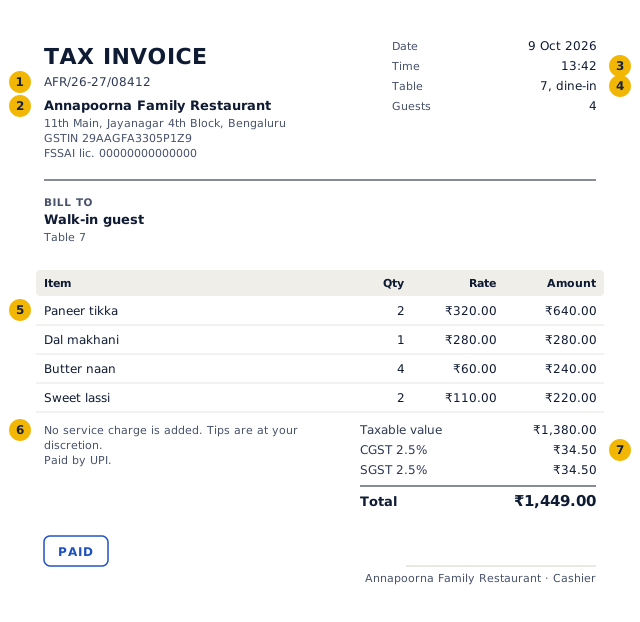
- Bill number: from a continuous series, at most 16 characters, unique for the financial year.
- Restaurant name, address and GSTIN, and the FSSAI licence or registration number, which FSSAI requires on every bill.
- Date and time: the time helps match the bill to the order and the payment.
- Table or order type: dine-in, takeaway or delivery, with the table or order number.
- Each dish with quantity, rate and amount; no HSN per dish is needed for restaurant service.
- Service charge statement and payment mode. A service charge cannot be added by default.
- CGST 2.5% + SGST 2.5% on the food total; never IGST for a meal served in the restaurant's state.
The numbers: bill AFR/26-27/08412
| Item | Qty | Rate | Taxable value | Tax |
|---|---|---|---|---|
| Paneer tikka | 2 | ₹320.00 | ₹640.00 | ₹32.00 |
| Dal makhani | 1 | ₹280.00 | ₹280.00 | ₹14.00 |
| Butter naan | 4 | ₹60.00 | ₹240.00 | ₹12.00 |
| Sweet lassi | 2 | ₹110.00 | ₹220.00 | ₹11.00 |
| Taxable value | ₹1,380.00 | |||
| CGST 2.5% | ₹34.50 | |||
| SGST 2.5% | ₹34.50 | |||
| Total | ₹1,449.00 | |||
The food comes to ₹1,380.00, GST at 5% to ₹69.00, and the bill to ₹1,449.00.
A takeaway with packaging and a round-off
Packaging charged on a takeaway or delivery order is part of the same restaurant supply, so it takes the same 5%. Show it as its own line so the customer can see it. Many restaurants round the bill to the nearest rupee; the GST stays exact and a separate round-off line closes the gap.
Takeaway: two dosas, coffee and packaging
| Item | Qty | Rate | Taxable value | Tax |
|---|---|---|---|---|
| Masala dosa | 2 | ₹85.00 | ₹170.00 | ₹8.50 |
| Filter coffee | 3 | ₹32.00 | ₹96.00 | ₹4.80 |
| Packaging (containers and bag) | 1 | ₹15.00 | ₹15.00 | ₹0.75 |
| Taxable value | ₹281.00 | |||
| CGST 2.5% | ₹7.03 | |||
| SGST 2.5% | ₹7.02 | |||
| Total | ₹295.05 | |||
The bill comes to ₹295.05. A restaurant that rounds would print ₹295.05, then "Round off -₹0.05", then ₹295.00 payable. Round-off is a payment convenience, not a change to the tax.
What goes on a restaurant bill, field by field
| Field | What to enter | Why |
|---|---|---|
| Title | "Tax invoice", or "Bill of supply" under composition | Tells the customer whether GST was charged |
| Restaurant details | Name, address, GSTIN, phone | Rule 46 particulars |
| FSSAI number | The 14-digit licence or registration number | Required by FSSAI on bills and cash receipts since 1 October 2021 |
| Bill number | Next number in a continuous series | Unique for the financial year; at most 16 characters |
| Date and time | When the bill is raised | Matches the bill to the order and payment |
| Order details | Table number and guests, or takeaway or delivery order number | Traceable to the KOT |
| Items | Dish, quantity, rate, amount | What the customer is paying for |
| Discount | Any discount, before tax | GST is charged on the price after an upfront discount |
| Packaging, delivery | Separate lines for packaging and the restaurant's own delivery charge | Same 5% rate as the food |
| GST | CGST 2.5% and SGST 2.5% (or UTGST), with amounts | Shows the tax on the supply |
| Round-off and total | Round-off line, then the amount payable | Keeps the tax exact while the bill is in whole rupees |
| Payment | Cash, card, UPI, with reference | Proof of payment for reimbursement |
| Service charge statement | That no service charge is added, or that any service charge is voluntary | Required by the CCPA guidelines |
If the customer is a GST-registered business and asks for a B2B bill, add its name, address and GSTIN. For a bill of ₹50,000 or more to an unregistered customer, rule 46 also requires the customer's name, address and state.
GST on restaurant food: rates and who pays
Restaurant rates were not changed by the GST rate rationalisation of 22 September 2025. The 5% rate without credit has applied to almost all restaurants since 15 November 2017, when the separate 18% rate for air-conditioned restaurants was abolished.
| Restaurant or supply | GST | Input tax credit |
|---|---|---|
| Stand-alone restaurant, cafe, dhaba, AC or non-AC: dine-in, takeaway, own delivery | 5% (2.5% CGST + 2.5% SGST) | Not allowed |
| Cloud kitchen or central kitchen | 5% | Not allowed |
| Restaurant in a hotel that is not a specified premises | 5% | Not allowed |
| Restaurant, room service or banquet in a specified premises | 18% (9% + 9%) | Allowed |
| Outdoor catering | 5%, or 18% if supplied by a specified premises | As for the rate |
| Order placed through a food delivery app | 5%, paid by the app under section 9(5) | Restaurant charges no GST on it |
| Composition restaurant | No GST on the bill; the restaurant pays 5% of turnover itself | Not allowed |
| Alcoholic drinks | Not GST; state VAT | Billed separately |
Restaurants in hotels: specified premises
A hotel is a specified premises for a financial year if, in the preceding financial year, it supplied any room at a value above ₹7,500 per day, or if it declared itself a specified premises (between 1 January and 31 March of the preceding year, or within 15 days of a new registration). Its restaurants then charge 18% with credit to everyone, including walk-in diners. Other hotel restaurants charge 5%. A stand-alone restaurant cannot opt into 18% to recover credit on its rent and equipment.
Delivery apps: section 9(5)
Since 1 January 2022, restaurant service ordered through an e-commerce operator such as Swiggy or Zomato is taxed in the hands of the operator under section 9(5) of the CGST Act. The app collects the 5% from the customer and pays it; the restaurant's own invoice for these orders carries no GST. The restaurant still reports the sales in GSTR-1 as supplies made through an e-commerce operator, and the app separately charges the restaurant 18% GST on its commission. Orders the restaurant takes and delivers itself are ordinary 5% bills. Restaurants in specified premises are outside section 9(5) and bill their own 18%.
Composition restaurants: bill of supply
A restaurant with aggregate turnover up to ₹1.5 crore (₹75 lakh in some special category states) can opt for composition. It pays 5% of its turnover (2.5% CGST + 2.5% SGST) from its own pocket, cannot collect GST from customers and cannot claim credit. Instead of a tax invoice it issues a bill of supply with the words "composition taxable person, not eligible to collect tax on supplies" at the top. A composition restaurant that adds GST to the bill is collecting tax it has no right to collect. See the bill of supply format.
Service charge: what the CCPA rules and the courts say
On 4 July 2022 the Central Consumer Protection Authority (CCPA) issued guidelines on service charge in hotels and restaurants under the Consumer Protection Act 2019. In short:
- No hotel or restaurant may add a service charge automatically or by default to the bill.
- It may not collect a service charge under any other name.
- It may not force a customer to pay it, and must tell the customer that it is voluntary and at the customer's discretion.
- It may not refuse entry or service because a customer will not pay it.
- It may not add the service charge to the food bill and charge GST on the total.
Restaurant associations challenged the guidelines. On 28 March 2025 a single judge of the Delhi High Court dismissed their petitions, upheld the guidelines, held that a mandatory service charge is an unfair trade practice that misleads customers into thinking it is a government levy, and imposed costs of ₹1 lakh each on the two associations. Their appeals were taken to a division bench of the same court; the single judge's ruling stands unless the appeal court sets it aside.
Food bills for business customers and reimbursement
- Can a company claim input tax credit on a restaurant bill?
- No, in almost all cases. Section 17(5)(b) of the CGST Act blocks credit on food and beverages and outdoor catering, unless the buyer uses them to make the same kind of taxable supply (a caterer subcontracting a caterer) or must provide them to employees by law. A company lunch or client dinner is an expense without GST credit.
- Should the bill still carry the company's GSTIN?
- It can, and some companies ask for it for their records, but it does not unlock credit. What matters for reimbursement is a proper bill: restaurant name and GSTIN, bill number, date, items and the amount paid.
- What do employers accept as a food bill?
- An original or digital tax invoice from the restaurant, or the e-receipt from a delivery app, showing the date, the restaurant, what was ordered and the amount paid. Most expense policies reject handwritten bills without a GSTIN or bill number, and bills dated outside the trip.
Mistakes to avoid on a restaurant bill
- Charging 18% because the restaurant is air-conditioned. AC and non-AC restaurants have had the same 5% rate since November 2017.
- Charging 18% in a hotel that is not a specified premises, or 5% in one that is.
- Adding a service charge by default. The CCPA guidelines prohibit it, and the Delhi High Court upheld them in 2025.
- Charging GST on app orders. For orders through a delivery app, the app pays the 5%; the restaurant's invoice for those orders carries no GST.
- Collecting GST under composition. A composition restaurant issues a bill of supply with no tax lines.
- Leaving out the FSSAI number. It must be on every bill and cash receipt.
- Putting liquor on the GST bill. Alcoholic drinks are outside GST and are billed with state VAT, usually on a separate bill.
- Taxing packaging at a different rate. Packaging on a takeaway is part of the restaurant supply at 5%.
Restaurant bill vs cash memo vs bill of supply vs KOT
| Restaurant bill (tax invoice) | Cash memo | Bill of supply | KOT | |
|---|---|---|---|---|
| Who uses it | GST-registered restaurant | Unregistered eatery, small cash sales | Composition restaurant | Kitchen, internally |
| GST shown | Yes, CGST + SGST | No | No; statement that tax cannot be collected | No |
| Customer keeps it | Yes | Yes | Yes | No |
| Good for reimbursement | Yes | Often not | Yes | No |
| Format | Restaurant bill format | Cash memo format | Bill of supply format | From the POS |
Key terms
- Restaurant service
- Supply of food or drink by a restaurant, eating joint, mess or canteen, for consumption on or away from the premises; taxed as a service.
- Specified premises
- A hotel that sold any room above ₹7,500 a day in the previous financial year, or declared itself one; its restaurants charge 18% with credit.
- Section 9(5)
- The rule that makes an e-commerce operator pay GST on notified services sold through it, including restaurant service.
- Bill of supply
- The bill a composition taxpayer or a seller of exempt supplies issues instead of a tax invoice; it shows no GST.
- KOT
- Kitchen order ticket: the internal slip that sends an order to the kitchen.
- FSSAI number
- The 14-digit licence or registration number of a food business, required on its bills.
Questions people ask
What GST rate applies to restaurant bills?
Standalone restaurants, including takeaway, delivery and cloud kitchens, charge 5% GST without input tax credit, split 2.5% CGST and 2.5% SGST. Restaurants in hotels that are specified premises charge 18% with credit. The September 2025 rate changes did not alter restaurant rates.
Can a restaurant add a service charge?
Not automatically or by default. The CCPA's July 2022 guidelines require any service charge to be voluntary, and on 28 March 2025 a single judge of the Delhi High Court upheld them. A tip is the diner's choice.
Must the FSSAI number appear on the bill?
Yes. Since 1 October 2021 FSSAI has required food businesses to print their 14-digit licence or registration number on cash receipts, bills and invoices.
What about restaurants under the composition scheme?
A composition restaurant (turnover up to ₹1.5 crore) pays 5% of turnover itself, cannot collect GST from customers and issues a bill of supply headed "composition taxable person, not eligible to collect tax on supplies".
Is GST different for AC and non-AC restaurants?
No. Since 15 November 2017 both charge 5% without input tax credit. The air-conditioning test no longer exists.
Who pays GST on Swiggy and Zomato orders?
The platform. Under section 9(5) the e-commerce operator pays the 5% on restaurant service ordered through it, so the restaurant does not charge GST on those orders. Restaurants in specified premises are excluded and charge their own GST.
Is GST charged on packaging charges?
Yes, at the same 5% as the food, because packaging on a takeaway or delivery order is part of the restaurant supply.
Can my company claim GST on a restaurant bill?
Generally no. Section 17(5)(b) blocks input tax credit on food and beverages, except when the buyer resells the same kind of service or must provide meals to employees by law.
Is there GST on alcohol in a restaurant bill?
No. Alcoholic liquor for human consumption is outside GST and is taxed by the state, usually as VAT. Restaurants with a bar issue a separate bill or show liquor apart from the GST lines.
Can I generate a food bill online for free here?
You can fill in the bill, see the GST and total and download it as a PDF without signing up; the free PDF carries a small LuckPanda footer. Issuing it as a numbered bill, sending it or a clean PDF without our branding needs a sign-in and the Sales module.