 luckpanda
Quick answer
What is a cash memo?
A cash memo is the bill a shop gives when the customer pays on the spot, so it is both the bill and the proof of payment. A seller not registered under GST issues a plain cash memo with no tax. A registered seller's cash memo must meet the tax invoice rules (GSTIN, HSN codes and tax), and a composition dealer issues a bill of supply instead. Number every memo in one series for the financial year.
- Unregistered shop: no GST on the memo, ever.
- Registered under the regular scheme: a tax invoice, which may be titled "Cash memo-cum-tax invoice".
- Composition dealer: a bill of supply headed "composition taxable person, not eligible to collect tax on supplies".
- Sales under ₹200 to customers who do not want a bill can go on one consolidated invoice at the end of the day.
Last reviewed:
On this page
- What a cash memo is
- How to fill in this cash memo format
- Which document should your shop issue?
- Example: a cash memo without GST
- Example: a cash memo-cum-tax invoice with GST
- Cash memo format: fields for each kind of shop
- GST rules that apply to cash memos
- Cash limits, revenue stamp and UPI
- Cash memo bill book: printed or digital
- Cash memo in your accounts
- Mistakes to avoid
- Cash memo vs tax invoice vs bill of supply vs receipt
- Key terms
- Questions people ask
What a cash memo is
A cash memo (also called a cash bill) records a sale paid for at the time of sale, by cash, UPI or card. Because payment and bill happen together, the memo does two jobs: it tells the customer what they bought and what it cost, and it shows they paid. A credit memo or credit bill is the opposite case: goods go now and payment comes later, so it carries a due date and stays open in your books.
In accountancy (it appears in the class 11 syllabus) a cash memo is the source document for a cash sale: the shop's copy is the evidence behind the entry in the cash book.
Under GST the name on the top does not decide anything. What matters is whether you are registered, and under which scheme, because that fixes which document the law requires and what it must contain.
How to fill in this cash memo format
- Add your shopEnter the shop name, address and phone. If you are registered, add your GSTIN and state; if not, leave the GSTIN blank.
- Enter the customerWrite "Cash customer", or the buyer's name. For an unregistered buyer spending ₹50,000 or more, add the name, address and state.
- List the itemsAdd each item with quantity, unit and rate. If you are registered under the regular scheme, add the HSN code and GST rate; if you are unregistered or under composition, keep the rate at 0%.
- Note the payment and total in wordsIn the notes write "Paid in cash" or the UPI reference, the total in words, and the composition legend or "seller not registered" where it applies.
- Sign in to issue itCheck the totals, then sign in to issue: the memo takes the next number in your series for the year and goes into your sales records. Issuing needs the Sales module.
Which document should your shop issue?
| Your shop | Document for a cash sale | GST on it | Must say |
|---|---|---|---|
| Not registered under GST | Cash memo or bill | No; an unregistered person may not collect GST | Shop name, memo number, date, items, total |
| Registered, regular scheme | Tax invoice (can be titled "Cash memo-cum-tax invoice") | Yes, CGST + SGST or IGST by line | Every rule 46 particular, including GSTIN and HSN |
| Registered, composition scheme | Bill of supply | No | "Composition taxable person, not eligible to collect tax on supplies" |
| Registered, selling only exempt goods | Bill of supply | No | Rule 49 particulars |
Registration is compulsory once aggregate turnover crosses ₹40 lakh for a shop selling only goods in most states (₹20 lakh in some special category states), or ₹20 lakh where you also supply services. A kirana or hardware shop below that can stay unregistered and keep issuing plain cash memos. Composition is open to traders with turnover up to ₹1.5 crore (₹75 lakh in special category states).
Example: a cash memo without GST
Ganesh Kirana & General Stores in Solapur is below the GST threshold and not registered. A walk-in customer buys rice, dal, oil and tea and pays in cash. The memo carries no GSTIN, no HSN and no tax, and says the seller is not registered.
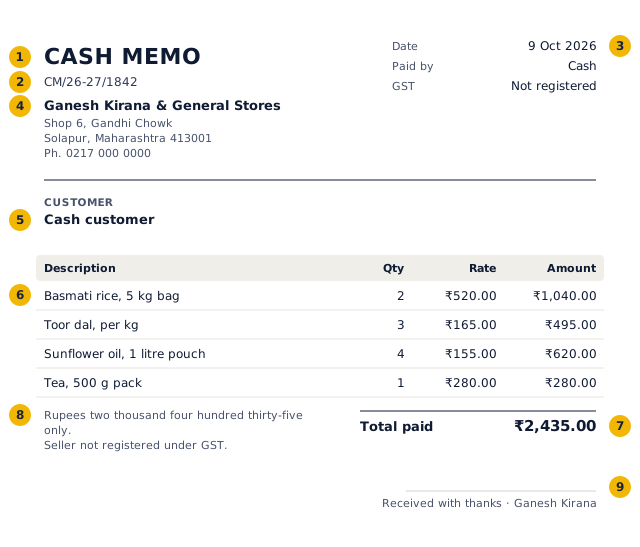
- Title: "Cash memo" or "Bill". Never "Tax invoice" if you are not registered.
- Memo number: one running series for the financial year.
- Date of the sale.
- Shop name, address and phone. No GSTIN, because there is none.
- Customer: "Cash customer" is enough for a small sale.
- Items with quantity, rate and amount.
- Total in figures. No tax line.
- Total in words and a note that the seller is not registered.
- Signature under "Received with thanks", which makes it the receipt too.
The numbers: cash memo CM/26-27/1842
| Item | Qty | Rate | Taxable value | Tax |
|---|---|---|---|---|
| Basmati rice, 5 kg bag | 2 | ₹520.00 | ₹1,040.00 | ₹0.00 |
| Toor dal, per kg | 3 | ₹165.00 | ₹495.00 | ₹0.00 |
| Sunflower oil, 1 litre pouch | 4 | ₹155.00 | ₹620.00 | ₹0.00 |
| Tea, 500 g pack | 1 | ₹280.00 | ₹280.00 | ₹0.00 |
| Subtotal | ₹2,435.00 | ₹0.00 | ||
| Total | ₹2,435.00 | |||
Total ₹2,435.00, written as "Rupees two thousand four hundred thirty-five only". The table's tax column stays at zero because the shop is not registered.
Example: a cash memo-cum-tax invoice with GST
A registered hardware shop in Pune sells electrical items to a walk-in customer who pays by UPI. The customer is unregistered and buys at the counter, so the place of supply is Maharashtra and the tax splits into CGST and SGST. The memo must carry the shop's GSTIN, an HSN code on each line, the rate and the tax.
Cash memo-cum-tax invoice: 18% goods, intra-state
| Item | HSN/SAC | Qty | Rate | Taxable value | Tax |
|---|---|---|---|---|---|
| Modular switch 6 A | 8536 | 6 | ₹45.00 | ₹270.00 | ₹48.60 |
| Extension board, 4 sockets | 8536 | 1 | ₹420.00 | ₹420.00 | ₹75.60 |
| PVC insulation tape | 3919 | 2 | ₹25.00 | ₹50.00 | ₹9.00 |
| Taxable value | ₹740.00 | ||||
| CGST 9% | ₹66.60 | ||||
| SGST 9% | ₹66.60 | ||||
| Total | ₹873.20 | ||||
Taxable value ₹740.00, CGST ₹66.60, SGST ₹66.60, total ₹873.20. The sale goes into GSTR-1 table 7 (B2CS) with the day's other consumer sales; the customer's name is not needed below ₹50,000.
The same counter, as a composition dealer
A composition dealer selling the same items issues a bill of supply: no rate, no tax line, and the legend "composition taxable person, not eligible to collect tax on supplies" at the top. The dealer pays its composition tax out of its own turnover; the customer pays only the price.
Bill of supply from a composition dealer
| Item | HSN/SAC | Qty | Rate | Taxable value | Tax |
|---|---|---|---|---|---|
| Modular switch 6 A | 8536 | 6 | ₹45.00 | ₹270.00 | ₹0.00 |
| Extension board, 4 sockets | 8536 | 1 | ₹420.00 | ₹420.00 | ₹0.00 |
| PVC insulation tape | 3919 | 2 | ₹25.00 | ₹50.00 | ₹0.00 |
| Subtotal | ₹740.00 | ₹0.00 | |||
| Total | ₹740.00 | ||||
Total ₹740.00 with no GST shown. Charging "GST" on this bill would be collecting tax the dealer is not allowed to collect.
Cash memo format: fields for each kind of shop
| Field | Unregistered shop | Regular GST (tax invoice) | Composition (bill of supply) |
|---|---|---|---|
| Title | Cash memo / Bill | Tax invoice (cash memo-cum-tax invoice) | Bill of supply, with the composition legend |
| Shop name and address | Yes | Yes | Yes |
| GSTIN | None | Yes | Yes |
| Serial number | One series | Consecutive, up to 16 characters, unique for the financial year | Same as tax invoice |
| Date | Yes | Yes | Yes |
| Customer name and address | Optional | If registered: name, address, GSTIN. If unregistered: required when the taxable value is ₹50,000 or more, or on request | Name, address and GSTIN if registered |
| HSN code | No | Yes | Yes |
| Quantity, rate, value | Yes | Yes, with discount and taxable value | Yes |
| Tax rate and amount | No | Yes, CGST + SGST or IGST | No |
| Place of supply | No | For inter-state supplies | No |
| Total in words | Good practice | Good practice | Good practice |
| Signature | Good practice | Yes, or digital signature (not needed on an electronic invoice) | Yes, as for a tax invoice |
GST rules that apply to cash memos
- Tax invoice particulars (rule 46). A registered supplier's invoice must show the supplier's name, address and GSTIN; a consecutive serial number of up to 16 characters, unique for the financial year; the date; the recipient's details; HSN; description; quantity; total and taxable value; the rate and amount of each tax; place of supply for inter-state sales; whether reverse charge applies; and a signature.
- Unregistered customers buying ₹50,000 or more. The invoice must also carry the customer's name and address, the delivery address and the state name and code. Below ₹50,000 these are added only if the customer asks.
- Small sales under ₹200 (section 31(3)(b) and rule 46). You need not issue a tax invoice for a supply under ₹200 if the customer is unregistered and does not want one, but you must issue one consolidated tax invoice for all such sales at the close of each day. The same relief applies to bills of supply.
- Bill of supply (rule 49). For composition dealers and exempt goods: supplier name, address and GSTIN, serial number, date, recipient's GSTIN if registered, HSN, description, value and signature.
- Unregistered sellers may not collect GST. A memo that adds "GST" without a registration collects tax illegally; the amount is still payable to the government.
- Copies. For goods, an invoice is made in triplicate: original for the buyer, duplicate for the transporter, triplicate for you. A printed bill book with carbon copies follows the same idea.
- Keep them for 72 months from the due date of the annual return for the year, under section 36 of the CGST Act.
Cash limits, revenue stamp and UPI
- Is there a limit on how much cash a shop can accept?
- Yes. The Income-tax Act bars receiving ₹2 lakh or more in cash from one person in a day, for one transaction or for one event, other than through an account payee cheque, bank draft or electronic mode. The penalty can equal the amount received. The rule carried over from the 1961 Act into the Income-tax Act 2025.
- What about the buyer?
- A business buyer cannot deduct most expenses paid in cash above ₹10,000 to one person in a day. Business customers will ask to pay large bills by UPI, card or bank transfer for that reason.
- Does a cash memo need a revenue stamp?
- A writing that acknowledges receipt of more than ₹5,000 is a "receipt" under the Indian Stamp Act and attracts a ₹1 stamp under the central schedule; states have their own schedules. A memo marked "received with thanks" for more than ₹5,000 in cash is the case most often stamped. Ask your accountant about your state's practice for printed tax invoices.
- Is a UPI payment a "cash" sale?
- For billing, yes: the customer pays at once, so you issue a cash memo or tax invoice rather than a credit bill. Note the UPI reference on the memo so it matches your bank statement.
Cash memo bill book: printed or digital
A printed cash memo bill book has the shop's details printed, numbers pre-printed in order and carbon copies, so every memo leaves a counterfoil. It works, but each book must be used in sequence, cancelled memos must be kept (marked "cancelled", not torn out), and totals are added by hand.
- Numbering: start a new series each financial year, for example CM/26-27/0001, and never reuse a number.
- Cancelled memos: keep both copies and write "Cancelled" across them; a gap in the series is the first thing an officer asks about.
- Daily totals: add up the day's memos and match them to the cash in the drawer and the UPI settlement.
- Digital memos: the series, totals, tax and amount in words are worked out for you, and copies cannot go missing.
Cash memo in your accounts
The shop's copy of each cash memo supports a cash book entry. For the GST memo above, the entry is:
| Account | Debit | Credit |
|---|---|---|
| Cash / Bank (UPI) | ₹873.20 | |
| Sales | ₹740.00 | |
| Output CGST | ₹66.60 | |
| Output SGST | ₹66.60 |
For an unregistered shop the entry is simply Cash Dr, Sales Cr for the memo total. In class 11 terms: the cash memo is the source document, the entry goes to the cash book (a book of original entry), and it is posted from there to the sales account in the ledger.
Mistakes to avoid
- Charging GST without a GSTIN. An unregistered or composition shop cannot add GST.
- Titling an unregistered memo "Tax invoice".
- Several series running at once without a prefix to tell them apart, or numbers restarting mid-year.
- No HSN on a registered shop's memo.
- Leaving out the customer's details on a ₹50,000-plus sale to an unregistered buyer.
- Accepting ₹2 lakh or more in cash for one sale or from one customer in a day.
- Tearing out spoilt memos instead of marking them cancelled.
- Issuing a cash memo for a credit sale. If the customer pays later, issue an invoice with a due date.
Cash memo vs tax invoice vs bill of supply vs receipt
| Cash memo | Tax invoice | Bill of supply | Credit memo / credit bill | Receipt | |
|---|---|---|---|---|---|
| Issued by | Any seller for a sale paid at once | Registered supplier, taxable supply | Composition dealer or exempt supply | Seller, when payment comes later | Whoever receives money |
| Shows GST | Only if it is also a tax invoice | Yes | No | If it is a tax invoice | No |
| Proves payment | Yes | Only if marked paid | Only if marked paid | No; it records a debt | Yes |
| Legal basis | None of its own under GST | Section 31, rule 46 | Section 31(3)(c), rule 49 | Section 31, rule 46 | Stamp Act for receipts above ₹5,000 |
| Typical user | Kirana, small retail, repair shop | Any registered shop | Composition trader | Wholesaler with regular buyers | Landlords, service providers, advances |
Key terms
- Cash memo
- A bill for a sale paid on the spot; it doubles as proof of payment.
- Tax invoice
- The invoice a registered supplier must issue for a taxable supply, with the rule 46 particulars.
- Bill of supply
- The document a composition dealer or a supplier of exempt goods issues instead of a tax invoice.
- Composition scheme
- A GST scheme for small businesses that pay tax on turnover at a low rate and cannot collect GST.
- Consolidated tax invoice
- One end-of-day invoice covering sales under ₹200 to unregistered customers who did not want a bill.
- B2CS
- GSTR-1 table 7, where a registered shop reports its consumer sales in summary.
Questions people ask
Is a cash memo valid under GST?
The name does not matter; the contents do. A registered seller's cash memo must carry everything rule 46 requires of a tax invoice, including the GSTIN, HSN and tax. An unregistered seller's cash memo is a simple bill and must not show GST.
What is the difference between a cash memo and a credit memo?
A cash memo is for a sale paid immediately. A credit memo, or credit bill, is for a sale where the buyer pays later, so it carries a due date and stays open in your books until paid.
Is there a limit on cash sales?
Yes. The Income-tax Act bars accepting ₹2 lakh or more in cash from one person in a day, for one transaction or for one event. Business buyers also lose the deduction for most cash payments above ₹10,000 to one person in a day, so larger sales are better taken by UPI, card or bank transfer.
Should a cash memo be numbered?
Yes, in one series for the financial year. Numbered memos let you match daily sales to the cash in the drawer, and they are the first thing a tax officer asks to see.
Can an unregistered shop charge GST on a cash memo?
No. Only a registered person can collect GST. An unregistered shop shows prices without tax, and a composition dealer issues a bill of supply without tax.
Do I need to give a cash memo for a sale under ₹200?
A registered shop need not issue a separate tax invoice for a sale under ₹200 to an unregistered customer who does not want one, but must issue one consolidated invoice for all such sales at the end of each day.
Is a cash memo the same as a receipt?
It can be both. A cash memo signed "received with thanks" bills the sale and acknowledges payment. A separate receipt is used where money is received without a sale bill, such as an advance or rent.
What is a cash memo bill book?
A printed book of pre-numbered cash memos with carbon copies. The original goes to the customer and the counterfoil stays as your record; cancelled memos are kept and marked, not torn out.
How long should I keep cash memos?
Under GST, for 72 months from the due date of the annual return for the year they relate to. Keep them in number order with the cancelled ones.
What is a kachha bill?
An informal slip or estimate without a number or the shop's details. It is not a valid tax invoice or cash memo, and it leaves the sale out of your books.