 luckpanda
Quick answer
What should a medical bill include in India?
A pharmacy bill must show the pharmacy's name, address and drug licence numbers, a serial number, and the name and quantity of each medicine; for prescription drugs, also the batch number, expiry, manufacturer, patient and prescribing doctor. Most medicines carry 5% GST since 22 September 2025. Consultations and treatment by doctors, clinics and hospitals are exempt from GST and are billed without it.
- Every retail sale of a drug is made against a numbered cash or credit memo, and the pharmacy keeps the carbon copy.
- Schedule H1 sales are also entered in a separate register kept for three years.
- Medicines given to in-patients are part of the exempt treatment; medicines sold to out-patients are a taxable sale.
- Insurers and employers want itemised, signed, original bills with the prescription.
Last reviewed:
On this page
- Pharmacy, clinic and hospital bills: which is which
- How to fill in this medical bill format
- Example: a pharmacy bill with GST
- What the Drugs and Cosmetics Rules require on a pharmacy bill
- GST on medicines and health care after GST 2.0
- Hospital bills: interim, final and package bills
- Medical bills for insurance claims and reimbursement
- Medical bill format, field by field
- Mistakes to avoid
- Medical bill vs prescription vs discharge summary vs medical certificate
- Key terms
- Questions people ask
Pharmacy, clinic and hospital bills: which is which
"Medical bill" covers three different documents, and each follows different rules:
| Pharmacy (medical store) bill | Clinic or doctor's bill | Hospital bill | |
|---|---|---|---|
| What is sold | Medicines and other goods | Consultation, procedures, dressings | Treatment: room, doctors, procedures, medicines, tests |
| GST | Yes, by product: most medicines 5% | Exempt health care service | Exempt for treatment; in-patient medicines are part of it |
| Document if GST-registered | Tax invoice | Bill of supply | Bill of supply for treatment; tax invoice for taxable extras |
| Licence on the bill | Retail drug licence numbers | Doctor's registration number (good practice) | Hospital registration, where the state requires it |
| Other law | Drugs and Cosmetics Rules (rule 65) | State medical council rules | State clinical establishment rules, insurer and TPA requirements |
How to fill in this medical bill format
- Add the pharmacy or clinicEnter the name and address as on the drug licence, your GSTIN and state if registered, and the licence numbers in the address or notes.
- Enter the patient and the doctorPut the patient's name and address under "Bill to", and the prescribing doctor and prescription date in the notes or the client name.
- Add each medicineUse one line per medicine with the batch number and expiry in the description, HSN code (3004 for most packaged medicines), quantity and the taxable rate. For exempt services such as consultations, set the rate to 0%.
- Check the GST rate per lineSet the GST rate from each product's HSN entry: most medicines 5%, some nil, devices and other goods at their own rates. The tool splits CGST and SGST for local sales.
- Sign in to issue itSign in to issue: the bill takes the next number in your series and is kept as the carbon copy rule 65 asks you to keep. Issuing needs the Sales module.
Example: a pharmacy bill with GST
Shubham Medical & General Stores in Nagpur sells three medicines to Sunita Deshmukh on Dr A. Joshi's prescription. Amoxicillin is a Schedule H drug, so it may be sold only on a prescription and the sale must be recorded with the prescriber, patient, batch and manufacturer. The pharmacy is GST-registered in Maharashtra and the sale is local, so 5% GST splits into 2.5% CGST and 2.5% SGST.
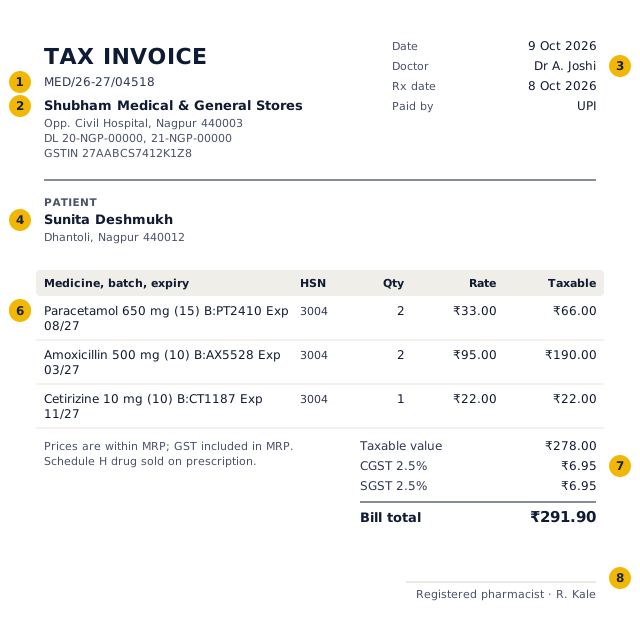
- Serial number of the cash or credit memo, in one series.
- Pharmacy name, address and sale licence numbers (rule 65), and the GSTIN.
- Prescribing doctor and the prescription date, for Schedule H and H1 drugs.
- Patient's name and address.
- Medicine name, quantity, batch number and expiry on every line.
- HSN 3004 for packaged medicines; the code decides the GST rate.
- GST: CGST + SGST at 2.5% each for a sale within Maharashtra.
- Signature of the registered pharmacist who supplied the drugs.
The numbers: bill MED/26-27/04518
| Item | HSN/SAC | Qty | Rate | Taxable value | Tax |
|---|---|---|---|---|---|
| Paracetamol 650 mg (15) B:PT2410 Exp 08/27 | 3004 | 2 | ₹33.00 | ₹66.00 | ₹3.30 |
| Amoxicillin 500 mg (10) B:AX5528 Exp 03/27 | 3004 | 2 | ₹95.00 | ₹190.00 | ₹9.50 |
| Cetirizine 10 mg (10) B:CT1187 Exp 11/27 | 3004 | 1 | ₹22.00 | ₹22.00 | ₹1.10 |
| Taxable value | ₹278.00 | ||||
| CGST 2.5% | ₹6.95 | ||||
| SGST 2.5% | ₹6.95 | ||||
| Total | ₹291.90 | ||||
Taxable value ₹278.00, GST ₹13.90, bill total ₹291.90. The rates are taxable values: medicine MRPs include GST, so a strip of paracetamol with an MRP of ₹34.65 has a taxable value of ₹33.00.
A clinic bill without GST
The same patient's consultation and dressing at a clinic are health care services by an authorised medical practitioner, so they are exempt. A clinic that is GST-registered for some other taxable supply issues a bill of supply for them; an unregistered clinic issues a plain bill. Either way, no GST is shown.
Clinic bill: consultation and dressing (exempt)
| Item | Qty | Rate | Taxable value | Tax |
|---|---|---|---|---|
| Consultation, Dr A. Joshi, MBBS, MD | 1 | ₹800.00 | ₹800.00 | ₹0.00 |
| Wound dressing | 1 | ₹300.00 | ₹300.00 | ₹0.00 |
| Subtotal | ₹1,100.00 | ₹0.00 | ||
| Total | ₹1,100.00 | |||
Total ₹1,100.00 with no GST. Medicines dispensed from the clinic's own counter to this out-patient would go on a separate, taxed bill.
What the Drugs and Cosmetics Rules require on a pharmacy bill
Rule 65 of the Drugs and Cosmetics Rules 1945 sets the conditions of a retail drug licence. For billing, it comes down to this:
| Requirement | What it means on the bill | Rule 65 |
|---|---|---|
| Every retail sale against a cash or credit memo | Name, address and sale licence number of the pharmacy; serial number; name and quantity of each drug. Keep the carbon copies | Sub-rule (4)(3) |
| Prescription sales recorded | Date, prescriber's name and address, patient's name and address, drug and quantity, pharmacist's signature; for Schedule C, H and H1 drugs also the manufacturer, batch number and expiry. A serially numbered cash or credit memo book can be used instead of a prescription register for drugs supplied in original packs | Sub-rule (3) |
| Schedule H1 drugs | Also entered in a separate register: prescriber, patient, drug and quantity. Kept for three years and open for inspection | Sub-rule (3)(1)(h) |
| Supply under a pharmacist | Prescription drugs are supplied by or under the supervision of a registered pharmacist | Sub-rule (2) |
| Purchase records | Your own purchase bills, with supplier licence, batch and manufacturer, kept in date order | Sub-rule (4)(4) |
Retail licences are issued in Form 20 (drugs other than those in Schedules C, C(1) and X) and Form 21 (Schedule C and C(1) drugs); wholesale licences in Forms 20B and 21B. Print both retail numbers on the bill. The selling price can never exceed the MRP printed on the pack, which already includes GST.
GST on medicines and health care after GST 2.0
- Medicines: most packaged medicines moved from 12% to 5% on 22 September 2025, and a list of life-saving drugs became nil-rated. Check the HSN entry for each product rather than assuming.
- Medical devices and diagnostic kits: many moved to 5% at the same time; others, and general pharmacy goods such as cosmetics and toiletries, carry their own rates.
- Health care services by a clinical establishment, an authorised medical practitioner or paramedics are exempt. That covers diagnosis, treatment and care, including diagnostic labs that are clinical establishments.
- Not exempt: cosmetic or plastic surgery, unless it restores or reconstructs anatomy or function affected by congenital defects, developmental abnormalities, injury or trauma.
- In-patients: medicines, consumables and food supplied to admitted patients as part of treatment are part of a composite supply of exempt health care (CBIC Circular 32/06/2018-GST).
- Out-patients: medicines sold by a hospital pharmacy to out-patients are a separate taxable sale and need a tax invoice.
- Input tax credit: a hospital cannot claim credit on inputs used for exempt treatment, so its costs include the GST it pays.
Hospital bills: interim, final and package bills
A hospital bill is itemised by head, because insurers and patients check each one:
- Room or bed charges per day, with the room category;
- Doctors' visits and consultations, with each doctor's name;
- Procedures and operation theatre charges, surgeon and anaesthetist fees;
- Investigations: lab tests and imaging, each named;
- Medicines and consumables, with a separate pharmacy statement listing batch numbers;
- Package charges, with what the package includes and what was billed outside it;
- Advances received, discounts, and the balance payable.
Most hospitals issue an interim bill during a long stay and a final bill at discharge, with the discharge summary. Treatment is exempt from GST, so the final bill shows no GST on those heads; taxable extras (for example retail items bought by attendants) appear on a separate invoice.
Medical bills for insurance claims and reimbursement
- What does a health insurer need for a reimbursement claim?
- Typically: the claim form, the final hospital bill itemised by head, payment receipts, the discharge summary, prescriptions with the matching pharmacy bills, and investigation reports. Bills must carry the patient's name, dates, the hospital's or pharmacy's details and a signature or stamp. In a cashless claim the hospital sends these to the insurer or TPA directly.
- Why do pharmacy bills get rejected in claims?
- Because they do not match a prescription: a bill with no doctor's name, a date before the prescription, missing batch or patient details, or medicines not linked to the treatment claimed. Keep each pharmacy bill with its prescription.
- Is medical reimbursement from an employer tax-free?
- Generally not any more. The old tax-free medical reimbursement of up to ₹15,000 a year was replaced by the standard deduction from 2018-19, so most reimbursements are taxed as salary unless a specific exclusion applies. Employers still ask for itemised bills to approve the claim.
- What do government employees submit?
- Central government employees claim under the CS(MA) Rules or CGHS: original bills and cash memos, the prescription, and an essentiality certificate signed by the treating doctor. State schemes have their own forms, so check the department's format.
- Can medical bills reduce income tax?
- Under the old regime, health insurance premiums are deductible, and so are medical expenses for a senior citizen who has no health insurance, within limits. Pay by card, UPI or bank: cash payments do not qualify, except for preventive health check-ups. The new regime has no such deduction.
Medical bill format, field by field
| Field | Pharmacy bill | Clinic or hospital bill |
|---|---|---|
| Title | Tax invoice (or cash/credit memo if unregistered) | Bill, or bill of supply if registered |
| Seller details | Name, address, drug licence numbers, GSTIN | Name, address, registration number, doctor's registration |
| Number and date | One consecutive series, up to 16 characters | One series |
| Patient | Name and address | Name, age, patient or IP number, admission and discharge dates |
| Doctor | Prescribing doctor and prescription date | Treating doctor(s) |
| Lines | Medicine, HSN, batch, expiry, quantity, rate | Service heads, with dates and quantities |
| Tax | GST by line (most medicines 5%) | None on exempt treatment |
| Total | In figures and words, within MRP | With advances and balance |
| Signature | Registered pharmacist | Authorised signatory |
Mistakes to avoid
- Charging GST on a consultation. Doctors' and clinics' health care services are exempt.
- Adding GST on top of the MRP. The MRP already includes it; the selling price cannot exceed it.
- One GST rate for the whole bill. Medicines, devices and cosmetics can carry different rates; go by HSN.
- No batch or expiry on a prescription drug line, which breaks the rule 65 record and makes recalls untraceable.
- Selling a Schedule H1 drug without the separate register entry.
- No licence numbers on the bill.
- Undated or unsigned bills for insurance or reimbursement, or bills that do not match the prescription.
Medical bill vs prescription vs discharge summary vs medical certificate
| Medical bill | Prescription | Discharge summary | Medical certificate | |
|---|---|---|---|---|
| Issued by | Pharmacy, clinic or hospital | Registered doctor | Hospital | Registered doctor |
| Shows | What was supplied and what it cost | What the doctor ordered | Diagnosis, treatment, advice on discharge | Fitness or illness for a period |
| Has amounts | Yes | No | No | No |
| Needed for insurance | Yes | Yes, with pharmacy bills | Yes, for hospitalisation | Sometimes, for leave or disability cover |
| GST | On taxable goods only | No | No | No |
Key terms
- Drug licence (Forms 20 and 21)
- The retail licences a pharmacy needs to sell drugs; their numbers go on every bill.
- Schedule H / H1
- Prescription-only drugs; H1 sales are also recorded in a separate register kept for three years.
- Batch number
- The manufacturer's lot code that lets a medicine be traced and recalled.
- Clinical establishment
- A hospital, clinic, nursing home or lab offering diagnosis or treatment; its health care services are exempt from GST.
- Composite supply
- A bundle supplied together with one principal supply; in-patient medicines follow the exempt treatment.
- MRP
- The maximum retail price printed on the pack, inclusive of all taxes.
- Essentiality certificate
- A doctor's certificate that the treatment and medicines were essential, needed for government medical claims.
Questions people ask
What GST applies to medicines?
Most medicines have been taxed at 5% since 22 September 2025, and a list of life-saving drugs is exempt. Medical devices and other pharmacy products carry their own rates, so check each HSN code.
Is GST charged on a doctor's consultation?
No. Health care services by a clinical establishment, an authorised medical practitioner or paramedics are exempt. Medicines sold to out-patients are a separate taxable sale; medicines given to in-patients as part of treatment form part of the exempt service.
Why do batch number and expiry matter?
They let the patient and the pharmacy trace a medicine if it is recalled, and the Drugs and Cosmetics Rules require sale records of prescription drugs to identify the batch and manufacturer.
Why does the bill show the doctor's name?
Schedule H and H1 drugs may only be sold against a prescription, and Schedule H1 sales must be entered in a register with the patient, doctor and drug details. Printing the doctor's name on the bill keeps that record together.
Is a medical bill without GST valid?
Yes, where no GST applies: an unregistered pharmacy's cash memo, or a clinic or hospital bill for exempt treatment. A GST-registered pharmacy selling taxable medicines must issue a tax invoice with GST.
Can a pharmacy charge more than the MRP?
No. The MRP is the maximum retail price including all taxes. A pharmacy may sell below it, and many give a discount, but never above.
What is a drug licence number on a bill?
The number of the pharmacy's retail sale licence, issued in Forms 20 and 21 under the Drugs and Cosmetics Rules. Rule 65 requires it on every cash or credit memo.
What do insurers need on a hospital bill?
An itemised final bill with the patient's name, admission and discharge dates, each head of charge, payments received and a signature or stamp, together with the discharge summary, prescriptions, pharmacy bills and reports.
Is medical reimbursement from my employer tax-free?
Generally no: the old ₹15,000 tax-free reimbursement ended in 2018-19 and reimbursements are usually taxed as salary unless a specific exclusion applies.
Do diagnostic labs charge GST?
Diagnosis by a clinical establishment, which includes laboratories, is an exempt health care service, so lab test bills normally carry no GST.