 luckpanda
Quick answer
What should a legal invoice include?
A legal invoice bills a client for one matter: each time entry with its date, timekeeper, task description, hours (usually in tenths) and rate; costs and disbursements listed separately at cost; any flat fee; and, if the client paid a retainer, the trust balance before the invoice, the amount applied and the balance left. It ends with the total due and how to pay.
- Bill per matter, with the matter name and number on every invoice.
- Describe the task in each entry, not just "call" or "research"; avoid block billing.
- Advance fees stay in the client trust account until earned (ABA Model Rule 1.15(c)).
- Contingent fees are not invoiced as you go; the client gets a written closing statement.
Last reviewed:
On this page
- What a legal invoice is for
- How to fill in this legal invoice template
- Example: an hourly invoice paid from trust
- What goes on a law firm invoice, field by field
- Retainers and the client trust account (US)
- Hourly, flat, contingent and hybrid: how each is invoiced
- Corporate clients: UTBMS codes and LEDES files
- UK and India: VAT, transparency and reverse charge
- Mistakes to avoid on legal invoices
- Legal invoice vs pre-bill vs trust statement vs receipt
- Key terms
- Questions people ask
What a legal invoice is for
A law firm invoice is a statement of account for one matter: the work done in a billing period, the costs advanced, what has been paid and what is still owed. Clients read it line by line, and in a fee dispute, a fee petition or a bar complaint it becomes evidence of what was agreed and what was done. That is why legal invoices are more detailed than most service invoices.
Three things set it apart. Time is recorded per entry, by timekeeper, in small increments. Client money is kept apart from the firm's money: a retainer paid in advance sits in a trust account and only moves to the firm as it is earned. And the basis of the fee is fixed in advance, so the invoice has to match the engagement letter: hourly, flat, contingent or a mix.
How to fill in this legal invoice template
- Add the firm and the clientEnter the firm's name, address and billing email, and the client exactly as named in the engagement letter.
- Name the matter and periodPut the matter name, matter number and billing period in the notes, e.g. "Matter 2026-0147, services 22 Sep to 1 Oct 2026".
- Add time entriesOne line per entry: date, timekeeper and task in the description, hours in tenths as the quantity (0.6, 2.4), the timekeeper's rate as the price.
- Add costs and flat feesAdd each cost at cost on its own line, and flat fees as single lines. Leave tax at zero unless your jurisdiction taxes legal services; in the UK add VAT at 20% to fees only.
- State the trust position and termsIn the notes, show the trust balance before, the amount to be applied and the balance after. In the terms, give the due date and your time-recording increment.
- Sign in to issueSign in to give the invoice its number, keep it with the client's other bills and record payments against it. Issuing and sending need the Sales module.
Example: an hourly invoice paid from trust
Patel Chen LLP in Richmond, Virginia, is negotiating a lease amendment for Blue Heron Bakery LLC. The client paid a $5,000.00 advance that the firm holds in its client trust account. The invoice for 22 September to 1 October shows four time entries by three timekeepers and one cost, then how the trust balance will be applied.
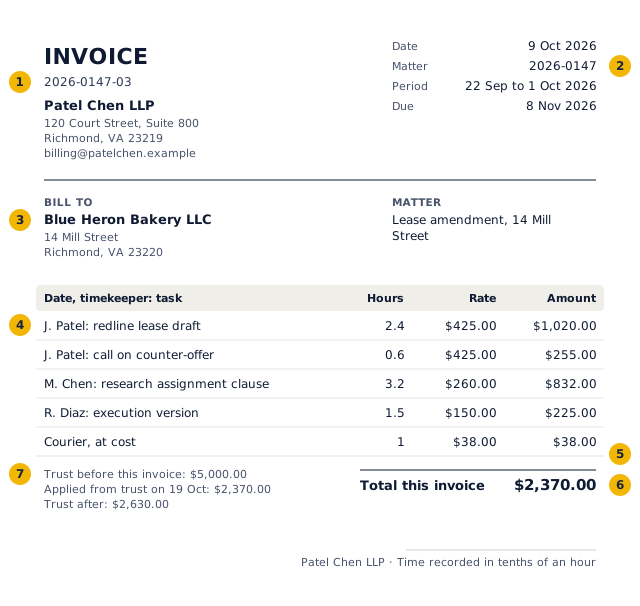
- Invoice number tied to the matter (matter 2026-0147, third bill), so every bill for the matter sorts together.
- Matter number and billing period: the client, the court or an auditor can check which work is covered.
- Client as named in the engagement letter, which may differ from who pays (an insurer, a parent company).
- Time entries: date, timekeeper, a task description specific enough to check, hours in tenths, and each timekeeper's rate as agreed in the engagement letter.
- Subtotal: fees $2,332.00 plus costs $38.00. Virginia does not tax legal services, so no tax line is added.
- Total this invoice, with costs billed at cost unless the client agreed otherwise.
- Trust account: balance before, amount to be applied and when, balance after.
The numbers: invoice 2026-0147-03
| Item | Qty | Rate | Amount | Tax |
|---|---|---|---|---|
| 22 Sep, J. Patel (partner): review landlord's draft lease amendment; prepare redline | 2.4 | $425.00 | $1,020.00 | $0.00 |
| 26 Sep, J. Patel (partner): call with client on landlord's counter-proposal | 0.6 | $425.00 | $255.00 | $0.00 |
| 29 Sep, M. Chen (associate): research enforceability of the assignment clause | 3.2 | $260.00 | $832.00 | $0.00 |
| 1 Oct, R. Diaz (paralegal): prepare execution version and signature pages | 1.5 | $150.00 | $225.00 | $0.00 |
| Costs: courier to landlord's counsel, at cost | 1 | $38.00 | $38.00 | $0.00 |
| Subtotal | $2,370.00 | $0.00 | ||
| Total | $2,370.00 | |||
Fees are $2,332.00 and costs $38.00, so the invoice totals $2,370.00. Legal services are not subject to sales tax in Virginia, so no tax is added. Because the engagement letter allows it, the firm will transfer $2,370.00 from trust to its operating account ten days after sending the invoice unless the client questions it, leaving $2,630.00 in trust.
How the hours were rounded
| Actual time | Recorded (tenths) | Why |
|---|---|---|
| 4 minutes | 0.1 | The minimum increment is 6 minutes |
| 20 minutes | 0.4 | 20 minutes is 0.33 hours, rounded up to the next tenth |
| 36 minutes | 0.6 | Exactly 6 tenths |
| 2 hours 20 minutes | 2.4 | 2.33 hours, rounded up to 2.4 |
| 1 hour 30 minutes | 1.5 | Exactly 15 tenths |
Rounding up to the next increment is common practice, not a rule; the engagement letter should say how time is rounded. What is not allowed is billing more time than was actually spent: ABA Formal Opinion 93-379 says a lawyer may not bill for hours not worked, and that when one piece of work benefits two clients the time is not billed twice.
What goes on a law firm invoice, field by field
| Field | What to enter | Why |
|---|---|---|
| Firm details | Firm name, address, phone, billing email; tax ID or VAT/GST number where required | Identifies who is billing and where to send payment |
| Client and matter | Client name, matter name and matter number, client reference or PO | One invoice per matter; corporate clients route bills by matter number |
| Invoice number and date | A unique number, often the matter number plus a sequence | Lets the client and the firm match payments and trust transfers |
| Billing period | First and last day of work covered | Prevents double billing across invoices |
| Time entries | Date, timekeeper (name and role), task description, hours, rate, amount | The core of the bill; the client checks each line |
| Flat fees | The fixed fee for a defined stage, with what it covers | Shows what was included; extra work is billed separately |
| Costs and disbursements | Filing fees, court reporters, experts, travel, couriers: each at cost with a date | Kept apart from fees; not part of the hourly charge |
| Fee and cost subtotals | Fees by timekeeper if the client asks; costs subtotal | Clients and insurers check rates and staffing |
| Trust or retainer | Balance before, amount applied, balance after | Required in practice by trust accounting rules; avoids disputes |
| Previous balance | Unpaid earlier invoices and payments received since | Shows the full account for the matter |
| Terms and payment | Due date, payment methods, interest on late payment if agreed | Must match the engagement letter |
Writing time entries that get paid
- Start with a verb and name the object: "Draft response to motion to compel", "Review landlord's redline of section 7".
- One task per entry with its own time. Block billing, several tasks under one time figure, is often cut or refused by courts reviewing fee petitions and by corporate billing guidelines.
- Name who you talked to and about what, without revealing privileged content: "Call with client re settlement range" is enough.
- Do not bill clerical work at a professional rate. Scheduling, copying and filing are usually overhead unless the client agreed otherwise.
- Show no-charge entries as 0.0 or "no charge" when you want the client to see the work was done.
Retainers and the client trust account (US)
ABA Model Rule 1.15(c) says a lawyer must deposit into a client trust account legal fees and expenses that have been paid in advance, to be withdrawn only as fees are earned or expenses incurred. Every state has its own version of the rule, so check your state's wording; the mechanics on the invoice are the same everywhere.
- Deposit the advance in trustThe $5,000.00 advance goes into the client trust account, not the operating account. It is still the client's money.
- Do the work and invoice itThe invoice records what was earned: $2,370.00 in fees and costs for the period.
- Tell the client before you take itSend the invoice with a clear statement that the amount will be paid from trust, and when. Many states require notice before or at the time of withdrawal.
- Transfer only the earned amountMove $2,370.00 from trust to operating. If the client disputes part of it, the disputed part stays in trust until resolved (Rule 1.15(e)).
- Show the balanceThe next invoice opens with the $2,630.00 left in trust. Unearned funds go back to the client when the matter ends (Rule 1.16(d)).
IOLTA accounts
IOLTA (Interest on Lawyers' Trust Accounts) is a pooled trust account for client funds that are too small or held too briefly to earn the client net interest. The bank pays the interest to the state's IOLTA program, which funds civil legal aid. Larger or longer-held sums go in a separate interest-bearing trust account for that client. Either way, the invoice shows the client's own balance, not the pooled account.
Evergreen retainers and flat fees
An evergreen retainer requires the client to top the trust balance back up to an agreed level after each invoice; the invoice then shows the replenishment requested. Flat fees paid up front are treated differently from state to state: some states let the lawyer treat a flat fee as earned on receipt if the agreement says so, others require it to stay in trust until earned in stages. Read your state's rule before you deposit one.
Hourly, flat, contingent and hybrid: how each is invoiced
| Fee basis | How the invoice looks | Watch for |
|---|---|---|
| Hourly | Time entries by timekeeper and rate, costs separately | Increments, rates and who may bill must be in the engagement letter |
| Flat (fixed) fee | One line per stage, e.g. "Will and power of attorney package", plus costs | Say what the fee covers and what is billed on top |
| Contingent | No running invoice; a closing statement when the matter is resolved | Rule 1.5(c): written agreement signed by the client; written statement at the end |
| Hybrid | Reduced hourly rate plus a success fee, or a flat fee per stage plus hourly for the rest | Each part follows its own rule |
| Subscription or monthly retainer | A fixed monthly fee for defined access, often billed by a recurring invoice | State bars differ on whether it is earned on receipt |
Under Model Rule 1.5(b) the scope of the representation and the basis or rate of the fee and expenses must be communicated to the client, preferably in writing, before or within a reasonable time after starting the work, and any change must be communicated too. Model Rule 1.5(c) requires a contingent fee agreement in writing, signed by the client, stating the percentages, which expenses are deducted from the recovery and whether before or after the fee is calculated. When the matter ends the lawyer gives the client a written statement of the outcome and, if there is a recovery, the remittance to the client and how it was worked out. Contingent fees are not allowed in criminal cases or for most domestic relations matters (Rule 1.5(d)).
A flat-fee invoice: estate planning package
| Item | Qty | Rate | Amount | Tax |
|---|---|---|---|---|
| Flat fee: revocable living trust, pour-over will, durable power of attorney and advance directive | 1 | $2,800.00 | $2,800.00 | $0.00 |
| Additional deed to fund trust, 22 Oak Lane, flat fee | 1 | $350.00 | $350.00 | $0.00 |
| Costs: county recording fee, at cost | 1 | $42.00 | $42.00 | $0.00 |
| Subtotal | $3,192.00 | $0.00 | ||
| Total | $3,192.00 | |||
The flat fee covers the documents named; the extra deed was agreed separately, and the recording fee is passed through at cost. The client owes $3,192.00.
Corporate clients: UTBMS codes and LEDES files
Companies and insurers that buy a lot of legal work often require e-billing: the firm uploads the invoice as a data file to the client's billing platform, where it is checked automatically against the client's billing guidelines. Two standards make that work.
- UTBMS (Uniform Task-Based Management System) codes classify each entry by phase, task and activity. The litigation code set groups tasks into phases such as L100 case assessment, development and administration, L200 pre-trial pleadings and motions, L300 discovery, L400 trial preparation and trial, and L500 appeal; activity codes (A101 plan and prepare, A102 research, A103 draft/revise, A104 review/analyze, and so on) say what kind of work was done; expense codes start with E.
- LEDES (Legal Electronic Data Exchange Standard) is the file format. LEDES 1998B, a pipe-delimited text file, is the most widely used; XML versions also exist. Each line carries the matter, timekeeper, date, hours, rate and the UTBMS codes.
This template produces a standard invoice, not a LEDES file. If a client requires e-billing, put the UTBMS task and activity codes at the start of each description (for example "L120 A104: review complaint") so the bill can be transferred to their system, and check their billing guidelines for rate caps, staffing limits and non-billable tasks.
UK and India: VAT, transparency and reverse charge
United Kingdom
A VAT-registered solicitor charges VAT at 20% on fees and on recharges of the firm's own costs (copying, travel, its own search costs). True disbursements, paid as the client's agent for something the client receives, such as a court fee or a search fee in the client's name, can be passed on outside VAT if they meet HMRC's conditions in VAT Notice 700, section 25. Show them as separate, untaxed lines.
The SRA Transparency Rules require firms that offer certain services to publish price information on their website, For individuals these are residential conveyancing, uncontested probate, immigration applications and First-tier Tribunal immigration appeals (excluding asylum), summary-only road traffic offences dealt with at a single hearing, and Employment Tribunal claims for unfair or wrongful dismissal; for businesses, defending those claims, debt recovery up to £100,000 and licensing applications for business premises. The invoice should match the published price basis and the client care letter. Client money is governed by the SRA Accounts Rules: before taking your fees from money held for the client, you must give the client a bill or other written notification of the costs (rule 4.3).
UK: fixed-fee conveyancing with a disbursement outside VAT
| Item | Qty | Rate | Amount | Tax |
|---|---|---|---|---|
| Legal fee: purchase of 14 Elm Road, fixed fee | 1 | £1,200.00 | £1,200.00 | £240.00 |
| Electronic identity check | 1 | £15.00 | £15.00 | £3.00 |
| Local authority search fee paid on your behalf (disbursement) | 1 | £150.00 | £150.00 | £0.00 |
| Subtotal | £1,365.00 | |||
| VAT 20% | £243.00 | |||
| Total | £1,608.00 | |||
VAT is charged on the fee and the ID check, not on the search fee paid as the client's agent. Search fees vary by council; the figure here is illustrative.
India
Legal services by an individual advocate or a firm of advocates to a business entity are taxed under reverse charge: the advocate does not charge GST, and the business client pays GST at 18% directly (Notification 13/2017-Central Tax (Rate)). Services to individuals for personal matters, and to business entities with turnover up to the registration threshold of the previous year, are exempt. Senior advocates are covered by the same reverse charge. The advocate's invoice therefore shows the fee without GST and a note that GST is payable by the recipient under reverse charge.
India: advocate's bill to a company (GST under reverse charge)
| Item | HSN/SAC | Qty | Rate | Taxable value | Tax |
|---|---|---|---|---|---|
| Drafting and vetting of supply agreement, fixed fee | 998212 | 1 | ₹45,000.00 | ₹45,000.00 | ₹0.00 |
| Court fee and stamp paper, at actuals | 1 | ₹1,200.00 | ₹1,200.00 | ₹0.00 | |
| Subtotal | ₹46,200.00 | ₹0.00 | |||
| Total | ₹46,200.00 | ||||
No GST appears on the advocate's bill. The company pays 18% GST on ₹45,000 under reverse charge and may claim it back as input tax credit if it uses the service for its business.
Bar Council of India rules bar advocates from soliciting work or advertising; websites may carry factual information such as name, contact details, enrolment and areas of practice. Keep the invoice factual too: no promotional text.
Mistakes to avoid on legal invoices
- Vague entries such as "attention to file" or "research". Clients cut what they cannot check.
- Block billing: several tasks under one time figure. Record each task with its own time.
- Billing more than the time spent, including minimum charges not in the engagement letter, or charging two clients for the same hour.
- Taking money from trust before the client has the invoice, or taking a disputed amount.
- Marking up costs without agreement. Pass disbursements through at cost unless the engagement letter says otherwise.
- Rate changes without notice. Model Rule 1.5(b) requires changes in the basis or rate to be communicated.
- Privileged detail in descriptions. Invoices can be produced in fee disputes or to third-party payers; describe the task, not the advice.
- Invoicing a contingency matter monthly. Track time if you need it for a fee petition, but the client's statement comes at the end.
Legal invoice vs pre-bill vs trust statement vs receipt
| Document | What it is | Who sees it | When |
|---|---|---|---|
| Pre-bill (draft bill) | Internal draft of the invoice for the responsible lawyer to review and write down | The firm only | Before the invoice is issued |
| Legal invoice | The bill for fees and costs on a matter for a period | The client | Monthly or at a stage |
| Trust account statement | Deposits, withdrawals and balance of the client's trust funds | The client, on request or periodically | With the invoice or on request (Rule 1.15(d)) |
| Closing (settlement) statement | How a recovery was divided: fee, costs, amount to the client | The client | At the end of a contingency matter |
| Receipt | Confirms payment received | The client | After payment |
Key terms
- Matter
- One piece of legal work for a client, with its own number, time records, trust ledger and invoices.
- Timekeeper
- Anyone whose time is billed: partner, associate, paralegal, each with an agreed rate.
- Block billing
- Several tasks recorded under one time figure; often reduced by courts and clients.
- Client trust account
- A bank account holding client money, such as advance fees, separately from the firm's own funds.
- IOLTA
- Interest on Lawyers' Trust Accounts: a pooled trust account whose interest funds legal aid.
- UTBMS
- Uniform Task-Based Management System: phase, task, activity and expense codes for legal bills.
- LEDES
- Legal Electronic Data Exchange Standard: the file format used to submit legal bills electronically.
Questions people ask
Why do lawyers bill in tenths of an hour?
A tenth (0.1) is six minutes, the usual minimum increment. A short email might be 0.1 and a 20-minute call 0.4, rounded up from 0.33. State your increment in the engagement letter so the client knows how time is rounded.
How should a retainer held in trust appear on the invoice?
Show the trust balance before the invoice, any amount applied to it and the balance remaining. Under the ABA Model Rules, which most states follow in some form, fees paid in advance stay in the client trust account and are withdrawn only as they are earned or expenses incurred. Follow your own state bar's rules on notice to the client before applying trust funds.
What are LEDES and UTBMS codes?
Corporate clients and insurers often require electronic bills in the LEDES file format, with each entry tagged by UTBMS task and activity codes. LuckPanda does not produce LEDES files; this template suits clients who accept a standard invoice.
Should costs be billed separately from fees?
Yes. Filing fees, court reporters, expert fees and couriers are passed through at cost unless the engagement letter says otherwise, and clients expect to see them apart from professional fees.
What is block billing?
Recording several tasks under one time figure, for example "research, draft motion, call client: 4.5". The client cannot tell how long each task took, so courts reviewing fee awards and corporate billing guidelines often reduce or reject it. Give each task its own entry.
Do lawyers send invoices on contingency cases?
Not as the case runs. The fee is a share of any recovery, set out in a written agreement signed by the client. At the end the lawyer gives a written statement showing the recovery, the fee, the expenses deducted and the amount paid to the client.
Can a law firm charge interest on unpaid invoices?
Usually yes, if the engagement letter says so and the rate is lawful in your state. Interest that was not agreed in advance is hard to justify. Show it on its own line.
What is an IOLTA account?
A pooled client trust account for small or short-term deposits whose interest goes to the state's IOLTA program to fund legal aid. Larger sums held for longer go in a separate interest-bearing trust account for that client.
Is sales tax charged on legal services?
In most US states, no. A few states tax some professional services, so check your state. In the UK, VAT at 20% applies to a registered firm's fees; in India, GST on legal services to businesses is usually paid by the client under reverse charge.
Should the invoice show work done for free?
It can. Listing no-charge entries shows the client the full effort on the matter and makes write-downs visible, which helps when the client compares bills.