 luckpanda
Quick answer
Invoice template for hours worked: what it is
An invoice is the request for payment you send after supplying goods or services. It records what was supplied, at what price and tax, and when payment is due. Timesheet-style lines: each day's start, finish and hours.
Last reviewed:
On this page
Example: a filled hours worked invoice
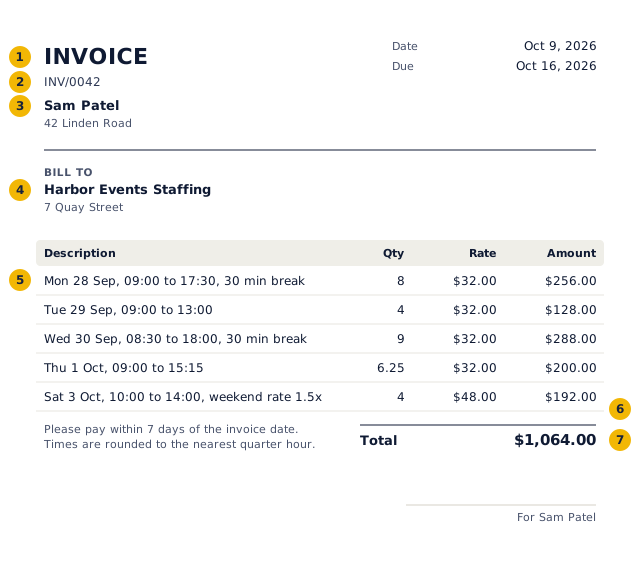
- The title says what the document is: an invoice.
- A unique number from a continuous series, allocated when you issue it.
- Your business name and address, and tax number if registered.
- Who it is for.
- Each line: description, quantity, rate and amount.
- Tax by rate.
- The total in the document's currency and format.
Worked example: the numbers behind the invoice above
| Item | Qty | Rate | Amount | Tax |
|---|---|---|---|---|
| Mon 28 Sep, 09:00 to 17:30, 30 min break | 8 | $32.00 | $256.00 | $0.00 |
| Tue 29 Sep, 09:00 to 13:00 | 4 | $32.00 | $128.00 | $0.00 |
| Wed 30 Sep, 08:30 to 18:00, 30 min break | 9 | $32.00 | $288.00 | $0.00 |
| Thu 1 Oct, 09:00 to 15:15 | 6.25 | $32.00 | $200.00 | $0.00 |
| Sat 3 Oct, 10:00 to 14:00, weekend rate 1.5x | 4 | $48.00 | $192.00 | $0.00 |
| Subtotal | $1,064.00 | $0.00 | ||
| Total | $1,064.00 | |||
No tax is charged on these lines, so the total equals the value of the supply.
How to fill in the hours worked invoice
- Enter your name and the client, plus any reference they gave you.
- Add one line per day: the date, start and finish times and the break.
- Enter the hours as a decimal and your rate; premium hours go on their own line.
- Save it, and get the hours approved if your agreement asks for sign-off.
Shifts in decimal hours
Those five shifts are the example in the editor: 27.25 hours at the standard rate and 4 weekend hours at time and a half.
| Shift | Unpaid break | Hours billed |
|---|---|---|
| 09:00 to 17:30 | 30 min | 8.0 |
| 09:00 to 13:00 | None | 4.0 |
| 08:30 to 18:00 | 30 min | 9.0 |
| 09:00 to 15:15 | None | 6.25 |
| 10:00 to 14:00, Saturday | None | 4.0 at 1.5x |
Getting hours approved
- Agree the rate, any overtime rule and the billing period before you start
- Record times daily, not from memory at the end of the week
- Round consistently, for example to the nearest quarter hour, and say so
- Ask who signs off hours and put their name or reference on the invoice
- Attach the signed timesheet if the client uses one
What to put on an invoice, field by field
| Field | What to enter |
|---|---|
| Document title | Say exactly what it is: "Invoice". The title tells the buyer and the tax authority how to treat it. |
| Number and date | A unique number in a continuous series and the issue date. LuckPanda allocates the number when you issue. |
| Your business | Name, address, and tax ID if your state or client needs it |
| Customer | Name, address, and tax ID if your state or client needs it |
| Lines | Description, quantity, unit and rate. Each line carries its own tax rate. |
| Tax | Sales tax where you must collect it, at the rate for the delivery address. |
| Totals | Taxable value, tax by component and the total, in the document currency. Amounts in words are customary in India. |
| Terms | Due date, bank or payment details and late-payment terms. |
United States rules for an invoice
- There is no federal invoice format. Include what your client's accounts payable needs to pay: your legal name, invoice number and date, what was supplied, amounts, due date and payment instructions.
- Sales tax is set by each state. Charge it only where you have nexus (a physical presence or, since 2018, economic nexus by sales volume) and the item is taxable; most services are exempt in many states.
- A business that pays a contractor $2,000 or more in a year (the threshold rose from $600 for payments made from 2026) reports it on Form 1099-NEC, so expect your client to ask for a W-9.
Mistakes to avoid
- Editing or deleting an issued invoice instead of issuing a credit note.
- Gaps or duplicates in the number series.
- Charging the wrong tax type (for India: IGST on an intra-state sale, or CGST and SGST across states).
- Leaving out the due date and payment details, which is the commonest reason invoices are paid late.
- Rounding each line's tax differently from the total; LuckPanda computes tax per line and keeps the components adding up.
Invoice vs other sales documents
| Document | When | Asks for payment | Tax document | In the books |
|---|---|---|---|---|
| Quotation / estimate | Before the order | No | No | No |
| Proforma invoice | After the order, before supply | Advance only | No | No |
| Invoice / tax invoice | On supply | Yes | Yes | Yes: sale and receivable |
| Receipt | When paid | No, confirms payment | No (receipt voucher for advances in India) | Yes: payment |
| Credit note | After an invoice, to reduce it | No, reduces what is owed | Yes | Yes: reverses part of the sale |
Questions people ask
How do I turn clock times into hours?
Take the finish time minus the start time, subtract unpaid breaks, and turn leftover minutes into a decimal by dividing by 60. 08:45 to 17:15 with a 30-minute break is 8 hours; 09:00 to 15:15 is 6.25.
Should I invoice weekly or monthly?
Weekly suits short engagements and temp work, and keeps each invoice small enough to check quickly. Monthly is fine for steady part-time work if the client agrees.
How do I show overtime or weekend rates?
Put premium hours on separate lines with the higher rate and say why, such as "Saturday, 1.5x rate". Folding them into one line at a blended rate makes the invoice hard to check.
How is this different from an hourly invoice?
An hourly invoice usually groups time by week or task. This layout lists every working day, which suits clients who sign off timesheets or pay by the shift.