 luckpanda
Quick answer
Freelance invoice template: what it is
An invoice is the request for payment you send after supplying goods or services. It records what was supplied, at what price and tax, and when payment is due. Project, day or hourly billing for freelancers.
Last reviewed:
On this page
Example: a filled freelance invoice
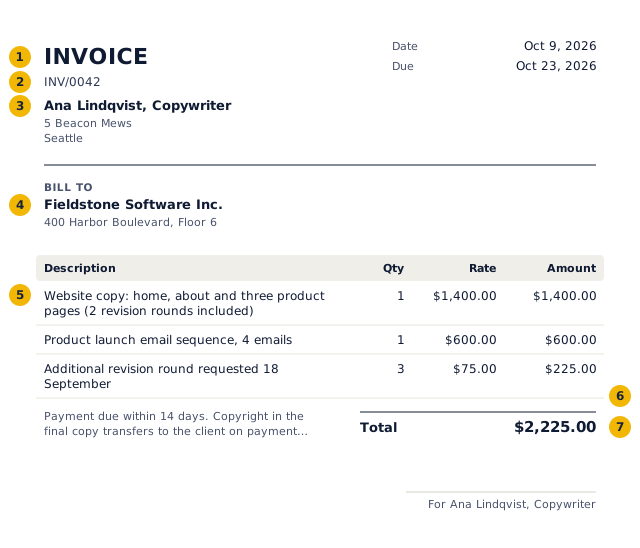
- The title says what the document is: an invoice.
- A unique number from a continuous series, allocated when you issue it.
- Your business name and address, and tax number if registered.
- Who it is for.
- Each line: description, quantity, rate and amount.
- Tax by rate.
- The total in the document's currency and format.
Worked example: the numbers behind the invoice above
| Item | Qty | Rate | Amount | Tax |
|---|---|---|---|---|
| Website copy: home, about and three product pages (2 revision rounds included) | 1 | $1,400.00 | $1,400.00 | $0.00 |
| Product launch email sequence, 4 emails | 1 | $600.00 | $600.00 | $0.00 |
| Additional revision round requested 18 September | 3 | $75.00 | $225.00 | $0.00 |
| Subtotal | $2,225.00 | $0.00 | ||
| Total | $2,225.00 | |||
No tax is charged on these lines, so the total equals the value of the supply.
How to fill in the freelance invoice
- Add your name or trading name and the client's billing contact.
- Bill by project, day or hour, one line per deliverable.
- Note usage rights and any deposit already agreed in the terms.
- Save it, and sign in to send it with a payment link.
Project, day rate or hourly?
| Billing method | Suits | On the invoice |
|---|---|---|
| Project fee | Defined deliverables | One line per milestone, with the agreed fee |
| Day rate | Embedded or on-site work | Days worked and their dates |
| Hourly | Open-ended or support work | Hours per task, from your time log |
Terms worth putting on every freelance invoice
- The due date as a date, with "Net 14" or "Net 30" if you like
- How to pay: bank details or a payment link
- What the fee covered, such as two rounds of revisions
- When usage rights or ownership pass to the client, often on payment in full
- Your late-payment policy, matching your contract
What to put on an invoice, field by field
| Field | What to enter |
|---|---|
| Document title | Say exactly what it is: "Invoice". The title tells the buyer and the tax authority how to treat it. |
| Number and date | A unique number in a continuous series and the issue date. LuckPanda allocates the number when you issue. |
| Your business | Name, address, and tax ID if your state or client needs it |
| Customer | Name, address, and tax ID if your state or client needs it |
| Lines | Description, quantity, unit and rate. Each line carries its own tax rate. |
| Tax | Sales tax where you must collect it, at the rate for the delivery address. |
| Totals | Taxable value, tax by component and the total, in the document currency. Amounts in words are customary in India. |
| Terms | Due date, bank or payment details and late-payment terms. |
United States rules for an invoice
- There is no federal invoice format. Include what your client's accounts payable needs to pay: your legal name, invoice number and date, what was supplied, amounts, due date and payment instructions.
- Sales tax is set by each state. Charge it only where you have nexus (a physical presence or, since 2018, economic nexus by sales volume) and the item is taxable; most services are exempt in many states.
- A business that pays a contractor $2,000 or more in a year (the threshold rose from $600 for payments made from 2026) reports it on Form 1099-NEC, so expect your client to ask for a W-9.
Mistakes to avoid
- Editing or deleting an issued invoice instead of issuing a credit note.
- Gaps or duplicates in the number series.
- Charging the wrong tax type (for India: IGST on an intra-state sale, or CGST and SGST across states).
- Leaving out the due date and payment details, which is the commonest reason invoices are paid late.
- Rounding each line's tax differently from the total; LuckPanda computes tax per line and keeps the components adding up.
Invoice vs other sales documents
| Document | When | Asks for payment | Tax document | In the books |
|---|---|---|---|---|
| Quotation / estimate | Before the order | No | No | No |
| Proforma invoice | After the order, before supply | Advance only | No | No |
| Invoice / tax invoice | On supply | Yes | Yes | Yes: sale and receivable |
| Receipt | When paid | No, confirms payment | No (receipt voucher for advances in India) | Yes: payment |
| Credit note | After an invoice, to reduce it | No, reduces what is owed | Yes | Yes: reverses part of the sale |
Questions people ask
Should freelancers ask for a deposit?
For new clients and projects of more than a few days, a deposit of 25 to 50% is common. Invoice it at the start and deduct it on the final invoice.
What can I do if a client pays late?
Send a reminder on the due date and again a week later. In the UK the Late Payment of Commercial Debts (Interest) Act lets you claim interest at 8% over the Bank of England base rate, plus fixed compensation, on business invoices. In the US, late fees should be agreed in your contract.
Do I charge VAT or sales tax as a freelancer?
In the UK only once you are VAT registered, which is compulsory above £90,000 of taxable turnover. In the US most freelance services are not subject to sales tax, though some states tax certain digital and design services.
Can I invoice a client in another currency?
Yes. Pick the client's currency; amounts are formatted the way that currency is written.