 luckpanda
Quick answer
What is the format of a construction bill in India?
A construction bill in India is usually a running account (RA) bill: a GST tax invoice for the work measured since the last bill, item by item from the bill of quantities, at the agreed rates. It shows quantities up to the previous bill, in this bill and up to date from the measurement book, works contract GST at 18%, and the deductions the client makes when paying: retention, advance recovery and TDS.
- Each RA bill charges only the quantity executed since the previous bill, at the BOQ rate.
- Works contract services (SAC 9954) are taxed at 18% GST; the place of supply is where the building is.
- GST is charged on the full bill value; retention held back does not reduce it.
- The client deducts income-tax TDS at 1% or 2%; government clients also deduct 2% GST TDS.
Last reviewed:
On this page
- What a construction bill (RA bill) is
- How to fill in this construction bill format
- Example: RA bill no. 3 for a residential building
- From bill total to amount paid: retention, advances and TDS
- GST on construction bills: works contract rates in 2026
- What goes on a construction bill, field by field
- Extra items, escalation and the final bill
- Outside India: progress billing, retainage, CIS and the reverse charge
- Mistakes to avoid
- RA bill vs final bill vs estimate vs labour bill vs progress invoice
- Key terms
- Questions people ask
What a construction bill (RA bill) is
Building work takes months, so contractors are paid as it goes. Under an item-rate contract the client agrees a bill of quantities (BOQ): every item of work (excavation, PCC, RCC, brickwork, plaster, flooring) with its unit and rate. Each month or at agreed stages the contractor and the client's engineer measure what has been built and record it in the measurement book (MB). The contractor then raises a running account bill: the up-to-date quantity of each item, less what was billed before, times the BOQ rate.
The last bill, raised when the work is complete and finally measured, is the final bill. It settles the account: any quantity variations, extra items and escalation are adjusted, and the retention held back is released after the defect liability period.
| Contract type | How bills are worked out | Common in |
|---|---|---|
| Item-rate (BOQ) contract | Measured quantity × BOQ rate, item by item | Government (CPWD, PWD) and most private buildings |
| Lump-sum contract | Agreed percentage of the price at each stage: plinth, slabs, brickwork, finishing | Houses, turnkey jobs |
| Percentage-rate contract | Schedule rates plus or minus the quoted percentage | Government works based on a schedule of rates |
| Labour-only (rate) contract | Area or quantity × labour rate; client supplies materials | Individual owners; see the labour bill |
| Cost-plus contract | Actual cost plus an agreed fee | Private owners with changing scope |
How to fill in this construction bill format
- Add the contractor and the clientEnter the contractor's name, address and GSTIN, and the client with its GSTIN. Both in the state of the site gives CGST and SGST.
- Reference the work order and RA billIn the notes, give the work order number, RA bill number, measurement period and measurement book pages.
- Bill each BOQ item for this bill's quantityOne line per item: BOQ number and description, the quantity executed since the last bill, the BOQ rate, and SAC 9954. Put the up-to-date and previous quantities in the description.
- Apply works contract GSTSet GST at 18%. Add approved extra items and escalation as separate lines at the same rate.
- Note deductions and termsIn the notes and terms, state the retention rate, advance recovery and TDS the client will deduct, and the payment period after certification.
- Sign in to issueSign in to give the bill the next number in your GST series, keep all RA bills for the work order together and record each net payment with its TDS. Issuing needs the Sales module.
Example: RA bill no. 3 for a residential building
Kaveri Constructions is building a residential block in Hebbal, Bengaluru, for Hebbal Homes LLP under work order HH/WO/2026/07. In September the second-floor slab was cast, brickwork continued and internal plaster started. The engineer-in-charge recorded the measurements on MB pages 41 to 48, and Kaveri raised RA bill no. 3.
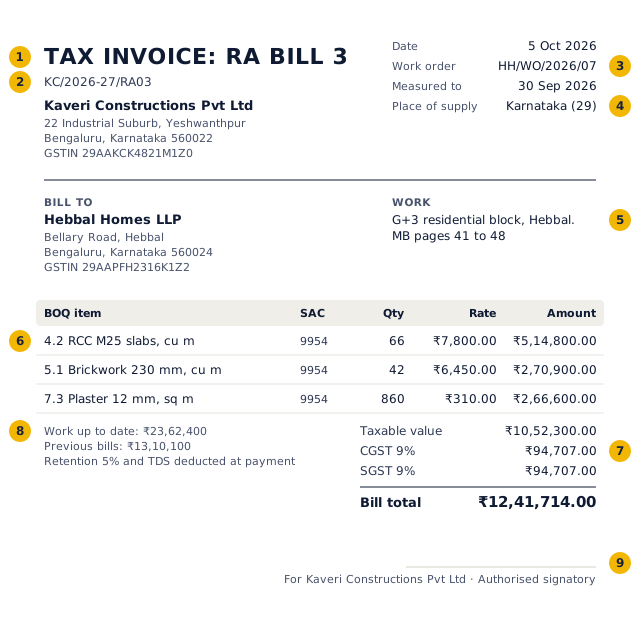
- Tax invoice with the RA bill number: the RA bill is the GST invoice for the stage, not a separate document.
- Invoice number in the contractor's GST series, at most 16 characters, unique for the financial year.
- Work order and measurement date: which contract and up to when the work was measured.
- Place of supply: the location of the building (section 12(3) IGST Act), so CGST and SGST of Karnataka.
- Site and MB reference: lets the engineer trace each quantity to the measurement book.
- BOQ items with SAC 9954, quantity this bill and BOQ rate. Up-to-date and previous quantities go in the description or an abstract.
- Works contract GST at 18%, split into CGST 9% and SGST 9% because contractor, client and site are in one state.
- Cumulative values and deductions: what has been billed in total, and what the client will deduct.
- Signature of the contractor; the client's engineer certifies the bill separately.
The numbers: RA bill no. 3
| Item | HSN/SAC | Qty | Rate | Taxable value | Tax |
|---|---|---|---|---|---|
| BOQ 4.2: RCC M25 in slabs and beams, 2nd floor, per cu m (up to date 186, previous 120) | 9954 | 66 | ₹7,800.00 | ₹5,14,800.00 | ₹92,664.00 |
| BOQ 5.1: brickwork in CM 1:6, 230 mm, per cu m (up to date 100, previous 58) | 9954 | 42 | ₹6,450.00 | ₹2,70,900.00 | ₹48,762.00 |
| BOQ 7.3: internal plaster 12 mm, ground and 1st floor, per sq m | 9954 | 860 | ₹310.00 | ₹2,66,600.00 | ₹47,988.00 |
| Taxable value | ₹10,52,300.00 | ||||
| CGST 9% | ₹94,707.00 | ||||
| SGST 9% | ₹94,707.00 | ||||
| Total | ₹12,41,714.00 | ||||
The gross value of work this bill is ₹10,52,300. GST at 18% adds ₹1,89,414 (CGST ₹94,707 and SGST ₹94,707), so the bill total is ₹12,41,714.
The RA bill abstract: previous, this bill, up to date
Clients and their engineers check an RA bill against an abstract that carries every BOQ item forward from bill to bill. Only the "this bill" column is charged; the up-to-date column must agree with the measurement book.
| BOQ item | Rate (₹) | Qty previous | Qty this bill | Qty to date | This bill (₹) | To date (₹) |
|---|---|---|---|---|---|---|
| 4.2 RCC, cu m | 7,800 | 120 | 66 | 186 | 5,14,800 | 14,50,800 |
| 5.1 Brickwork, cu m | 6,450 | 58 | 42 | 100 | 2,70,900 | 6,45,000 |
| 7.3 Plaster, sq m | 310 | 0 | 860 | 860 | 2,66,600 | 2,66,600 |
| Total | 10,52,300 | 23,62,400 |
The previous bills totalled ₹13,10,100 of work (₹23,62,400 less ₹10,52,300). Showing both totals lets the client confirm that nothing has been billed twice and that the work done so far stays within the contract value.
From bill total to amount paid: retention, advances and TDS
The contractor bills the full amount; the client pays it less the deductions in the contract and the law. For RA bill no. 3 from a private developer:
| Line | Basis | Amount (₹) |
|---|---|---|
| Bill total | Gross work value ₹10,52,300 + GST ₹1,89,414 | 12,41,714 |
| Less retention money | 5% of gross work value | 52,615 |
| Less income-tax TDS | 2% of gross work value, excluding GST (contractor is a company) | 21,046 |
| Net paid to the contractor | 11,68,053 |
If the same bill went to a government department, two more deductions would apply: GST TDS at 2% of the value excluding GST (₹21,046) and, commonly, the construction workers' welfare cess at 1% of the cost of construction (₹10,523). The net payment would fall to ₹11,36,484.
Retention money and security deposit
Retention, typically 5 to 10% of each bill, is the client's security for defects. It is released after the defect liability period, commonly 12 months from completion, or earlier against a bank guarantee. CPWD contracts deduct a security deposit of 2.5% of the gross amount of each running and final bill until 2.5% of the tendered value is held. GST is charged on the full bill value, because the retention is part of the price that is only paid later; no fresh invoice or GST is needed when it is released.
Mobilisation and secured advances
Many contracts pay a mobilisation advance at the start, against a bank guarantee, and recover it from the RA bills. Under CPWD's general conditions, for example, the advance may be up to 10% of the tendered value, carries simple interest at 10% a year, and is recovered from the bills starting after the first 10% of the work is done, so that it is fully recovered by the time 80% is done. A secured advance against materials brought to site is recovered as the materials are used. GST is due on an advance for services when it is received (section 13), against a receipt voucher, so the later RA bills adjust the tax already paid; the recovery itself is a payment deduction, not a reduction of the bill.
Income-tax TDS on contractor payments
From 1 April 2026 TDS on payments to contractors is governed by section 393(1) of the Income-tax Act, 2025 (the table entry for sums paid for carrying out any work, including supply of labour, under a contract), which replaces section 194C of the 1961 Act. The rates are unchanged: 1% if the contractor is an individual or HUF, 2% for others. No TDS is needed if a single payment is up to ₹30,000 and the year's total is up to ₹1,00,000. Where GST is shown separately on the bill, TDS is usually worked out on the value excluding GST, as CBDT Circular 23/2017 allowed under the old Act.
GST TDS and the construction cess
Government departments, local authorities and governmental agencies deduct GST TDS under section 51 of the CGST Act at 2% (1% CGST plus 1% SGST, or 2% IGST) where the value of supply under the contract exceeds ₹2,50,000; the contractor claims it in the electronic cash ledger. The building and other construction workers' welfare cess of 1% of the cost of construction, long levied under the 1996 Cess Act, is now levied under the Code on Social Security, 2020, at the same 1% rate; government clients usually deduct it from each bill.
GST on construction bills: works contract rates in 2026
A contract to build, repair, renovate or fit out immovable property in which goods pass to the client in the course of the work is a works contract (section 2(119) of the CGST Act). It is treated as a supply of services, classified under heading 9954 (construction services), and billed on a tax invoice. The place of supply is where the property is (section 12(3) of the IGST Act).
| Supply | GST rate from 22 September 2025 | Notes |
|---|---|---|
| Composite works contract, general (private buildings, factories, commercial) | 18% | Item (xii) of serial 3, Notification 11/2017-CT(Rate) |
| Works contracts for the Central or a State Government, local authority or governmental authority | 18% | The concessional 12% entries were omitted from 18 July 2022 |
| Government works contracts of mainly earthwork, offshore oil and gas works, and sub-contracts for them | 18% | Were 12%; raised to 18% from 22 September 2025 (Notification 15/2025-CT(Rate)) |
| Sale of an affordable residential apartment by a developer | 1% effective, no ITC | Developer's rate to the buyer, not the contractor's |
| Sale of other residential apartments by a developer | 5% effective, no ITC | Developer's rate to the buyer |
| Pure labour contract | 18% | Unless a specific exemption applies (for example, some single residential units) |
In short: after GST 2.0 a contractor's works contract bill carries 18% almost everywhere. The 1% and 5% rates that people quote for housing are the developer's rates on selling apartments; a contractor building for that developer still bills 18%, and the developer cannot claim that GST as input tax credit because its own sale is without ITC.
When the invoice is due
A contract longer than three months with periodic payments is a continuous supply of services. Under section 31(5) of the CGST Act, where payment is linked to completing an event, such as a stage or a certified RA bill, the invoice is due on or before the date the event is completed; where the contract fixes due dates, on or before each due date. So the RA bill is the tax invoice, raised with the measurement, not after the client pays.
Input tax credit for the client
A client who takes a works contract to construct its own building (other than plant and machinery) cannot claim the GST as input tax credit (section 17(5)(c)). A main contractor who uses a sub-contractor's works contract for its own works contract supply can. That is why the client's GSTIN and the purpose matter less to the contractor's bill than to the client's books: the contractor charges 18% either way.
What goes on a construction bill, field by field
| Field | What to enter | Why |
|---|---|---|
| Title | "Tax invoice" with "RA bill no. 3" or "Final bill" | GST needs a tax invoice; the RA number tracks the stage |
| Invoice number and date | Next number in the contractor's GST series, up to 16 characters | Rule 46 of the CGST Rules |
| Contractor | Name, address, GSTIN, PAN | Needed for GST, TDS and the client's vendor records |
| Client | Name, address, GSTIN | The client claims or records GST against it |
| Work order | Number and date of the work order or agreement | Links the bill to the agreed rates |
| Site and period | Project, site address, measurement period or date | Place of supply and the scope of this bill |
| MB reference | Measurement book number and pages | Lets the engineer check every quantity |
| BOQ items | Item number, description, unit, SAC 9954 | Must match the BOQ wording |
| Quantities | Up to previous bill, this bill, up to date | Only "this bill" is charged |
| Rate and amount | BOQ rate × quantity this bill | The taxable value |
| Extra and substituted items | Separately, with the approval reference and rate | Not in the BOQ, so they need sanction |
| GST | CGST + SGST (same state as the site) or IGST at 18% | Works contract rate |
| Deductions (memo) | Retention, advance recovery, TDS, GST TDS, cess | Shows the expected net payment |
| Signature and certification | Contractor's signature; space for the engineer's certificate | The client pays against the certified bill |
Extra items, escalation and the final bill
- Deviations. Quantities above the BOQ quantity beyond the deviation limit in the contract are often paid at a revised rate; bill them as separate lines with the approval reference.
- Extra and substituted items. Work not in the BOQ is billed only after the client approves the item and its rate. Until then, keep it out of the RA bill.
- Escalation. Contracts with a price variation clause (for example, CPWD clause 10CC) adjust for changes in material and labour indices. The escalation is worked out separately and billed with GST at the works contract rate, because it is part of the consideration for the same supply.
- Part rates. Work partly done (shuttering fixed but concrete not poured) may be paid at a part rate the engineer allows; the balance is paid when the item is complete.
- Final bill. Measures the whole work, adjusts all quantities and pays the balance. Retention is released by a separate payment after the defect liability period, with no fresh GST invoice.
Outside India: progress billing, retainage, CIS and the reverse charge
United States. The same idea is called progress billing: each invoice bills the share of a schedule of values completed this period, with retainage (commonly 5 to 10%) held back until completion, and lien waivers exchanged for payments. Commercial jobs often use AIA G702/G703-style pay applications. The construction invoice template covers US progress billing, retainage caps, lien waivers and state sales tax in depth.
United Kingdom. Under the Construction Industry Scheme (CIS) the contractor deducts tax from a subcontractor's payments: 20% if the subcontractor is registered, 30% if not, 0% with gross payment status. The deduction is worked out on the invoice total less VAT and less materials, plant hire, fuel and consumables the subcontractor paid for, in practice the labour element, so a subcontractor's invoice should show labour and materials separately. Since 1 March 2021 the VAT domestic reverse charge applies to standard- and reduced-rated building services reported under CIS between VAT-registered businesses: the subcontractor's invoice shows the VAT rate and the words "Customer to pay the VAT to HMRC", and the customer accounts for the VAT. It does not apply when the customer is an end user, such as a homeowner or a developer that confirms in writing it is an end user.
UK subcontractor invoice under the domestic reverse charge (VAT shown for reference only)
| Item | Qty | Rate | Amount | Tax |
|---|---|---|---|---|
| Labour: first-fix carpentry, plots 12 to 15, September 2026 | 1 | £6,400.00 | £6,400.00 | £0.00 |
| Materials: timber and fixings, as itemised | 1 | £1,850.00 | £1,850.00 | £0.00 |
| Subtotal | £8,250.00 | £0.00 | ||
| Total | £8,250.00 | |||
The invoice shows £8,250.00 net. Under the reverse charge the main contractor, not the subcontractor, accounts for the 20% VAT (£1,650.00) to HMRC. The main contractor deducts CIS at 20% on the labour of £6,400.00, that is £1,280.00, and pays the subcontractor £6,970.00.
Mistakes to avoid
- Billing the up-to-date quantity again instead of only the quantity since the last bill.
- Quantities that do not agree with the measurement book. The bill will not be certified.
- Charging 12% or 5% GST on a government or housing works contract out of habit. Since 22 September 2025 a contractor's works contract bill is 18% in almost every case.
- Charging GST only on the net amount after retention. GST is due on the full value; retention is a payment deduction.
- Raising the GST invoice only when paid. For stage payments the invoice is due when the stage is complete.
- Billing extra items before approval. They are disputed and delay the whole bill.
- Ignoring advance recovery and TDS when forecasting cash: the net payment can be 10 to 20% below the bill total.
RA bill vs final bill vs estimate vs labour bill vs progress invoice
| Estimate or BOQ | RA bill | Final bill | Labour bill | US progress invoice | |
|---|---|---|---|---|---|
| Purpose | Prices the work before the contract | Interim bill for work measured so far | Settles the whole contract | Bills labour only; client supplies material | Interim bill against a schedule of values |
| Based on | Drawings and rates | Measurement book and BOQ rates | Final measurement, deviations, escalation | Area or days × labour rate | Percent complete per line |
| Tax | None | GST 18% on the bill | GST 18% on the balance | GST 18% if registered | State sales tax rules |
| Held back | Not applicable | Retention, TDS, advance recovery | Retention released later | TDS | Retainage |
Key terms
- RA bill
- Running account bill: an interim bill for work measured since the previous bill.
- BOQ
- Bill of quantities: the contract list of work items with units, quantities and rates.
- Measurement book (MB)
- The engineer's record of measured work from which bills are prepared.
- Works contract
- A contract to build or repair immovable property in which goods pass in the course of the work; a service under GST.
- Retention money
- Part of each bill held back by the client until the defect liability period ends.
- Mobilisation advance
- An advance paid at the start of a contract and recovered from later bills.
- Defect liability period
- The period after completion in which the contractor must fix defects at its own cost.
Questions people ask
What is an RA bill?
A running account bill is an interim bill raised during the contract for work done so far. For every BOQ item it shows the quantity up to the previous bill, in this bill and up to date, taken from the measurement book. The final bill settles the account at completion.
What GST applies to a construction contract?
A contract that supplies both materials and labour to build, repair or fit out immovable property is a works contract, treated as a supply of services and taxed at 18%. The concessional rates for government works were withdrawn in 2022 and the last 12% entries moved to 18% from 22 September 2025; the 1% and 5% housing rates apply to developers selling apartments, not to contractors' bills.
When must the GST invoice be issued for an RA bill?
A contract paid in stages is a continuous supply of services, so the invoice is due on or before the date each payment milestone is completed, normally when the RA bill is certified. GST is charged on the full bill value; retention held back by the client does not reduce it.
What does the client deduct from an RA bill?
Commonly retention money, recovery of any mobilisation advance, and income-tax TDS at 1% (individuals and HUFs) or 2% (others) on the value excluding GST, now under section 393 of the Income-tax Act, 2025. Government departments also deduct GST TDS at 2% and usually the 1% construction workers' welfare cess.
What is a measurement book?
The record, kept by the client's engineer, of every measurement of work done: date, location, dimensions and quantity for each BOQ item. RA bills are prepared from it and certified against it.
What is the difference between an RA bill and a final bill?
An RA bill is an interim payment for work measured so far. The final bill is raised after completion and final measurement; it adjusts all quantities, extra items and escalation and closes the account. Retention is released later, after the defect liability period.
Is GST payable on a mobilisation advance?
Yes. For services, GST is due when an advance is received, against a receipt voucher. The tax is adjusted in the RA bills as the advance is recovered.
What is the TDS rate on contractor bills from April 2026?
1% if the contractor is an individual or HUF and 2% for others, under section 393 of the Income-tax Act, 2025, with no deduction where a single payment is up to ₹30,000 and the year's total up to ₹1,00,000.
Can I make a construction bill in Excel or Word?
Yes, and many contractors do. The risk is formulas that carry the wrong previous quantity or GST split. This format computes each line and the CGST/SGST or IGST split from the two GSTINs; signing in keeps every RA bill for the work order in one series.
What is retention money in construction?
A percentage of each bill, typically 5 to 10%, held by the client as security for defects and released after the defect liability period, commonly 12 months from completion.