 luckpanda
Quick answer
What should a photography invoice include?
A photography invoice bills your time and the right to use the pictures as separate lines: the session or day fee, editing and retouching, any prints or albums, expenses such as travel, and a usage licence that names the media, duration and territory. It also shows any retainer already paid, the balance due, when files are delivered and that copyright stays with you unless transferred in writing.
- Put the usage licence on its own line: in some US states it keeps that part out of sales tax.
- Prints and albums are taxable in most US states; digital-only delivery is taxed in some (North Carolina) and not in others (California, New York).
- In the US and UK the photographer owns the copyright by default; in India the paying client does unless the contract says otherwise.
- Deliver final files and start the licence on payment in full.
Last reviewed:
On this page
- What a photography invoice bills
- How to fill in this photography invoice template
- Example: a commercial shoot for a coffee roaster
- Writing the usage licence line
- Retainers, balances, kill fees and expenses
- Sales tax on photography in the US: prints vs digital files
- UK and India: VAT, GST and who owns the photos
- Wedding, portrait, commercial, real estate and stock: what changes
- Mistakes to avoid
- Photography invoice vs quote vs contract vs licence agreement
- Key terms
- Questions people ask
What a photography invoice bills
A photography job sells two different things. One is work: planning, shooting, travel, editing, printing. The other is permission: the right to use the images for agreed purposes. Clients often assume that paying for the shoot means they own the pictures outright. Billing the two separately, and naming the licence, is how you avoid that argument months later when the photo turns up on a billboard.
| Line | Typical wording | How it is priced |
|---|---|---|
| Creative or session fee | Half-day commercial shoot, 4 hours, 9 October | Per hour, half day or day |
| Pre-production | Location scouting, casting, shot list | Per hour or flat |
| Post-production | Retouching, 40 selected images | Per image or per hour |
| Usage licence | Website, social and printed menus, 2 years, US | By media, duration, territory and exclusivity |
| Products | 30-page lay-flat album; 3 framed prints 16 x 20 in | Per item |
| Crew and rentals | Second shooter, assistant, studio hire, lighting | Per day or at cost |
| Expenses | Mileage, parking, props, permits | At cost or at an agreed rate |
How to fill in this photography invoice template
- Add your business and the clientEnter your studio or trading name and the client, with the shoot date and location in the first line or the notes.
- Bill time, editing and products separatelyOne line for the session or day fee, one for retouching (per image or per hour), one per product such as an album or prints, and one per expense.
- Add the usage licenceA separate line naming the media, duration, territory and exclusivity, priced on its own.
- Set tax per lineApply your state's rate to the lines it taxes (prints, and in some states digital files and session fees). In the UK add VAT at 20% if registered; in India use the SAC for the genre and 18% GST.
- State delivery, copyright and retainerIn the terms: files delivered on payment, the licence start date, who owns the copyright, and any retainer already paid.
- Sign in to issueSign in to number the invoice, keep it on the client's account and collect the balance with a payment link. Issuing, sending and payment links need the Sales module.
Example: a commercial shoot for a coffee roaster
Juniper Lane Photography in Asheville, North Carolina, photographs Copper Kettle Coffee Roasters' new roastery for a half day, retouches 40 images and licenses them for the client's website, social media and printed menus for two years. The files are delivered through an online gallery once the invoice is paid.
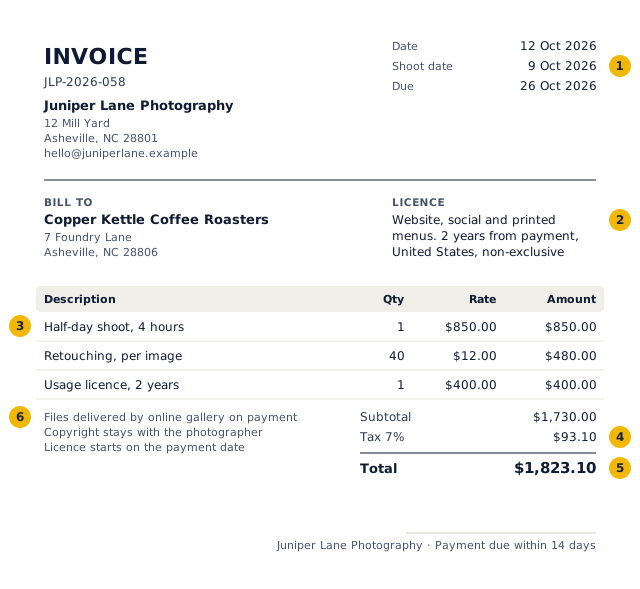
- Shoot date (and location): ties the invoice to the job and to the tax rate where the photos are delivered.
- Licence summary: media, duration, territory, exclusivity. The full terms live in the contract.
- Creative fee and post-production as separate lines, so the client sees time and editing apart.
- Sales tax per line: taxable on the photographs and the work that produces them; not on the separately stated licence in North Carolina.
- Total due, with any retainer already paid shown in the notes or as a payment.
- Delivery, copyright and licence start: files on payment; licence from the payment date.
The numbers: invoice JLP-2026-058 (Buncombe County, 7%)
| Item | Qty | Rate | Amount | Tax |
|---|---|---|---|---|
| Half-day commercial shoot at the roastery, 9 October (4 hours) | 1 | $850.00 | $850.00 | $59.50 |
| Retouching and colour grading, per selected image | 40 | $12.00 | $480.00 | $33.60 |
| Usage licence: website, social media and printed menus, 2 years (separately stated) | 1 | $400.00 | $400.00 | $0.00 |
| Subtotal | $1,730.00 | |||
| Tax 7% | $93.10 | |||
| Total | $1,823.10 | |||
Tax of $93.10 applies to the shoot and retouching ($1,330.00); the $400.00 licence fee is separately stated and not taxed, so the client owes $1,823.10. Had the licence been folded into the session fee, the whole $1,730.00 would have been taxable.
Writing the usage licence line
A usage licence is permission to use the images in defined ways. It does not transfer copyright. Four things define it, and each one changes the price:
| Term | Narrow (cheaper) | Broad (dearer) |
|---|---|---|
| Media | Website and social media | All media, including print, outdoor and broadcast |
| Duration | 1 year | Unlimited (perpetual) |
| Territory | One country or region | Worldwide |
| Exclusivity | Non-exclusive: you may license the images to others | Exclusive: only this client may use them for the term |
On the invoice, a one-line summary is enough ("Usage licence: website, social and printed menus, 2 years from payment, United States, non-exclusive"), with "as set out in the agreement dated …" for the detail. Say when the licence starts: tying it to payment in full gives you leverage on late payers. A buyout usually means an unlimited licence, not a copyright transfer; if the client wants the copyright, that is an assignment in a signed document, priced accordingly.
Retainers, balances, kill fees and expenses
- Booking retainer. Wedding and event photographers commonly take 25 to 50% when the date is booked, to hold it. Invoice it as its own invoice, or show it as a payment against the package invoice. Whether it is refundable is a contract term; say so.
- Balance. For weddings and events, usually due 14 to 30 days before the date; for commercial work, on delivery or within 14 to 30 days.
- Cancellation or kill fee. Charged when the client cancels after booking. Professional terms vary: the ASMP's sample commercial terms, for example, make the client liable for fees and expenses incurred plus 50% of the photographer's fee, rising to 100% with less than two business days' notice. Invoice it on its own line, citing the clause.
- Weather days and reshoots. Bill a weather-delay fee or a reshoot only if the agreement provides for it.
- Expenses. Itemize them (mileage, parking, studio hire, props, permits). In California, travel, equipment rental and assistants' wages are part of the taxable charge when the client receives prints, whether itemized or not.
A wedding package in California, with an album
Wedding package, California base rate 7.25% (prints delivered, so the whole charge is taxable)
| Item | Qty | Rate | Amount | Tax |
|---|---|---|---|---|
| Wedding coverage, 8 hours, 14 November 2026 | 1 | $3,200.00 | $3,200.00 | $232.00 |
| Second photographer, 8 hours | 1 | $600.00 | $600.00 | $43.50 |
| 30-page lay-flat album | 1 | $650.00 | $650.00 | $47.13 |
| Subtotal | $4,450.00 | |||
| Tax 7.25% | $322.63 | |||
| Total | $4,772.63 | |||
Because the couple receives a tangible album, California taxes the entire charge, including coverage and the second photographer: $322.63 on $4,450.00, for $4,772.63. A $1,500.00 retainer paid at booking leaves $3,272.63, due 14 days before the wedding. If the same package were delivered as downloadable files only, California would generally not tax it.
Sales tax on photography in the US: prints vs digital files
There is no single US rule. States split on two questions: is a photo delivered electronically taxable, and is the session fee part of the taxable price? Check the state where the photos are delivered.
| State | Prints and albums | Digital files delivered electronically | Session fee | Licence fee |
|---|---|---|---|---|
| North Carolina | Taxable | Taxable (certain digital property) | Taxable if the client buys photographs; not taxable if no photos are bought | Not taxable if separately stated on the invoice |
| California | Taxable, including related services and expenses | Generally not taxable if nothing tangible is delivered | Taxable with prints; not taxable if no prints are bought | Regulation 1528 has its own rules for reproduction rights |
| New York | Taxable | Not taxable when delivered solely electronically | Part of the taxable receipt when a tangible photo is sold | Not addressed in the opinion; check with the Department |
Two practical rules follow. Put products, services and the licence on separate lines, because several states tax them differently. And know how the files leave your hands: a USB drive or a print turns a non-taxable digital sale into a taxable sale of tangible property in states like California and New York.
Copyright and model releases (US)
Copyright belongs to the author, the photographer, from the moment the photo is taken (17 U.S.C. § 201). A commissioned shoot is a work made for hire only if the photographer is the client's employee, or the work falls in one of nine statutory categories and both sides sign a written agreement saying so; ordinary wedding, portrait and most commercial shoots do not qualify. A model release is a separate document signed by the people in the photos. Rights of publicity are state law, so the rule of thumb is: get a release for any commercial or promotional use of an identifiable person; editorial and news use usually does not need one.
UK and India: VAT, GST and who owns the photos
United Kingdom
Register for VAT once taxable turnover for the last 12 months goes over £90,000; then charge VAT at 20% on fees, licences, prints and expenses re-charged. For photographs commissioned after 1 August 1989 the photographer is the first owner of copyright (Copyright, Designs and Patents Act 1988, section 11), unless the photographer is an employee. Someone who commissions photos for private and domestic purposes, such as a wedding couple, has the right to stop them being issued, exhibited or communicated to the public (section 85), so get written consent before you use a client's wedding photos in your portfolio.
UK: portrait session with prints, VAT at 20%
| Item | Qty | Rate | Amount | Tax |
|---|---|---|---|---|
| Family portrait session, studio, 90 minutes | 1 | £175.00 | £175.00 | £35.00 |
| Framed print, 16 x 12 in | 2 | £95.00 | £190.00 | £38.00 |
| Digital files for personal use, 10 images | 1 | £150.00 | £150.00 | £30.00 |
| Subtotal | £515.00 | |||
| VAT 20% | £103.00 | |||
| Total | £618.00 | |||
India
Photography services are taxed at 18% GST under heading 9983, and the sub-codes say what kind of photography it is: 998381 portrait, 998382 advertising, 998383 event photography and videography (weddings), 998384 specialty, 998385 restoration and retouching, 998386 processing, 998387 other. Photography studios must register once turnover crosses the GST threshold for services.
India: wedding photography and video, Ahmedabad (CGST + SGST)
| Item | HSN/SAC | Qty | Rate | Taxable value | Tax |
|---|---|---|---|---|---|
| Wedding photography, 2 days, candid and traditional | 998383 | 1 | ₹1,20,000.00 | ₹1,20,000.00 | ₹21,600.00 |
| Wedding highlights film and full-length video | 998383 | 1 | ₹45,000.00 | ₹45,000.00 | ₹8,100.00 |
| Taxable value | ₹1,65,000.00 | ||||
| CGST 9% | ₹14,850.00 | ||||
| SGST 9% | ₹14,850.00 | ||||
| Total | ₹1,94,700.00 | ||||
The couple pays ₹1,94,700, including ₹29,700 GST split equally between CGST and SGST because the wedding and the studio are both in Gujarat.
Wedding, portrait, commercial, real estate and stock: what changes
| Genre | Usual billing | Licence | Watch for |
|---|---|---|---|
| Wedding and event | Package; retainer at booking, balance before the date | Personal use | Overtime, travel, second shooter, album tax |
| Portrait and family | Session fee plus products ordered at a viewing | Personal use | Session fee taxability when products are bought |
| Commercial and advertising | Creative fee + licence + expenses | Defined media, duration, territory | Model and property releases, exclusivity |
| Real estate | Per property or package; often digital only | Marketing that listing, often by the agent and the seller | Who may reuse photos after the sale |
| Editorial | Day rate or per published image | One-time publication rights | Kill fee if the story is dropped |
| Stock | Per image licence, often through an agency | Standard or extended licence | You invoice only direct stock sales; agencies pay royalties |
Mistakes to avoid
- One lump sum for "photography". The client cannot see what the licence covers, and in some states the whole amount becomes taxable.
- No licence on the invoice or in a contract. The client assumes unlimited use.
- Sending full-resolution files before payment. Deliver watermarked or low-resolution proofs until the invoice is paid.
- Assuming you own the copyright in India. Without a written agreement, the client who paid usually does.
- Charging tax on everything, or on nothing. Prints, digital files, session fees and licences can each be treated differently.
- Using clients' photos in your portfolio without consent, especially private commissions in the UK.
- Retainer terms only in an email. Put refundability and cancellation terms in the contract and refer to them on the invoice.
Photography invoice vs quote vs contract vs licence agreement
| Quote | Contract | Licence agreement | Invoice | |
|---|---|---|---|---|
| Purpose | Prices the job | Sets the deal: date, deliverables, retainer, cancellation | Defines how images may be used | Requests payment |
| When | Before booking | At booking | With the contract or on payment | Retainer at booking; balance before or after the shoot |
| Legally binding | No, until accepted | Yes | Yes | Evidence of the amount owed |
| Copyright | May mention it | States who owns it | Grants rights, keeps ownership | Summarises it in one line |
Key terms
- Creative fee
- The charge for the photographer's time and skill on the shoot, separate from the licence.
- Usage licence
- Permission to use images for defined media, duration and territory; copyright stays with the owner.
- Buyout
- An unlimited usage licence; not a copyright transfer unless a signed assignment says so.
- Retainer
- A payment at booking that holds the date and is credited against the final invoice.
- Kill fee
- A fee due when the client cancels a commission or does not use the work.
- Model release
- A signed consent from a person in a photo to its use, needed for commercial use.
- Work made for hire
- US: a work whose copyright belongs to the employer or, in nine categories with a signed agreement, the commissioner.
Questions people ask
How much retainer do photographers take?
Wedding and event photographers commonly take 25 to 50% when the date is booked, often non-refundable because the date is held. The balance is usually due before or on the day.
What is a usage licence?
Permission to use the photographs for agreed purposes, such as a company website for two years. Copyright normally stays with the photographer unless the contract transfers it.
Do I charge sales tax on photography?
Many US states tax photography, especially prints and other physical products, and some tax digital files too. Check your state before invoicing.
Are digital photo files taxable?
It depends on the state. North Carolina taxes photographs delivered electronically; California and New York generally do not tax photos delivered only electronically. A USB drive or prints make the sale taxable in most states.
Should the licence fee be a separate line?
Yes. It shows the client what they are paying for, and in North Carolina a separately stated copyright or licence fee is not part of the taxable sales price.
Who owns the copyright in photos a client paid for?
In the US and the UK, the photographer, unless they are an employee or sign the copyright over in writing. In India, the client who commissioned the photos for payment, unless there is an agreement to the contrary.
What is a kill fee in photography?
A fee the client pays if they cancel a commissioned shoot or drop the images. The amount comes from your contract, commonly a percentage of the fee plus expenses already incurred.
Do I need a model release?
For commercial or promotional use of an identifiable person, yes. Editorial and news uses usually do not need one. Releases are separate from the invoice.
What GST rate applies to photography in India?
18%. Use the SAC for the type of work: 998381 portrait, 998382 advertising, 998383 event and wedding photography and videography, 998385 retouching.
When should I send final files?
When the invoice is paid in full. Until then, share watermarked or low-resolution proofs, and start the licence from the payment date.