 luckpanda
Quick answer
What should an HVAC invoice include?
An HVAC invoice names the equipment (system type, make, model and serial number), says what was found and fixed, and bills the diagnostic or service call, labour, each part, and refrigerant by type and pounds on separate lines. It adds sales tax where your state charges it, the technician and certification, the warranty on parts and labour, and the due date.
- Record make, model and serial: warranty claims and repair-or-replace advice depend on them.
- Bill refrigerant by type and pounds added, so the customer sees what a leak costs.
- Show a diagnostic fee and its credit separately if you waive it when the customer goes ahead.
- Bill maintenance agreements as their own recurring line, with member discounts shown.
Last reviewed:
On this page
- What goes on an HVAC invoice
- How to fill in this HVAC invoice template
- Example: an HVAC repair invoice with refrigerant
- Refrigerant on the invoice: Section 608 and the R-410A transition
- Diagnostic fees, flat rate and after-hours calls
- Installation invoices: deposits, equipment and warranty registration
- Maintenance agreements and recurring billing
- Sales tax on HVAC labour, parts and equipment
- Payment terms, liens and 1099-NEC
- United Kingdom and India
- Mistakes to avoid
- HVAC estimate vs proposal vs invoice
- Key terms
- Questions people ask
What goes on an HVAC invoice
The customer did not see the inside of the condenser. The invoice has to explain, in a few lines, what the system is, what was wrong, what you did and what each part of the bill is for. It is also the record the customer, the manufacturer and the next technician will rely on.
- Your business: name, address, phone, email and your state HVAC or mechanical contractor licence number where your state licenses the trade.
- Customer and service address, and the date and arrival time of the visit.
- Equipment: system type (split AC, heat pump, furnace, boiler, packaged unit, mini-split), make, model and serial number of each unit worked on, and the refrigerant type.
- Complaint and findings: what the customer reported, what you measured (pressures, temperatures, amp draw), what failed.
- Diagnostic fee or service call, and any credit of it against the repair.
- Labour: hours at your rate, or the flat price for the repair from your price book.
- Parts: each with a description and part number where useful (capacitor 45/5 µF, contactor 2-pole 40 A, ignitor, flame sensor).
- Refrigerant: type and pounds recovered or added, at a price per pound.
- Permit fees for installations and replacements, at cost.
- Technician name and EPA Section 608 certification type for work on the refrigerant circuit.
- Recommendations declined, dated, and the warranty on labour and parts.
- Sales tax where your state charges it, the total and the due date.
How to fill in this HVAC invoice template
- Add your business and the customerEnter your business name, address and email, with your HVAC or mechanical licence number in the tax ID field where your state licenses the trade. Enter the customer under Bill to.
- Record the equipment and findingsIn Notes, enter the system type, make, model and serial number, the refrigerant, what the customer reported and what you found.
- Add the linesDiagnostic or service call, labour (hours × rate or 1 × the flat price), each part, and refrigerant with pounds as the quantity and the price per pound.
- Set sales tax per lineLeave Tax % at 0 where your state does not tax the line, and enter your combined rate where it does. Rules differ for homes and businesses, and across state lines.
- Add technician, warranty and termsAdd the technician's name and Section 608 certification, declined recommendations and the warranty on labour and parts; set the due date.
- Sign in to issueSign in to keep the invoice: it gets the next number in your series and the customer's history is kept. With the Sales module you can issue it, send it and bill maintenance plans as recurring invoices.
Example: an HVAC repair invoice with refrigerant
Northstar Heating & Air in Kansas City, Missouri, sent a technician to Teresa Nguyen, whose air conditioner was running but not cooling. He found a failed run capacitor and a leak at the service valve flare, replaced the capacitor, repaired the flare, and added 3 lb of R-410A. Payment was due on the day.
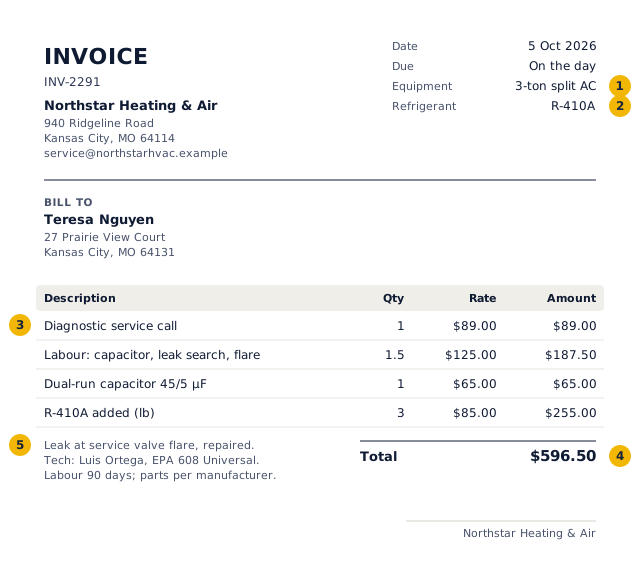
- Equipment: system type here; record make, model and serial number of each unit in the notes or on the work order.
- Refrigerant type, which drives the price per pound and the repair-or-replace conversation.
- Diagnostic, labour, part and refrigerant on separate lines, with refrigerant as pounds × price per pound.
- Total, due on the day for a residential service call.
- Finding, technician certification and warranty: what was wrong, who did it, and how long it is guaranteed.
The numbers: invoice INV-2291
| Item | Qty | Rate | Amount | Tax |
|---|---|---|---|---|
| Diagnostic service call, 5 October: AC running but not cooling | 1 | $89.00 | $89.00 | $0.00 |
| Labour: replace capacitor, electronic leak search, repair flare fitting at service valve | 1.5 | $125.00 | $187.50 | $0.00 |
| Dual-run capacitor 45/5 µF | 1 | $65.00 | $65.00 | $0.00 |
| Refrigerant R-410A added, per pound | 3 | $85.00 | $255.00 | $0.00 |
| Subtotal | $596.50 | $0.00 | ||
| Total | $596.50 | |||
Labour is 1.5 hours at $125.00, or $187.50, and the refrigerant 3 lb at $85.00, or $255.00. With the $89.00 diagnostic and the $65.00 capacitor, the invoice is $596.50. If Northstar credited the diagnostic against an approved repair, it would add a line "Diagnostic fee credited" and the customer would see both.
Refrigerant on the invoice: Section 608 and the R-410A transition
Refrigerant is the line customers question most, because the amount depends on the leak and the price depends on the gas. Bill it by type and pounds, at a price per pound, and say whether the leak was found and repaired. "R-410A added, 3 lb" tells the customer far more than "refrigerant charge, $255".
Who may handle and buy it
- Under Clean Air Act Section 608, anyone who maintains, services, repairs or disposes of equipment that could release refrigerant must be EPA-certified. Certification is by appliance type: Type I (small appliances), Type II (high-pressure, which covers residential split systems), Type III (low-pressure) or Universal (all three).
- Refrigerant, HFCs such as R-410A included, may be sold only to certified technicians (small cans for car air conditioning are a separate case). Putting the technician's name and certification type on the invoice is a simple record that a certified person did the work.
- For appliances holding 50 lb or more of an ozone-depleting refrigerant, EPA requires the technician to give the owner an invoice or other record showing the amount added. Home systems are far smaller, but the same habit costs nothing and answers the customer's question.
- The AIM Act leak-repair rules that began on 1 January 2026 apply to HFC appliances with 15 lb or more of charge and exclude residential and light commercial air conditioning and heat pumps, so they concern commercial refrigeration rather than home service calls.
R-410A, R-454B and R-32
EPA's Technology Transitions rule sets a global-warming-potential limit of 700 for new residential and light commercial air conditioning and heat pump systems installed from 1 January 2025, which is why new equipment uses R-454B or R-32 rather than R-410A. Systems whose components were all made or imported before 2025 have no installation deadline, so some R-410A equipment is still being installed from stock. Existing R-410A systems can be serviced as before, but the gas costs more as supply falls. Naming the refrigerant on every invoice helps a customer follow repair-or-replace advice: three pounds a season on an ageing R-410A system adds up.
Diagnostic fees, flat rate and after-hours calls
| Charge | How to bill it | Tip |
|---|---|---|
| Diagnostic or service call | A fixed fee per visit | If you credit it when the customer approves the repair, show the fee and the credit as two lines |
| Flat-rate repair | One price per task from your price book (e.g. "replace dual-run capacitor"), parts and labour included | Easiest for homeowners to approve; do not break it into hours afterwards |
| Time and materials | Hours × rate plus parts | Leak searches, intermittent faults and ductwork where the time cannot be known in advance |
| After-hours or emergency | Higher rate or fixed surcharge on its own line | Tell the customer the premium before you dispatch |
| Refrigerant | Pounds × price per pound, by type | Recovered refrigerant that goes back into the same system is not sold again |
| Maintenance agreement | Annual or monthly fee on its own line | Show member discounts on repairs as a separate amount |
Whichever method you use, the invoice should match the quote or the price the customer approved on site. If the technician quoted a flat $289 to replace a capacitor and contactor, bill $289 as one line; adding up hours and parts after the event invites the customer to compare the two.
Installation invoices: deposits, equipment and warranty registration
A system replacement is a different invoice from a repair: a larger sum, often a deposit, a permit, and equipment the customer will need to identify for a decade. Bill it against the accepted proposal, and list:
- Each piece of equipment with make, model and serial number: outdoor unit, indoor coil or air handler, furnace, thermostat. The serial numbers are what the manufacturer's registration and any warranty claim are matched against.
- The refrigerant of the new system (R-454B, R-32, or R-410A where installed from pre-2025 stock) and the factory charge plus any refrigerant added for the line set length.
- Installation labour as the quoted price, then line set, pad, electrical disconnect and whip, condensate work and ductwork modifications, each on its own line if they were priced separately.
- Permit at cost, and removal and disposal of the old equipment, including recovery of its refrigerant.
- The deposit already paid, shown as a payment against the total rather than a negative line.
- Warranties: the manufacturer's parts warranty (and whether it depends on online registration), and your own labour warranty, in years.
In California, the down payment on a home improvement contract may not exceed $1,000 or 10% of the contract price, whichever is less (Bus. & Prof. Code §7159.5); other states set no cap but a deposit should still match the equipment you are ordering. If the system was sold during a visit to the customer's home, the FTC Cooling-Off Rule gives the buyer 3 days to cancel a sale of $25 or more, unless they asked you to come and repair their equipment or signed a handwritten emergency waiver.
Maintenance agreements and recurring billing
A maintenance agreement (service plan, comfort club) is a fee for scheduled visits, usually a spring cooling tune-up and an autumn heating tune-up, often with priority booking and a discount on repairs. Bill it either once a year or monthly, as its own line that names the plan and the period. Visits covered by the plan go on the visit's work order at no charge; repairs found during a visit are invoiced separately, with the member discount shown so the customer sees the plan paying for itself.
Annual plan renewal with a repair at the member discount
| Item | Qty | Rate | Amount | Tax |
|---|---|---|---|---|
| Comfort plan, 12 months from 1 November 2026: 2 tune-ups | 1 | $189.00 | $189.00 | $0.00 |
| Replace contactor, 2-pole 40 A (flat rate), 15% member discount | 1 | $165.00 | $140.25 | $0.00 |
| Subtotal | $329.25 | $0.00 | ||
| Total | $329.25 | |||
The plan is $189.00 and the contactor repair $140.25 after the $24.75 member discount, so the invoice comes to $329.25 before any sales tax. A monthly plan would instead be a $16.00 line on a recurring invoice every month, and the repair a separate invoice.
- Say what the plan covers in the terms: number of visits, what each includes, what is excluded (refrigerant, parts, after-hours calls).
- Renewal and cancellation: whether it renews automatically, the notice period, and whether a monthly plan can be cancelled mid-year.
- Commercial maintenance contracts are usually billed monthly or quarterly per site, with the equipment list attached and the client's purchase order number on every invoice.
Sales tax on HVAC labour, parts and equipment
Central heating and cooling equipment is usually part of the building, so most states treat HVAC repairs and installations as contracting on real property. The Kansas City example shows how much the answer can change across a state line.
| State | Rule for HVAC work | Source |
|---|---|---|
| Missouri | A contractor who improves, repairs or replaces real property is the final consumer of the materials and supplies: it pays tax when buying the capacitor and refrigerant and does not collect tax from the customer. Separately stated repair labour on equipment that is personal property is not taxed | 12 CSR 10-112.010; 12 CSR 10-103.600 |
| Kansas | Labour to install, repair and service is generally taxable, including on equipment built into real property, but installation labour on the construction, repair or remodelling of a residence is exempt. Check the Department of Revenue's guidance for how a home repair is treated | K.S.A. 79-3603(p), (q) |
| Texas | Repair of residential property: labour not taxable; materials taxed on a separated contract or paid by you on a lump-sum one. Nonresidential repair and maintenance: the total charge is taxable | Comptroller Pub. 94-116; Rule 3.357 |
| Ohio | A contractor installing or repairing equipment that becomes part of real property pays tax on materials and does not charge it to the customer. Duct cleaning on its own is a taxable cleaning service; an HVAC tune-up is not | Ohio Adm. Code 5703-9-14; Information Release ST 2002-04 |
| Washington | Construction and repair for consumers is a retail sale: tax is collected on the full price, labour included | RCW 82.04.050; WAC 458-20-170 |
Northstar's invoice is for a house in Missouri, so it carries no sales tax line; the firm paid tax on the capacitor and refrigerant when it bought them. If you work on both sides of a state line, or for homes and businesses, set your price book so each line carries the right Tax % for the customer's address and property type.
Payment terms, liens and 1099-NEC
- Residential service calls are normally due on the day, by card or check, and the invoice should say so before the technician leaves.
- Installations are billed as a deposit and a final invoice on completion (or on passed inspection), and sometimes financed by a third-party lender, in which case the lender pays you and the customer owes the lender.
- Commercial service and maintenance contracts run on Net 15 or Net 30, with the client's PO number on every invoice.
- Late fees must be agreed in the proposal or service agreement before the work and repeated in the invoice terms; state law limits them, particularly for consumers.
On installations and other improvements to real property, a contractor who is not paid can usually record a mechanic's lien, but only after the state's notices and within its deadlines. In California a contractor working directly for the owner records the lien within 90 days after completion, or 60 days after the owner records a notice of completion; in Arizona even a contractor hired by the owner must serve a preliminary 20-day notice and record within 120 days after completion. Check your state's rules when the job starts.
Businesses that pay you $2,000 or more for services in a year file Form 1099-NEC for tax years beginning after 2025 (it was $600, and the figure will be adjusted for inflation from 2027), so commercial clients and property managers will ask for your Form W-9. Homeowners do not file one for work on their own home, and card or app payments are reported on Form 1099-K by the processor.
United Kingdom and India
United Kingdom. Anyone who works on equipment containing F gas refrigerants needs the right F-gas qualification, and a business working on other people's equipment needs company certification; gas boilers and furnaces need a Gas Safe registered engineer. HVAC businesses register for VAT above £90,000 taxable turnover and charge 20% on repairs and servicing. Installing a heat pump in a home counts as installing energy-saving materials and is zero-rated until 31 March 2027, reverting to 5% from 1 April 2027, so a heat pump installation invoice shows VAT at 0% on the qualifying installation.
UK: air source heat pump installed in a home, VAT at 0%
| Item | Qty | Rate | Amount | Tax |
|---|---|---|---|---|
| Air source heat pump 8 kW, supply and installation | 1 | £9,800.00 | £9,800.00 | £0.00 |
| Subtotal | £9,800.00 | £0.00 | ||
| Total | £9,800.00 | |||
The invoice total is £9,800.00 with VAT at 0%. Repairs and servicing of the same heat pump later are standard-rated at 20%, and other work done at the same time may not qualify, so put it on separate lines.
India. Air conditioners (HSN 8415) moved from 28% to 18% GST from 22 September 2025, so a split AC sold with installation is billed at 18%; repair and maintenance services are also generally taxed at 18%. An HVAC business registers once aggregate turnover exceeds ₹20 lakh (₹10 lakh in special category states) and shows GSTINs, HSN or SAC codes and CGST + SGST or IGST on the invoice. Use the GST invoice generator for India.
Mistakes to avoid
- "Recharged system, $255." Name the refrigerant and the pounds, and say whether the leak was found and repaired.
- No model or serial number. Without them the customer cannot claim on the manufacturer's warranty and you cannot check recalls or parts later.
- A diagnostic fee that silently disappears. If you credit it against the repair, show the fee and the credit.
- Flat-rate repairs broken into hours afterwards. Bill the price the customer approved.
- Recommendations not recorded. "Customer declined: replace blower capacitor, measured 3.1 µF on a 5 µF rating", dated, protects you when it fails next month.
- Printing tax-credit claims for equipment installed in 2026; the 25C credit has ended.
- Editing an issued invoice to apply a forgotten member discount. Issue a credit note for the discount.
HVAC estimate vs proposal vs invoice
| Document | When | What it does |
|---|---|---|
| Free estimate | Before a repair or replacement | Prices the job; often given free for replacements, while diagnosis of a fault is usually charged |
| Proposal | For replacements and new systems | Offers options (good, better, best), equipment, warranty and financing; the customer signs one |
| Work order | On the day | What the technician was sent to do and what the customer approved on site |
| Invoice | On completion | Bills what was done, with equipment details, refrigerant and warranty |
| Maintenance agreement | Yearly or monthly | Covers scheduled tune-ups; billed as its own recurring line |
Write the estimate or proposal with the estimate generator; when the customer accepts an option, those lines become the invoice.
Key terms
- Section 608 certification
- EPA certification required to maintain, service, repair or dispose of equipment that could release refrigerant: Type I, II, III or Universal.
- GWP
- Global warming potential; new residential split systems installed from 2025 must use refrigerant with a GWP of 700 or less.
- Diagnostic fee
- A charge for finding the fault, often credited against the repair if the customer goes ahead.
- Maintenance agreement
- A yearly or monthly plan covering scheduled tune-ups, usually with priority service and repair discounts.
- Flat-rate price book
- A list of fixed prices per repair task, parts and labour included.
- Line set
- The insulated copper refrigerant lines connecting the outdoor unit and the indoor coil.
Questions people ask
Why bill refrigerant by the pound?
Because the amount varies with the leak and the system size, and some refrigerants cost much more as they are phased down. Showing the refrigerant type, pounds added and the price per pound lets the customer see what they paid for.
Who is allowed to add refrigerant?
Technicians who maintain, service or repair stationary air conditioning and refrigeration equipment need EPA Section 608 certification, and refrigerant may be sold only to certified technicians. Putting the technician's name and certification type on the invoice keeps a record of who did the work.
Should the diagnostic fee be credited against the repair?
Many companies waive or credit it if the customer goes ahead with the repair. If you do, show the fee and the credit, so the customer sees the policy applied.
How do maintenance agreements fit on an invoice?
Bill the agreement as its own line, yearly or monthly, and show any member discount on repairs as a separate amount so it is visible.
What should an HVAC invoice include?
Your business and licence, the customer and service address, the equipment (type, make, model, serial, refrigerant), the findings, and separate lines for the diagnostic, labour, parts and refrigerant by the pound, then sales tax where due, the technician, the warranty and the due date.
Is HVAC repair taxable?
It depends on the state and the property. In Missouri and Ohio a contractor repairing equipment that is part of a house pays tax on parts when buying them and charges the homeowner none; Texas taxes nonresidential repair in full; Washington taxes the whole price, labour included.
Can I still install R-410A systems in 2026?
New residential split systems must meet a 700 GWP limit for installations from 1 January 2025, but systems whose components were all made or imported before 2025 have no installation deadline, so pre-2025 R-410A stock can still be installed. Existing R-410A systems can be serviced as before.
Can my customer claim a tax credit for a new heat pump?
Not for equipment placed in service in 2026: the Section 25C credit ended for property placed in service after 31 December 2025. State and utility rebates may still apply.
What is the difference between an HVAC estimate and an invoice?
The estimate or proposal prices the job before work starts; the customer accepts it. The invoice bills what was actually done, with equipment details, refrigerant, technician and warranty.