 luckpanda
Quick answer
What should an electrician invoice include?
An electrician invoice shows your business with its electrical contractor licence number, the customer and the job address, the work described by circuit or location, labour as hours at a rate or a flat price per task, materials, and the permit and inspection fees passed through at cost. It ends with sales tax where your state charges it, the total, the due date and your workmanship warranty.
- Describe the work by circuit, room or panel, not "electrical work".
- Keep labour, materials and permit fees on separate lines; states tax them differently.
- Put the permit number and inspection result on the invoice: the homeowner needs them later.
- Show the licence number; several states require it on contracts and bids, and customers look for it.
Last reviewed:
On this page
- What goes on an electrician invoice
- How to fill in this electrician invoice template
- Example: an electrician invoice for two new circuits
- Service calls, flat rate and time and materials
- Licence numbers, permits and inspections
- Sales tax on electrical labour and materials
- Deposits, payment terms, liens and 1099-NEC
- United Kingdom and India
- Mistakes to avoid
- Estimate vs work order vs change order vs invoice
- Key terms
- Questions people ask
What goes on an electrician invoice
For many homeowners the invoice is the only record of what was installed behind the drywall. A home inspector, an insurer or the next electrician will read it years later, so write it for them as well as for the customer paying it.
- Your business: legal name, address, phone, email and your electrical contractor licence number (with the state that issued it if you work in more than one).
- Customer and job site: the billing name and address, and the address where the work was done if different (rentals, new builds, commercial units).
- Invoice number, issue date, due date, and the date or dates of the work.
- Work by circuit or location: "two new 20 A GFCI circuits from the main panel to the garage workbench", "replace 100 A panel with 200 A panel, 30 spaces".
- Labour: hours at your rate, or the flat price for each task, and the electrician or crew who did it.
- Materials: wire by gauge, type and length; breakers by amperage; devices and fixtures by type. Group small items, but keep anything over a few dollars identifiable.
- Service call or trip charge, and any after-hours or emergency premium, each on its own line.
- Permit and inspection fees with the permit number and the inspection result.
- Sales tax, where your state taxes the job, with the rate.
- Warranty and terms: how long your workmanship is guaranteed, that manufacturers warrant the devices, the due date, payment methods and late fee.
How to fill in this electrician invoice template
- Add your business and licenceEnter your business name, address and email. Put your electrical contractor licence number in the tax ID field under your address (or your EIN, with the licence number in the notes).
- Add the customer and job siteEnter the customer under Bill to. If the job address differs from the billing address, put it in the notes.
- Describe the work line by lineAdd the service call, then labour by circuit or task (hours × rate, or 1 × the flat price), then materials, then the permit fee at cost with its permit number.
- Apply sales tax only where it is dueLeave Tax % at 0 on lines your state does not tax. Enter your combined state and local rate on taxable lines, which may be materials only or labour and materials, depending on the state and the job.
- Add notes, warranty and termsRecord the inspection results in Notes, and your workmanship warranty, due date and late fee in Terms.
- Sign in to issueSign in to keep the invoice: it gets the next number in your series and the customer's balance is tracked. Issuing and sending need the Sales module.
Example: an electrician invoice for two new circuits
Bright Circuit Electric in Dayton, Ohio, was called by Kevin and Laura Marsh to add two dedicated GFCI circuits to their garage workbench. The job started with a service call and load assessment, took 5.5 hours, needed a permit with rough-in and final inspections, and was billed with 10-day terms once the final inspection passed.
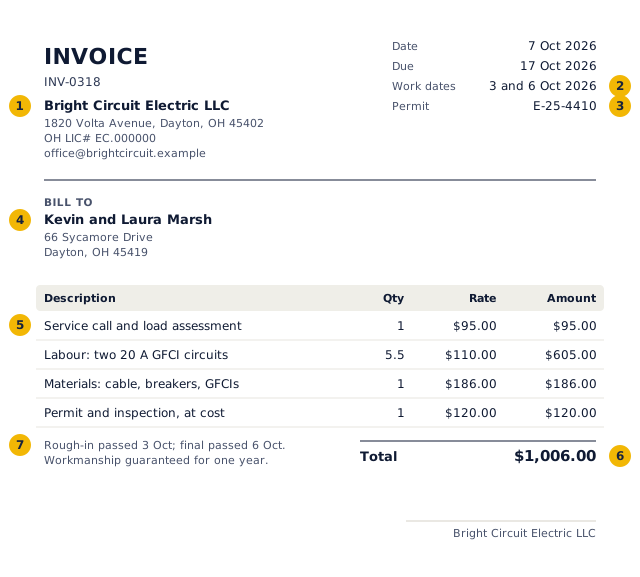
- Licence number under the business name; Ohio's format is "OH LIC#".
- Dates of the work, which may differ from the invoice date.
- Permit number, for the homeowner's records, insurer and any future sale.
- Customer and job address. Add the site address separately if it is not the billing address.
- Service call, labour, materials and permit on separate lines: they are priced, and often taxed, differently.
- Total with no sales tax line: see the sales tax section for why.
- Inspection results and warranty, the two things the customer will look for later.
The numbers: invoice INV-0318
| Item | Qty | Rate | Amount | Tax |
|---|---|---|---|---|
| Service call and load assessment, 3 October | 1 | $95.00 | $95.00 | $0.00 |
| Labour: install two new 20 A GFCI circuits from main panel to garage workbench | 5.5 | $110.00 | $605.00 | $0.00 |
| Materials: 12/2 NM cable (150 ft), two 20 A breakers, two GFCI receptacles, boxes and covers | 1 | $186.00 | $186.00 | $0.00 |
| Electrical permit and inspection fee (permit E-25-4410), at cost | 1 | $120.00 | $120.00 | $0.00 |
| Subtotal | $1,006.00 | $0.00 | ||
| Total | $1,006.00 | |||
The labour is 5.5 hours at $110.00, or $605.00; with the $95.00 service call, $186.00 of materials and the $120.00 permit at cost, the customer owes $1,006.00 by 17 October.
Service calls, flat rate and time and materials
| Charge | How to bill it | Why it is a separate line |
|---|---|---|
| Service call or trip charge | A fixed fee per visit, often covering the first half hour or the diagnosis | The customer agreed to it on the phone; bundled into labour it looks like an extra hour |
| Labour, time and materials | Hours on site × hourly rate, in quarter or half hours | Troubleshooting and remodels where the scope is unclear until walls are open |
| Labour, flat rate | A set price per task from your price book, e.g. "install ceiling fan on existing rated box" | The customer approves a price, not hours; do not convert it to hours afterwards |
| After-hours or emergency premium | A higher hourly rate, or a fixed surcharge, for nights, weekends and holidays | Quote it before you go out and show it separately so the base rate stays visible |
| Materials | Cost plus your markup, or price-book prices | Taxed differently from labour in many states; customers compare it with retail |
| Permit and inspection | At cost, with the permit number | A pass-through, not your income; often queried when bundled |
| Disposal | Fixed fee for removed panels, fixtures or lamps you take away | Fluorescent lamps and ballasts may need special recycling |
Progress billing on larger jobs
Remodels, service upgrades and new construction are usually billed by phase: a deposit or mobilisation invoice, then rough-in (wiring in open walls, passed rough inspection), trim-out (devices, fixtures, panel make-up) and final (passed final inspection, power on). Each invoice should name the phase, the percentage or amount of the contract it represents, what was billed before, and the balance left. Change orders, for example three extra recessed lights the customer added, go on their own lines with the date they were approved.
Licence numbers, permits and inspections
Electrical contractors are licensed by the state (and in some places by the city or county), and several states say exactly which documents must carry the licence number. Texas is the strictest for invoices: the rule names them outright.
| State | Where the licence number must appear | Rule |
|---|---|---|
| Texas | Name, address, phone and licence number on all proposals, invoices and written contracts, with the TDLR "Regulated by" notice; licence number (prefixed TECL) on both sides of each vehicle | 16 TAC §73.51 |
| California | All construction contracts, subcontracts and calls for bid, and all advertising (invoices are not named) | Bus. & Prof. Code §7030.5 |
| Florida | Every offer of services, business proposal, bid, contract and advertisement, and on vehicles that carry the business name | Fla. Stat. §489.119(5) |
| Arizona | Prefixed "ROC" on written bids and estimates, advertising, letterheads and other documents used to correspond with customers | A.R.S. §32-1124 |
| Ohio | As "OH LIC#" on contracts, advertisements, business cards, business locations and vehicles | Ohio Adm. Code 4101:16-2-05 |
Where the rule names contracts and estimates but not invoices, put the number on the invoice anyway: on a small service job the invoice is often the only written document, and it costs nothing. In California the licence number must also appear in any home improvement contract over $500 (Bus. & Prof. Code §7159), a separate document signed before work starts.
Permits and inspections on the invoice
- Bill the permit and inspection fee at cost, with the permit number. If you charge for the time spent pulling the permit and meeting the inspector, call it a permit-handling fee on its own line.
- Record each inspection and its result in the notes: "rough-in inspection passed 3 October; final passed 6 October". The homeowner needs this for their insurer and for a future sale.
- If the final inspection is still pending when you invoice, say so, and say what happens if it fails (normally you correct the work at no charge).
Sales tax on electrical labour and materials
Electrical work on a building is usually treated as a construction contract on real property, not a sale of goods, and states split three ways: the contractor pays tax on materials when buying them and charges the customer none; the contractor charges tax on the materials only; or the whole price, labour included, is taxed. Which one applies depends on the state, whether the property is residential, and whether the job is a repair or an improvement.
| State | Electrical work on a home | Other points |
|---|---|---|
| Ohio | No sales tax charged to the customer: a contractor incorporating materials into real property is their consumer and pays tax when buying them (Ohio Adm. Code 5703-9-14) | Installing items that stay personal property (freestanding equipment, some business fixtures) is a taxable sale of the whole job |
| Texas | Labour to repair or remodel residential property is not taxable. On a lump-sum contract you pay tax on materials and charge none; on a separated contract you collect tax on the materials amount | Repair and remodelling of nonresidential property is taxable on the total charge, labour included |
| California | Contractors are generally the consumers of materials (they pay tax when buying) and the retailers of fixtures; on time-and-materials work you charge tax on materials only in specific cases, such as billing tax on marked-up materials | Repair of fixtures with parts billed separately from labour: the parts are taxable |
| Washington | Construction and repair for consumers is a retail sale: the contractor collects retail sales tax on the full contract price, labour included | Materials are bought for resale, tax-free |
| New York | Repair, maintenance and installation work is taxable; a capital improvement is not, if the customer gives Form ST-124 | The contractor pays tax on materials used in a capital improvement |
This is why the example invoice from Dayton has no tax line: Bright Circuit Electric paid sales tax on the cable, breakers and receptacles when it bought them. The same job for a business customer in Texas is different, because nonresidential repair and remodelling is taxable on the whole charge.
The same circuits in a Dallas office: Texas tax at 8.25% on the total charge
| Item | Qty | Rate | Amount | Tax |
|---|---|---|---|---|
| Service call and load assessment | 1 | $95.00 | $95.00 | $7.84 |
| Labour: install two new 20 A GFCI circuits to the workshop | 5.5 | $110.00 | $605.00 | $49.91 |
| Materials: cable, two 20 A breakers, two GFCI receptacles, boxes | 1 | $186.00 | $186.00 | $15.35 |
| Subtotal | $886.00 | |||
| Tax 8.25% | $73.10 | |||
| Total | $959.10 | |||
At the 8.25% maximum combined Texas rate (6.25% state plus up to 2% local), tax on the $886.00 charge is $73.10 and the invoice totals $959.10, before any permit fee. For a home in Texas on a separated contract, only the $186.00 of materials would carry tax.
Deposits, payment terms, liens and 1099-NEC
Deposits and payment terms
Service calls are normally due on completion; remodels and upgrades are billed in phases with a deposit up front. Check your state before taking a large deposit from a homeowner. In California, the down payment on a home improvement contract may not exceed $1,000 or 10% of the contract price, whichever is less, and later payments may not run ahead of the work performed and materials delivered (Bus. & Prof. Code §7159.5). Small buyer-requested service and repair jobs of $750 or less, paid only on completion, follow lighter rules (§7159.10).
Show the deposit on the final invoice as a payment received, not as a negative line, so the invoice still shows the full contract price. For business customers, Net 15 or Net 30 is usual; write the due date as a date, not just "Net 30".
Late fees
There is no federal rule on late fees for trade invoices; what you may charge depends on your agreement and state law, which limits interest and fees more tightly for consumers than for businesses. Put the fee in the estimate or contract the customer accepts ("1.5% per month on balances over 30 days"), then repeat it in the invoice terms. A fee that first appears on the invoice is hard to enforce. If a California contract sets no rate, a debt carries 10% a year interest after breach (Civil Code §3289).
Mechanic's liens and preliminary notices
A contractor who improves real property can usually record a mechanic's lien against it if unpaid, but only by following the state's notice and deadline rules exactly. Two examples:
- California: a contractor working directly for the owner gives a preliminary notice only to the construction lender, if there is one; subcontractors and suppliers serve it within 20 days of first furnishing work. A direct contractor records the lien within 90 days after completion, or 60 days after the owner records a notice of completion (Civil Code §§8200, 8204, 8412).
- Arizona: everyone except wage labourers, including contractors hired by the owner, serves a preliminary 20-day notice; the lien is recorded within 120 days after completion, or 60 days after a notice of completion (A.R.S. §§33-992.01, 33-993).
Lien rules differ widely and change; on larger jobs, calendar the notice when you start, not when the invoice goes overdue.
1099-NEC and Form W-9
A business that pays you for services in the course of its trade or business files Form 1099-NEC if it pays you $2,000 or more in a year, for tax years beginning after 2025 (the threshold was $600 and will be adjusted for inflation from 2027). Homeowners paying for work on their own home do not file one: personal payments are not reportable. Payments to a contractor that is a corporation, including an LLC taxed as a C or S corporation, are generally exempt, and payments by card or through a payment app are reported by the processor on Form 1099-K instead. Expect commercial customers to ask for a Form W-9 before they pay the first invoice.
United Kingdom and India
United Kingdom. Electricians register for VAT once taxable turnover passes £90,000 in 12 months, and then charge 20% and issue VAT invoices. Some domestic work, such as replacing a consumer unit or changing circuits near a bath or shower, needs building regulations approval; an electrician registered with a competent person scheme self-certifies it and the customer receives the certificate, so mention it on the invoice. Installation work for a building contractor falls under the Construction Industry Scheme, and between VAT-registered businesses in a CIS chain the domestic reverse charge applies (the customer accounts for the VAT); private householders are outside both. On business invoices paid late you may claim statutory interest at 8% over the Bank of England base rate plus fixed recovery costs.
UK: consumer unit replacement for a homeowner, VAT at 20%
| Item | Qty | Rate | Amount | Tax |
|---|---|---|---|---|
| Replace consumer unit with 18th Edition RCBO board, incl. certification | 1 | £640.00 | £640.00 | £128.00 |
| Additional RCBOs for new circuits | 2 | £38.00 | £76.00 | £15.20 |
| Subtotal | £716.00 | |||
| VAT 20% | £143.20 | |||
| Total | £859.20 | |||
India. Electrical installation services are taxed under GST, generally at 18%, and a contractor must register once aggregate turnover exceeds ₹20 lakh (₹10 lakh in special category states). A GST invoice shows your GSTIN, the customer's GSTIN if registered, the SAC for the service (electrical installation falls under 9954), and CGST + SGST for a job in your own state or IGST otherwise. Use the GST invoice generator for India.
Mistakes to avoid
- "Electrical work, $1,006." Without circuits, locations and materials, the invoice is useless to an inspector or insurer and invites a dispute.
- Flat-rate jobs converted to hours. If you quoted $185 to hang a fan, bill $185. Showing 1.1 hours at $110 and a materials line invites a recalculation.
- Permit fees marked up without saying so. Bill them at cost, or call the difference a permit-handling fee on its own line.
- Charging sales tax on labour in a state that does not tax it, or failing to charge it where it does. You owe what you should have collected.
- No licence number. Several states require it on contracts and bids; missing it can make a contract harder to enforce.
- Unrecorded change orders. Get the customer's approval in writing (a text or signed change order) before the extra work, and quote it on the invoice.
- Editing an issued invoice after the customer queries it. Issue a credit note for the reduction instead, so the record stays straight.
Estimate vs work order vs change order vs invoice
| Document | When | What it does |
|---|---|---|
| Estimate or quote | Before the work | Prices the job. Accepted, it becomes the price you invoice against |
| Work order | When the job is scheduled | Tells the electrician what to do, where, and what the customer approved |
| Change order | During the job | Adds or removes work and price; signed or approved before the change is made |
| Invoice | At each phase, or on completion | Asks for payment for the work done; carries the permit, warranty and licence details |
| Receipt | When paid | Confirms the payment; customers sometimes search for an "electrician receipt" for insurance claims |
Start with the estimate generator; when the customer accepts, the same lines carry onto the invoice, and any change orders are added as new lines with their approval date.
Key terms
- Service call (trip charge)
- A fixed fee for attending, often covering the first period on site or the diagnosis.
- Time and materials (T&M)
- Billing for hours worked at an hourly rate plus materials at cost or with a markup.
- Flat-rate pricing
- A fixed price per task from a price book, regardless of the time taken.
- Rough-in and trim-out
- The phases of wiring before walls are closed (rough-in) and of fitting devices and fixtures after (trim-out).
- Change order
- A written, approved change to the scope and price of a job after it starts.
- Mechanic's lien
- A claim against real property for unpaid work or materials, available only if the state's notice and deadline rules are followed.
- Preliminary notice
- A notice served early in a job to preserve lien rights, required in some states (20 days in California and Arizona).
Questions people ask
Do I need to put my license number on the invoice?
In Texas, yes: electrical contractors must show their name, address, phone and licence number on all proposals, invoices and written contracts. California, Florida, Arizona and Ohio require it on contracts, bids or estimates and advertising. Even where it is optional, it reassures customers and their insurers.
Flat rate or time and materials?
Flat-rate pricing per task, such as installing a ceiling fan or replacing a panel, is easy for homeowners to accept. Time and materials suits troubleshooting and remodels where the scope is unclear. Say which one each line uses, and never convert a flat-rate price into hours on the invoice.
Who pays for the permit?
Usually the customer, with the electrician pulling it and passing the fee through at cost. Put the permit number on the invoice so the homeowner has it for the final inspection, insurance and any future sale.
Is electrical work taxable?
That varies by state. In Ohio and California a contractor generally pays tax on materials when buying them and charges the homeowner none; Texas taxes nonresidential repair and remodelling in full but not residential repair labour; Washington taxes the whole contract price, labour included.
How do I write an electrician invoice?
Add your business with its licence number, the customer and job address, then the service call, labour by circuit or task, materials and the permit fee at cost on separate lines. Apply sales tax only where your state requires it, record the inspection results and warranty, and set the due date.
Can an electrician ask for a deposit?
Yes, agreed in the estimate or contract. In California the down payment on a home improvement contract is capped at $1,000 or 10% of the price, whichever is less. Show the deposit on the final invoice as a payment received.
Should after-hours or emergency work be a separate line?
Yes. Quote the premium before you go out, then bill it as its own line or as a separately described rate, so the customer sees your normal rate and the premium they agreed to.
Do I get a 1099 for electrical work?
From a business that paid you $2,000 or more for services in the year, for tax years beginning after 2025, unless you are incorporated or were paid by card. Homeowners paying for work on their own home do not file one.
What is the difference between an electrical estimate and an invoice?
The estimate prices the job before work starts and, once accepted, is what the customer agreed to pay. The invoice bills the work done against it, with any approved change orders, the permit and the warranty.