 luckpanda
Quick answer
Moving invoice template: what it is
An invoice is the request for payment you send after supplying goods or services. It records what was supplied, at what price and tax, and when payment is due. Crew hours, travel time, materials and valuation for movers.
Last reviewed:
On this page
Example: a filled moving invoice
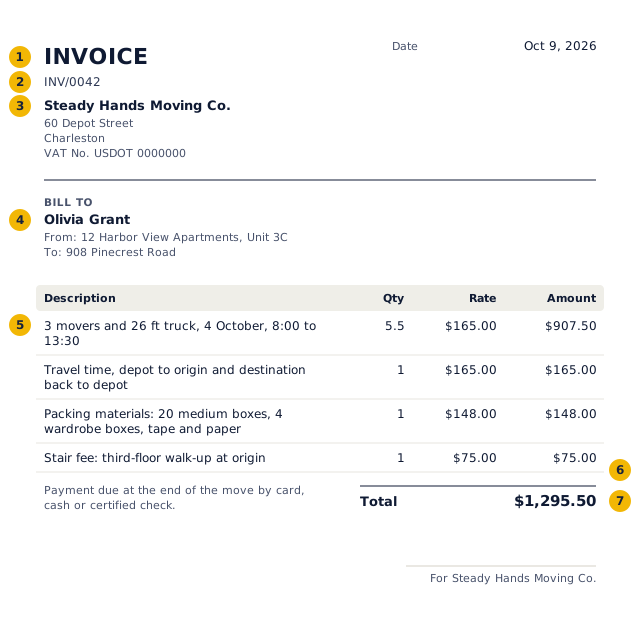
- The title says what the document is: an invoice.
- A unique number from a continuous series, allocated when you issue it.
- Your business name and address, and tax number if registered.
- Who it is for.
- Each line: description, quantity, rate and amount.
- Tax by rate.
- The total in the document's currency and format.
Worked example: the numbers behind the invoice above
| Item | Qty | Rate | Amount | Tax |
|---|---|---|---|---|
| 3 movers and 26 ft truck, 4 October, 8:00 to 13:30 | 5.5 | $165.00 | $907.50 | $0.00 |
| Travel time, depot to origin and destination back to depot | 1 | $165.00 | $165.00 | $0.00 |
| Packing materials: 20 medium boxes, 4 wardrobe boxes, tape and paper | 1 | $148.00 | $148.00 | $0.00 |
| Stair fee: third-floor walk-up at origin | 1 | $75.00 | $75.00 | $0.00 |
| Subtotal | $1,295.50 | $0.00 | ||
| Total | $1,295.50 | |||
No tax is charged on these lines, so the total equals the value of the supply.
How to fill in the moving invoice
- Enter your company, and your USDOT number if you move across state lines.
- Bill crew and truck by the hour with the start and finish times.
- Add travel time, packing materials and extras such as stairs or long carries.
- Record the valuation option the customer chose, then save and issue.
What a moving invoice should show
- Company name, USDOT and MC numbers, or state license number
- Customer, origin and destination addresses
- Order or bill of lading number
- Crew size, truck size, start time, finish time and breaks
- Travel time or fee between your depot and the job
- Packing materials by type and quantity
- Extra charges: stairs, long carry, piano or heavy items, shuttle truck
- Valuation option chosen and its cost
- Deposit paid and balance due
Worked example: a local move
Three movers and a 26-foot truck work from 8:00 to 13:30, 5.5 hours at 165.00 an hour (907.50). Travel to and from the depot is one hour at the same rate (165.00), packing materials come to 148.00 and a third-floor walk-up adds a 75.00 stair fee. The invoice totals 1,295.50.
What to put on an invoice, field by field
| Field | What to enter |
|---|---|
| Document title | Say exactly what it is: "Invoice". The title tells the buyer and the tax authority how to treat it. |
| Number and date | A unique number in a continuous series and the issue date. LuckPanda allocates the number when you issue. |
| Your business | Name, address, and tax ID if your state or client needs it |
| Customer | Name, address, and tax ID if your state or client needs it |
| Lines | Description, quantity, unit and rate. Each line carries its own tax rate. |
| Tax | Sales tax where you must collect it, at the rate for the delivery address. |
| Totals | Taxable value, tax by component and the total, in the document currency. Amounts in words are customary in India. |
| Terms | Due date, bank or payment details and late-payment terms. |
United States rules for an invoice
- There is no federal invoice format. Include what your client's accounts payable needs to pay: your legal name, invoice number and date, what was supplied, amounts, due date and payment instructions.
- Sales tax is set by each state. Charge it only where you have nexus (a physical presence or, since 2018, economic nexus by sales volume) and the item is taxable; most services are exempt in many states.
- A business that pays a contractor $2,000 or more in a year (the threshold rose from $600 for payments made from 2026) reports it on Form 1099-NEC, so expect your client to ask for a W-9.
Mistakes to avoid
- Editing or deleting an issued invoice instead of issuing a credit note.
- Gaps or duplicates in the number series.
- Charging the wrong tax type (for India: IGST on an intra-state sale, or CGST and SGST across states).
- Leaving out the due date and payment details, which is the commonest reason invoices are paid late.
- Rounding each line's tax differently from the total; LuckPanda computes tax per line and keeps the components adding up.
Invoice vs other sales documents
| Document | When | Asks for payment | Tax document | In the books |
|---|---|---|---|---|
| Quotation / estimate | Before the order | No | No | No |
| Proforma invoice | After the order, before supply | Advance only | No | No |
| Invoice / tax invoice | On supply | Yes | Yes | Yes: sale and receivable |
| Receipt | When paid | No, confirms payment | No (receipt voucher for advances in India) | Yes: payment |
| Credit note | After an invoice, to reduce it | No, reduces what is owed | Yes | Yes: reverses part of the sale |
Questions people ask
How are local and long-distance moves priced?
Local moves are usually charged by the hour for a crew and truck, plus travel time and materials. Interstate moves are priced on the weight of the shipment and the distance, with extra services added.
What is the 110 percent rule?
For an interstate household move on a non-binding estimate, the mover must deliver the goods on payment of no more than 110% of the estimate; anything above that is billed afterwards with at least 30 days to pay. A binding estimate fixes the price unless the customer adds services.
What is valuation coverage?
The mover's liability for loss or damage. For interstate moves, Full Value Protection is the default, and released value at 60 cents per pound per article is the no-cost alternative the customer can choose in writing. State rules govern local moves.
Do I need a USDOT number?
Movers carrying household goods across state lines need a USDOT number and FMCSA operating authority, and must give customers the "Your Rights and Responsibilities When You Move" information. Movers working within one state are licensed by that state, where it requires a licence.