 luckpanda
Quick answer
What must a donation receipt include for taxes?
In the US, a donor needs a written acknowledgment from the charity to deduct any single gift of $250 or more. It must give the organization's name, the amount of a cash gift or a description (not a value) of donated property, and a statement that no goods or services were given in return, or a description and good-faith estimate of those that were. The donor must have it by the date they file, or the return's due date if earlier.
- No IRS form: a letter, email or printed receipt with the right statements is enough.
- A payment over $75 that is partly for goods or services, such as a gala dinner, needs a written disclosure of the deductible amount.
- From 2026, donors who do not itemize can deduct up to $1,000 ($2,000 on a joint return) of cash gifts.
- India: the 80G-type deduction now runs on the charity's Form 114 certificate (formerly 10BE); UK charities need a Gift Aid declaration.
Last reviewed:
On this page
- What a donation receipt does
- How to fill in this donation receipt template
- Example: a donation receipt for cash and goods
- IRS rules for a donation receipt, by amount
- What changed for US donors in 2026
- What goes on a donation receipt, field by field
- India: 80G donation receipts and Form 114
- United Kingdom: Gift Aid declarations
- Mistakes to avoid
- Donation receipt vs thank-you letter vs Form 8283 vs Form 114
- Key terms
- Questions people ask
What a donation receipt does
A donation receipt is the charity's written acknowledgment of a gift. In the US it is mainly the donor's evidence for a tax deduction: without a proper acknowledgment, a gift of $250 or more cannot be deducted at all, however genuine it was. The charity is not penalised for failing to acknowledge an ordinary gift, but its donors lose the deduction, which is a fast way to lose donors.
The one place the charity itself is penalised is the quid pro quo disclosure: when a donor pays more than $75 and gets something back, the charity must say how much of the payment is deductible. The IRS penalty is $10 per contribution, up to $5,000 per fundraising event or mailing.
How to fill in this donation receipt template
- Enter the organizationUse the charity's legal name and address, and put the EIN in the tax number field. Mention 501(c)(3) status in the notes.
- Add the donor under "Received from"Enter the donor's name and address. Do not add a Social Security number.
- Add one line per giftFor cash, enter the amount and the check or card reference. For property, describe the items and leave the price at zero: the receipt describes, it does not value. Keep the tax rate at 0%.
- Add the required statementIn the notes, write "No goods or services were provided in exchange for this contribution", or describe what the donor received with a good-faith estimate of its value and the deductible amount.
- Sign in to issue itSign in to issue: the receipt takes the next number in your series and is kept on the donor's record, ready for the January summary. Issuing and sending receipts needs the Sales module.
Example: a donation receipt for cash and goods
Margaret Lin gave Riverbend Community Food Bank, a 501(c)(3) charity in Hartford, Connecticut, a $500 check and 12 boxes of canned and dry food on 3 October 2026. She received nothing in return. One receipt covers both gifts: the cash in dollars, the food described but not valued.
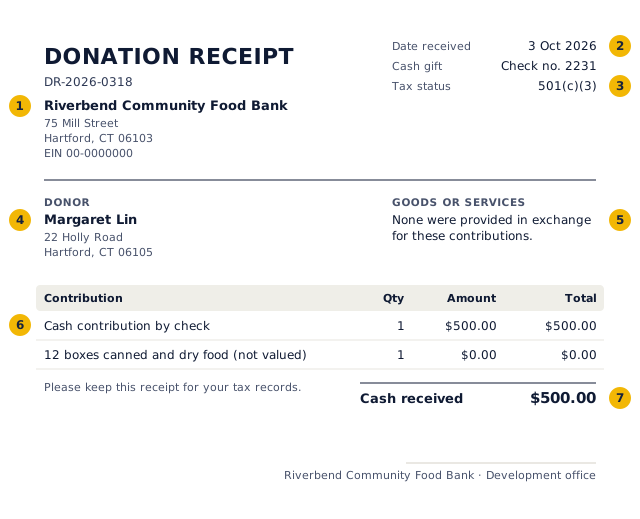
- Organization's name: required. The EIN is not required but helps the donor confirm eligibility.
- Date of the contribution: needed for any monetary gift record.
- Tax-exempt status: tells the donor the gift can be deductible.
- Donor's name. A Social Security number is not needed and should not be printed.
- Goods or services statement: "none", or a description and good-faith estimate of their value.
- Cash amount, and a description, not a value, of donated property.
- Cash received: the figure the donor can deduct, subject to their own limits.
The numbers: receipt DR-2026-0318
| Item | Qty | Rate | Amount | Tax |
|---|---|---|---|---|
| Cash contribution received 3 October 2026, check no. 2231 | 1 | $500.00 | $500.00 | $0.00 |
| Non-cash: 12 boxes of canned and dry food (described, not valued) | 1 | $0.00 | $0.00 | $0.00 |
| Subtotal | $500.00 | $0.00 | ||
| Total | $500.00 | |||
The receipt shows $500.00 of cash. Margaret values the food herself; if her non-cash gifts for the year exceed $500 she files Form 8283 with her return.
A quid pro quo gift: tickets to a fundraising dinner
At the food bank's autumn gala, Margaret bought two tickets at $150 each. The dinner and entertainment are worth a good-faith estimate of $60 per person. Each payment is over $75 and partly buys something, so the receipt must include the disclosure.
Gala tickets: payment received
| Item | Qty | Rate | Amount | Tax |
|---|---|---|---|---|
| Autumn gala ticket, 14 November 2026 | 2 | $150.00 | $300.00 | $0.00 |
| Subtotal | $300.00 | $0.00 | ||
| Total | $300.00 | |||
Received $300.00. The disclosure reads: "The fair market value of the dinner provided is estimated at $60 per ticket ($120 in total). The amount of your contribution that is deductible for federal income tax purposes is limited to the excess of your payment over that value: $180."
IRS rules for a donation receipt, by amount
| Situation | What the donor needs | What the receipt must say |
|---|---|---|
| Any cash, check or card gift | A bank record, or a written communication from the charity | Organization's name, date and amount |
| A single gift of $250 or more (cash or property) | A contemporaneous written acknowledgment | Name, cash amount or description of property, and the goods-or-services statement |
| A payment over $75, partly for goods or services | The charity's written disclosure | That only the excess over the value received is deductible, and a good-faith estimate of that value |
| Non-cash gifts over $500 in the year | Form 8283 (Section A) filed with the return | Description of the items; the donor supplies the value |
| A non-cash gift over $5,000 | A qualified appraisal and Form 8283 Section B, signed by the charity | The charity's acknowledgment on the form |
| A donated car, boat or plane claimed at over $500 | Form 1098-C from the charity | Vehicle-specific rules apply instead of an ordinary receipt |
The fine print
- Contemporaneous means the donor has the acknowledgment by the earlier of the date they file the return for the year of the gift and the return's due date, including extensions. Charities usually send acknowledgments by 31 January.
- Separate gifts are not added together. Weekly gifts of $50 do not need an acknowledgment even if they total more than $250 a year; a single $250 gift does. Each payroll deduction is treated as a separate gift.
- One annual statement listing each gift of $250 or more, with dates and amounts and the goods-or-services statement, satisfies the rule.
- No Social Security or tax identification number of the donor is needed on the acknowledgment.
- Token items do not count as goods or services: low-cost items bearing the charity's name, within the IRS's inflation-adjusted limits, and annual membership benefits for a payment of $75 or less.
- Religious organizations may state that only intangible religious benefits were provided.
- Services a volunteer gives are not deductible, but unreimbursed expenses of $250 or more need an acknowledgment describing the services.
What changed for US donors in 2026
Two rules from the 2025 tax law (OBBBA) apply from tax year 2026, and both make good receipts more useful:
- Donors who take the standard deduction can deduct up to $1,000 of cash gifts ($2,000 on a joint return) to qualifying charities. Gifts of property and gifts to donor-advised funds do not count, and the donor still needs a bank record or the charity's written receipt with its name, the date and the amount.
- Donors who itemize can deduct charitable gifts only to the extent they exceed 0.5% of adjusted gross income; amounts below the floor may carry forward.
For a charity, the practical change is volume: more small donors now have a reason to keep a receipt, so a receipt for every gift, not only those of $250 or more, is worth sending.
What goes on a donation receipt, field by field
| Field | What to enter | Required? |
|---|---|---|
| Organization name and address | Legal name as registered with the IRS | Yes |
| EIN and 501(c)(3) status | Employer Identification Number and exempt status | Not required by the IRS; standard practice |
| Receipt number and date | Next number in your series; date issued | Good practice; helps the annual summary |
| Donor name and address | As on the payment | Name yes; no SSN |
| Date of the gift | When the charity received it | Yes for monetary gifts |
| Cash amount | Dollars received, with check or card reference | Yes |
| Description of property | What was given, condition, quantity | Yes; never a value |
| Goods or services statement | "No goods or services were provided" or a description and good-faith estimate | Yes for gifts of $250 or more |
| Quid pro quo disclosure | Deductible amount = payment minus the value received | Yes for payments over $75 with a benefit |
| Signature or sender | An authorised person or office | Not required; adds authority |
India: 80G donation receipts and Form 114
Under the Income-tax Act 2025, in force from 1 April 2026, a donor's deduction for gifts to an approved trust or NGO (the old section 80G) no longer depends on the paper receipt alone. The charity reports each donation to the Income Tax Department, and the donor's claim is allowed on the basis of what the charity reports.
- Form 113 (formerly Form 10BD): the charity's annual statement of donations, filed by 31 May after the financial year.
- Form 114 (formerly Form 10BE): the donation certificate generated after that statement is filed, issued to each donor. This, not the receipt, is what the donor relies on.
- The receipt at the time of the gift should still show the charity's name, address and PAN, its registration (approval) number and validity, the donor's name, address and PAN, the amount, the date and the mode of payment. Without the donor's PAN the charity cannot report the gift.
- Cash gifts above ₹2,000 do not qualify, and gifts in kind (food, clothes, equipment) do not qualify at all: only sums of money.
- The deduction is available only under the old tax regime.
An Indian donation receipt: ₹25,000 by UPI
| Item | Qty | Rate | Taxable value | Tax |
|---|---|---|---|---|
| Donation to the general fund, received by UPI | 1 | ₹25,000.00 | ₹25,000.00 | ₹0.00 |
| Subtotal | ₹25,000.00 | ₹0.00 | ||
| Total | ₹25,000.00 | |||
The receipt records ₹25,000.00 with the donor's PAN; the trust includes it in Form 113 by 31 May and the donor downloads Form 114. Donations to an approved charity carry no GST: they are not a payment for a supply.
United Kingdom: Gift Aid declarations
UK law does not require a charity to issue receipts, but to claim Gift Aid (25p from HMRC for every £1 donated, so a £100 gift becomes £125) the charity must hold a Gift Aid declaration. It can be written, online or verbal, and must include:
- the charity's name and the donor's full name and home address (at least house name or number and postcode);
- whether it covers a single gift or past and future gifts;
- a statement that the donor wants Gift Aid to apply, and that they have paid at least as much UK Income Tax or Capital Gains Tax in the tax year as will be claimed on all their gifts.
A verbal declaration must be confirmed in writing, telling the donor they can cancel within 30 days. Keep declarations for six years after the most recent donation claimed on.
Mistakes to avoid
- Leaving out the goods-or-services statement. Without it, a $250 receipt does not support a deduction.
- Putting a value on donated goods. Describe them; the donor values them and files Form 8283 where required.
- Ignoring the gala dinner. A ticket over $75 with a meal needs the disclosure; "thank you for your donation of $150" overstates the deduction.
- Sending the receipt after the donor files. It must reach them in time; aim for January.
- Printing the donor's SSN. Not required, and a privacy risk.
- India: no donor PAN. The gift cannot be reported in Form 113, so the donor gets no Form 114.
- India: receipting large cash gifts as deductible. Cash above ₹2,000 does not qualify.
Donation receipt vs thank-you letter vs Form 8283 vs Form 114
| Donation receipt | Thank-you letter | Form 8283 | Form 114 (India) | Gift Aid declaration (UK) | |
|---|---|---|---|---|---|
| Who issues it | Charity | Charity | Donor files it; charity signs Section B | Charity, via the tax portal | Donor makes it; charity keeps it |
| Purpose | Acknowledge the gift | Thank the donor | Report non-cash gifts over $500 | Certify a reported donation | Let the charity claim 25% |
| Counts for tax | Yes, if it has the required statements | Only if it has them | Yes, with the return | Yes; the basis of the deduction | For the charity's claim |
| Shows a value | Cash amount only | Optional | Donor's value | Amount donated | No |
Key terms
- Contemporaneous written acknowledgment
- The charity's written statement that a donor needs to deduct any single gift of $250 or more.
- Quid pro quo contribution
- A payment that is partly a gift and partly for goods or services from the charity.
- Good-faith estimate
- The charity's reasonable estimate of the fair market value of what it gave the donor.
- Intangible religious benefit
- A religious benefit not usually sold commercially; a receipt may say only such benefits were provided.
- Form 8283
- The IRS form a donor files for non-cash gifts totalling more than $500 in a year.
- Form 114 (formerly 10BE)
- India's donation certificate, generated after the charity reports the gift in Form 113.
- Gift Aid declaration
- A UK donor's statement that lets the charity reclaim basic-rate tax on the gift.
Questions people ask
When is a donation receipt required?
For any single contribution of $250 or more, the donor needs a contemporaneous written acknowledgment from the charity to claim a deduction. Smaller gifts need a bank record or a receipt showing the charity, date and amount, so a receipt for every gift is good practice.
Should the receipt state the value of donated goods?
No. Describe the items; valuing them is the donor's responsibility. Donors claiming more than $500 of non-cash gifts in a year file Form 8283, and gifts over $5,000 need a qualified appraisal.
What if the donor received something in return?
Describe it and give a good-faith estimate of its value, such as the meal at a fundraising dinner. Payments over $75 that are partly a gift and partly for goods or services require a written disclosure of the deductible amount.
What does contemporaneous mean?
The donor must have the acknowledgment by the earlier of the date they file their return or the return's due date, including extensions.
Do I need the donor's Social Security number on the receipt?
No. The IRS says neither the donor's Social Security number nor tax identification number is needed on the acknowledgment.
Is the charity's EIN required on a donation receipt?
Not by the IRS acknowledgment rules, which require the organization's name. Most charities print the EIN and 501(c)(3) status anyway, because donors and their tax preparers use them to confirm the charity is eligible.
Can a donation receipt be sent by email?
Yes. The IRS accepts letters, postcards, emails and computer-generated forms that contain the required information.
Can one receipt cover a whole year of gifts?
Yes. An annual statement listing each gift with its date and amount, and the goods-or-services statement, works as the acknowledgment if it reaches the donor in time.
What is the penalty for not giving a quid pro quo disclosure?
$10 per contribution, up to $5,000 per fundraising event or mailing, unless the charity shows reasonable cause.
Can donors deduct gifts if they take the standard deduction?
From tax year 2026, yes, up to $1,000 of cash gifts ($2,000 for a joint return) to qualifying charities. Gifts to donor-advised funds and gifts of property do not qualify.
What is Form 10BE, now Form 114?
The donation certificate an Indian charity generates after filing its annual statement of donations. From 1 April 2026 it is Form 114 (the statement is Form 113). The donor's deduction relies on it.