 luckpanda
Quick answer
What should a cleaning invoice include?
A cleaning invoice lists the property cleaned, each visit by date (or the month a contract covers), the price per visit, hour or month, and any one-off extras such as an oven, window or move-out clean on their own lines. It ends with supplies if you charge for them, sales tax where your state taxes cleaning, the total, the due date and your cancellation and late-payment terms.
- Bill recurring homes per visit with the dates; bill commercial contracts as a monthly fee plus extras.
- Put extras, supplies and cancellation fees on separate lines so a regular client can check the bill quickly.
- Sales tax on cleaning depends on the state: California and Washington do not tax it; Texas and Ohio tax homes and offices alike.
- A business that pays you $2,000 or more in 2026 reports it on Form 1099-NEC, so give business clients a W-9.
Last reviewed:
On this page
- What a cleaning invoice shows
- How to fill in this cleaning invoice template
- Example: a monthly house-cleaning invoice
- Per visit, per hour or per month
- Residential and commercial cleaning invoices
- Billing recurring cleaning clients
- Is cleaning subject to sales tax?
- Deposits, late fees and 1099-NEC
- United Kingdom and India
- Mistakes to avoid
- Cleaning quote vs service agreement vs invoice vs receipt
- Key terms
- Questions people ask
What a cleaning invoice shows
A regular client should be able to check a cleaning invoice in the time it takes to read it: which property, which visits, what was extra, and what is owed by when. Everything else on the page supports one of those four answers.
- Your business: name, address, phone or email, and your EIN if you have one (sole traders can leave their Social Security number off the invoice and give it on a W-9 instead).
- The client and the property: the billing name and address, and the address cleaned if it differs, for example a rental unit or an office suite. For offices, name the floors or areas covered.
- Invoice number, issue date and due date.
- The visits: one line per visit with its date, or one line listing the dates, or one line for the month on a contract.
- Extras on their own lines: oven, fridge, inside windows, carpets, laundry, move-in or move-out cleans, post-construction cleans.
- Supplies or equipment, only if your agreement says they are charged separately.
- Adjustments: late-cancellation or lockout fees, credits for skipped visits, discounts.
- Sales tax where your state taxes the service, with the rate.
- Terms: due date, accepted payment methods, cancellation policy and late fee.
How to fill in this cleaning invoice template
- Add your business and the clientEnter your business name, address and email, and your EIN if you have one. Under Bill to, enter the client and their billing address; add the property cleaned in the notes if it is different.
- List the visitsOne line per visit, or one line with the dates and the number of visits as the quantity, at your per-visit price. For a contract, one line for the month.
- Add extras and fees on their own linesDeep cleans, windows, carpets, supplies, late-cancellation fees. Leave Tax % at 0 unless your state taxes the service; for taxable commercial work, enter your combined state and local rate on each taxable line.
- Set the dates and termsPick the issue and due dates (7 days is usual for homes, Net 15 or 30 for businesses) and put your cancellation and payment terms in Terms.
- Sign in to issue and repeat itSign in to keep the invoice: it gets the next number in your series and the client's balance is tracked. With the Sales module you can issue, send and set it to recur each month.
Example: a monthly house-cleaning invoice
Brightside Home Cleaning in Sacramento cleans Rachel Kim's house every Tuesday at $120 a visit. September 2026 had five Tuesdays, and on the 16th she also asked for the oven and fridge to be deep cleaned. Brightside bills the month in arrears on 1 October with 7-day terms. California does not tax cleaning services, so there is no sales tax line.
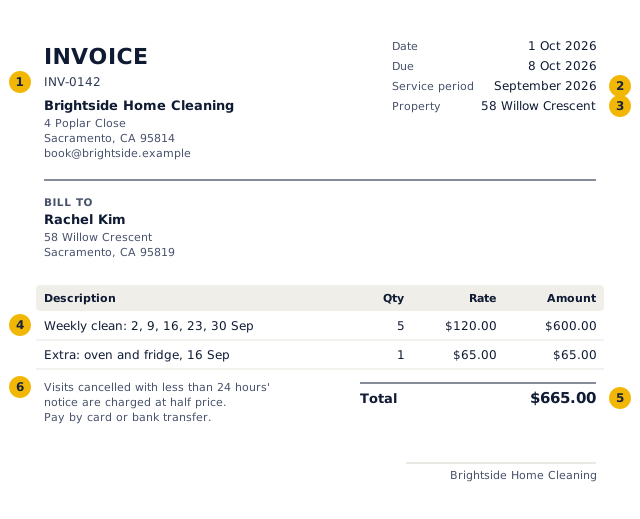
- Invoice number: one continuous series, so a client's monthly invoices are easy to match to payments.
- Service period: the month (or week) the invoice covers; billing in arrears is usual for homes.
- Property cleaned, when it differs from the billing address or the client has more than one.
- Visits with dates: the client can tick them off against the calendar.
- Total: no sales tax line, because California does not tax cleaning services.
- Cancellation rule and payment methods, repeated from your service agreement.
The numbers: September at $120 a visit
| Item | Qty | Rate | Amount | Tax |
|---|---|---|---|---|
| Standard weekly clean: 2, 9, 16, 23 and 30 September | 5 | $120.00 | $600.00 | $0.00 |
| Extra: oven and fridge deep clean, 16 September | 1 | $65.00 | $65.00 | $0.00 |
| Subtotal | $665.00 | $0.00 | ||
| Total | $665.00 | |||
Five visits at $120 are $600.00; with the $65.00 extra the invoice is $665.00. If Rachel had cancelled the 23 September visit at short notice, that line would read four visits plus a separate "Late cancellation, 23 September" line at $60.00, half the visit price, as the terms allow.
A move-out clean billed as a one-off job
One-off jobs are usually priced as a flat fee per job, with the property size on the line so the price makes sense later. Take a deposit when you book and show it on the final invoice as already paid. For a 2-bedroom apartment move-out clean at $340 plus inside windows at $45, with an $85 deposit taken at booking, the balance due is $300.
Move-out clean, 2-bedroom apartment
| Item | Qty | Rate | Amount | Tax |
|---|---|---|---|---|
| Move-out clean, 2-bed / 1-bath apartment, 14 October | 1 | $340.00 | $340.00 | $0.00 |
| Inside windows, 6 windows | 1 | $45.00 | $45.00 | $0.00 |
| Subtotal | $385.00 | $0.00 | ||
| Total | $385.00 | |||
The invoice total is $385.00. Show the $85.00 deposit received on 6 October under the total and ask for the $300.00 balance; do not deduct the deposit as a negative line, or the invoice no longer shows what the job cost.
Per visit, per hour or per month
| Pricing basis | Best for | How it reads on the invoice |
|---|---|---|
| Flat price per visit | Weekly or fortnightly homes with a set scope | "Standard weekly clean: 2, 9, 16, 23, 30 Sep", 5 × $120 |
| Hourly | Variable jobs, first cleans, hoarding or post-party cleans | "Cleaning, 2 cleaners × 3.5 h", 7 hours × the hourly rate |
| Flat fee per job | Move-in, move-out, deep and post-construction cleans | "Move-out clean, 2-bed / 1-bath", 1 job |
| Monthly contract fee | Offices, clinics, shops and common areas | "Office cleaning, October: Mon, Wed, Fri schedule", 1 month |
| Per square foot | Commercial bids and carpet or floor care | "Carpet extraction, 1,200 sq ft", priced per sq ft |
Whatever the basis, the invoice should use the same words and units as your quote or service agreement. If you quoted "$120 per standard clean", bill "standard clean" visits, not hours. When the scope changes, for example a client adds a home office to the weekly clean, confirm the new price in writing before it appears on an invoice.
Supplies and equipment
Most residential cleaners build their own supplies into the visit price, and that is simplest. Charge separately only where the agreement says so: client-requested products (a particular eco brand, specialist stone or hardwood cleaner), consumables you restock for an office (bin liners, paper towels, soap), or equipment hire such as a carpet extractor. Bill restocked consumables at the price you agreed, with the quantities, so a facilities manager can match them to their budget.
Cancellations, lockouts and skipped visits
A late-cancellation or lockout fee is enforceable only if the client agreed to it beforehand, so it belongs in the service agreement first and on the invoice second. When it applies, bill it on its own line with the date and the reason. A visit the client skipped with proper notice is simply left off; a visit you missed is either left off or, on a monthly contract, credited as a separate negative-looking line ("Credit: no service 27 Oct, holiday closure") so the monthly fee stays recognisable.
Residential and commercial cleaning invoices
| Residential (homes) | Commercial (offices, clinics, shops) | |
|---|---|---|
| Usual billing | Per visit, billed weekly or monthly in arrears | Fixed monthly fee, often billed in advance, plus extras in arrears |
| Payment terms | Due on receipt or within 7 days; card on file is common | Net 15 or Net 30 on account |
| What the client needs on the invoice | Dates, extras, total | Their purchase order number, site or cost centre, service period, your W-9 details |
| Sales tax | Depends on the state; taxed in Texas and Ohio, not in California or Washington | Same state rules; in New York a regular contract of 30 days or more is exempt |
| Paperwork before the first invoice | Service agreement with price and cancellation policy | Contract or PO, certificate of insurance, vendor set-up forms, W-9 |
| 1099-NEC | Not issued by homeowners for personal cleaning | Issued by the business if it paid you $2,000 or more in 2026 |
Commercial clients pay through an accounts-payable process. An invoice that misses their purchase order number, or bills the wrong legal entity, is usually returned unpaid weeks later. Ask for the PO number, the billing entity and the invoice email address when you sign the contract, and put them on every invoice.
Billing recurring cleaning clients
- Pick one cycle and keep it. Weekly invoices suit new clients; monthly invoices suit settled ones and cut payment admin. Commercial contracts are normally monthly.
- In arrears or in advance. Homes are usually billed after the visits (the September invoice above goes out on 1 October). Fixed monthly contracts are often billed on the first of the month for that month, with extras added in arrears on the next invoice.
- Same description every cycle. "Standard weekly clean" with the dates, every month. Changes then stand out, which is what a client checks for.
- Price increases with notice. Tell recurring clients in writing, typically 30 days before, and show the new rate from the first visit it applies to.
- Card on file needs written consent. If you charge a saved card automatically, get the client's written authorisation and still send the invoice, so they have the record.
In LuckPanda, a recurring invoice copies the schedule each cycle with new dates, so you only add the extras and remove skipped visits before issuing.
Is cleaning subject to sales tax?
There is no single US answer, and the residential-versus-commercial split many cleaners assume does not hold everywhere. Texas and Ohio tax house cleaning as well as office cleaning; New York looks at how long the contract runs; California and Washington do not tax janitorial services at all.
| State | Cleaning services | Source |
|---|---|---|
| California | Not taxed: cleaning is a service, and the cleaner is the consumer of the supplies it uses | CDTFA Regulation 1501 |
| Washington | Janitorial services (floors, walls and windows, in-place rug and upholstery cleaning) are excluded from retail sales; cleaning exterior walls, furnaces or septic tanks is not | RCW 82.04.050(2)(d) |
| Texas | Taxed: "tax is due on the charge to clean a home, office, warehouse, garage, restaurant…"; the only household exemption is for a cleaner who is the household's own employee | Comptroller Pub. 94-111 |
| Ohio | Taxed as janitorial services, offices and houses alike, including maid services, once a provider's cleaning sales reach $5,000 in a calendar year | Information Release ST 2002-04 |
| New York | Interior cleaning on a regular contract of 30 days or more is exempt; a one-off clean, such as a single whole-house clean, is taxable. Window cleaning stays taxable | 20 NYCRR 527.7 |
Brightside's Sacramento invoice therefore has no tax line. The same September in Austin, Texas, would carry sales tax on every visit and extra, and so would a monthly office contract there.
Texas: monthly office cleaning contract, tax at 8.25%
| Item | Qty | Rate | Amount | Tax |
|---|---|---|---|---|
| Office cleaning, October: Mon, Wed, Fri schedule, suite 400 | 1 | $1,850.00 | $1,850.00 | $152.63 |
| Carpet extraction, reception and corridors, 1,200 sq ft | 1,200 | $0.20 | $240.00 | $19.80 |
| Subtotal | $2,090.00 | |||
| Tax 8.25% | $172.43 | |||
| Total | $2,262.43 | |||
The monthly fee and the $240.00 carpet extraction make $2,090.00; at the 8.25% maximum combined Texas rate the tax is $172.43 and the client pays $2,262.43. Collect and remit it like any other sales tax: you need a Texas sales tax permit before you start.
Deposits, late fees and 1099-NEC
- Deposits suit one-off jobs: move-outs, deep cleans, post-construction cleans. Agree the amount at booking, then show it on the final invoice as received, with the balance due.
- Due dates for homes are usually on receipt or 7 days; for businesses Net 15 or Net 30 from the invoice date. Write the actual date on the invoice.
- Late fees must be agreed before the work, in the service agreement or quote, and stated again in the invoice terms. State law limits interest and fees, more tightly for consumers than businesses, so keep them modest and check your state before charging one.
- Payment methods: list them. A card on file or a payment link gets recurring clients to pay on the day the invoice arrives.
1099-NEC: who sends one
A business client that pays you for cleaning in the course of its trade or business must file Form 1099-NEC if it pays you $2,000 or more in a year, for tax years beginning after 2025 (the threshold was $600 and will be adjusted for inflation from 2027). It will ask for your Form W-9 first. Homeowners paying for their own house cleaning do not file one, because personal payments are not reportable, and card or app payments are reported by the processor on Form 1099-K instead. Either way, every payment is your income: the invoice series is your record of it.
United Kingdom and India
United Kingdom. A self-employed cleaner or cleaning company registers for VAT once taxable turnover passes £90,000 in a rolling 12 months; most domestic cleaners are below it and charge no VAT, so their invoices show no VAT number and no VAT line. Once registered, cleaning is charged at the standard rate of 20% and the invoice must be a VAT invoice with your VAT number, the VAT rate and the VAT amount. Business clients who pay late can be charged statutory interest at 8% over the Bank of England base rate plus a fixed recovery fee of £40, £70 or £100 depending on the debt; this does not apply to householders.
UK: monthly office clean by a VAT-registered company
| Item | Qty | Rate | Amount | Tax |
|---|---|---|---|---|
| Office cleaning, October: Mon, Wed, Fri (12 visits) | 12 | £85.00 | £1,020.00 | £204.00 |
| Washroom consumables restocked, as agreed | 1 | £64.00 | £64.00 | £12.80 |
| Subtotal | £1,084.00 | |||
| VAT 20% | £216.80 | |||
| Total | £1,300.80 | |||
Twelve visits at £85.00 and the consumables come to £1,084.00 before VAT; with VAT at 20% (£216.80) the client pays £1,300.80.
India. Cleaning services (SAC 998533) are taxed under GST, generally at 18%. A cleaning business must register once aggregate turnover exceeds ₹20 lakh (₹10 lakh in special category states); a registered business shows its GSTIN, the SAC and CGST + SGST (same state) or IGST (another state) on a tax invoice. Use the GST invoice generator for India.
Mistakes to avoid
- One line for the whole month with no dates. The client cannot check it, and a disputed visit holds up the whole payment.
- Extras bundled into the visit price. An oven clean hidden in a higher visit price looks like a price rise. Bill it separately.
- A cancellation fee that is not in the agreement. Put the policy in writing before the first visit; then bill it on its own line.
- Charging sales tax your state does not levy, or not charging it on commercial work your state does tax. Either way, you owe the difference.
- Netting the deposit as a negative line. Show the full job price, then the deposit received and the balance due.
- Missing the client's PO number on commercial invoices.
- Editing last month's issued invoice to add a missed extra. Bill it on the next invoice or issue a separate one.
Cleaning quote vs service agreement vs invoice vs receipt
| Document | When | What it does |
|---|---|---|
| Cleaning quote or estimate | Before the first visit | Prices the scope: rooms, frequency, extras. The client accepts it; nothing is owed yet |
| Service agreement | At the start of a recurring service | Sets the price, schedule, supplies, access, cancellation and price-change rules |
| Invoice | After the visits (or at the start of a prepaid month) | Asks for payment for what was done or scheduled; has a number, date and due date |
| Receipt | When payment arrives | Confirms what was paid and how; useful for clients who pay cash |
Start with a cleaning quote; once the client accepts, the same lines become the first invoice.
Key terms
- Billing in arrears
- Invoicing after the service is delivered, for example on 1 October for September's visits.
- Billing in advance
- Invoicing at the start of the period the fee covers; common for fixed monthly cleaning contracts.
- Late-cancellation fee
- A charge, agreed in advance, for a visit cancelled inside the notice period.
- Purchase order (PO)
- The commercial client's reference that authorises the spend; their accounts team needs it on your invoice.
- Form W-9
- The IRS form a US business client asks you to complete so it can report what it pays you.
- Form 1099-NEC
- The IRS information return a business files for nonemployee compensation it paid you.
Questions people ask
Should I bill cleaning per visit or per month?
Weekly or fortnightly home clients are often billed per visit. Commercial contracts are usually a fixed monthly fee for an agreed schedule, with extras on top.
Is cleaning subject to sales tax?
It depends on the state. California and Washington do not tax janitorial cleaning. Texas and Ohio tax it for homes and businesses alike. New York taxes one-off cleans but exempts regular contracts of 30 days or more. Check your state before adding a tax line.
What if the client cancels on the day?
Put a late-cancellation fee in your service agreement, often half or all of the visit price, and bill it on its own line when it applies.
How do I write an invoice for cleaning services?
Add your business and the client, list each visit with its date and price (or the month on a contract), add extras and supplies on their own lines, apply sales tax only if your state taxes the service, then set the due date and your cancellation and payment terms.
Should a cleaning invoice include supplies?
Only if your agreement says supplies are charged separately. Most residential cleaners include their own supplies in the visit price; commercial cleaners often bill restocked consumables such as bin liners and paper towels at agreed prices.
Do I need to send a 1099 to my house cleaner?
Not for cleaning your own home: personal payments are not reportable on Form 1099-NEC. A business that pays a cleaning contractor $2,000 or more in a year for services does file one, for tax years beginning after 2025.
Can I take a deposit for a deep or move-out clean?
Yes, if you agree it at booking. Show the full job price on the final invoice, then the deposit received and the balance due.
What payment terms should a cleaning business use?
Due on receipt or within 7 days for homes, often with a card on file. Net 15 or Net 30 for commercial accounts, which pay through accounts payable and need their PO number on the invoice.
Do self-employed cleaners need to charge VAT in the UK?
Only once VAT-registered, which is compulsory when taxable turnover passes £90,000 in 12 months. Below that, invoice without VAT and without a VAT number. Registered cleaners charge 20%.